

Table of Contents
amazon D-Link DIR-X1560 reviews
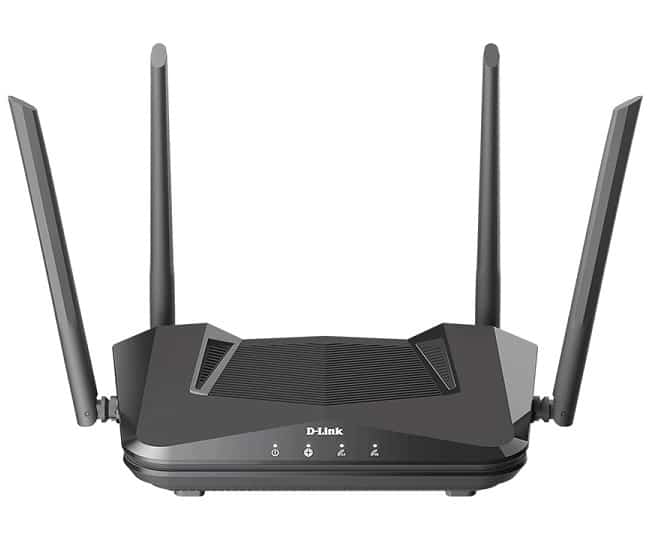
Until now, it has been a premium router going for upwards of $300. The D-Link EXO Mesh Wi-Fi 6 Router DIR-X1560 is in its way a lower-end Wi-Fi 6 router, costing less than $100. This 2-band Wi-Fi 6 router performs fairly well when it comes to transfer rates on the 5GHz band, while its 2.4GHz performance is mediocre at best.
Design and Features
The DIR-X1560 is a small router with a traditional desktop router design. Its black case measures 2.0 x 9.9 x 7.6 inches (HWD) and features four non-removable adjustable antennas and four LED indicators for power, Internet, and both radio frequency bands. You won’t find any multi-gig, link aggregation, or USB ports on this model, but it is equipped with four gigabit LAN ports, one WAN port, a reset button, a WPS button, and a power button.
The Router is powered by a 1.5 GHz triple-core CPU, 256 megabytes (MB) of RAM, and 128 MB of flash memory. It’s a dual-band AX1500 Router capable of up to 300Mbps transfer rate on the 2.4GHz band and up to 1200Mbps on the 5GHz band, and it uses 802.11ax technology, including Frequency Division Multiple Access. Digital Orthogonal (OFDMA), 1024 Quadratic Amplitude Modulation (QAM), Target Wake Up Time, WPA3 encryption, MU-MIMO data transmission, and burst format. However, it lacks support for the 160MHz channel bandwidth that you get with more expensive Wi-Fi 6 routers, such as the Asus RT-AX88U and TP-Link Archer AX6000.
You can combine the DIR-X1560 with one of D-Link’s mesh-enabled range extenders to create a network that allows you to use a single SSID for seamless roaming, and you can configure the Router to Select the best available radio band by enabling SmartConnect. Alexa and Google voice commands let you do things like turn the guest network on and off and restart the Router. You can prioritize bandwidth for specific clients using Intelligent QoS settings (Quality of Service) by D-Link. There’s also the lack of powerful parental controls with age-appropriate presets that come with the TP-Link AX6000: you’re limited to basic website blocking and scheduling instead. Furthermore, this Router does not offer anti-malware protection, a feature appearing in many of the latest high-end routers.
While the DIR-X1560 can be managed through the mobile app, the web control panel offers deeper control options. This opens up a small network map that shows how many clients are connected and presents the details like IP and MAC address, type of connection, subnet mask, and default gateway. Just tap on the Settings tab at the very top, and you will find further screens for configuring Wireless, Internet, Cloud, and Network settings. Features allows you to configure the more advanced features like QoS, port forwarding, firewall, and Quick VPS settings. You can also activate the site filter here. The Management tab lets you create access schedules, view system logs and usage statistics, and update the firmware.
Overall, while it’s a bit short on premium features, it’s a satisfactory feature set, and the interface you use to access and configure them is pretty easy to use. While it doesn’t have as many features as more expensive and muscular routers like the Asus ROG Rapture GT-AC5300, it should suffice for most home networks as it allows you to configure many access controls. Basics and protection of certain types of traffic, such as voice over IP (VoIP) phone data, can be crucial now as many people are working from home shortly.
Settings and Performance
The DIR-X1560 is easily installed using the D-Link mobile app or via the web console setup wizard. I started by plugging in the Router and connecting it to my desktop using the included LAN cable. I entered http://dlinkrouter.local./ into my web browser and followed the wizard instructions to connect the Router to my modem using the Router’s WAN port and configure my internet connection ( I chose DHCP). I have set the SSID name and password for the network, created an Administrator password, set the time zone, and waited 60 seconds for the settings to take effect. After 60 seconds of firmware update, the installation is complete.
Since the DIR-X1560 was the first low-cost Wi-Fi 6 router to appear in our lab, we compared its performance with the D-Link DIR-867, a similarly priced Wi-Fi 5 router self, to illustrate how it stacks up against old technology. To show how it compares to more expensive high-end Wi-Fi 6 routers, we used performance scores from the Asus RT-AX88U.
The performance throughout the DIR-X1560 is mixed. Its score was 80Mbps on the 2.4GHz proximity test (same room), 10 megabits per second (Mbps) slower than the 802.11ac-based D-Link DIR-867 Router 64Mbps slower than the Asus The RT-AX88U is based on 802.11ax. At 30 feet away, the DIR-X1560’s 38 Mbps score was 13 Mbps slower than the DIR-867 and 21 Mbps slower than the RT-AX88U.
The DIR-X1560 performed better in the 5GHz tests. Its score was 712Mbps at close range, 29% faster than the DIR-867 but following the RT-AX88U at 70Mbps. On the 30-foot test, the DIR-X1560’s 207Mbps score was 26% faster than the DIR-867 but not as fast as the RT-AX88U’s 318Mbps.
Transfer rate is a great way to measure router performance. But even if a router is capable of transmitting packets quickly, that can still be hindered by a weak signal. So, to expand on how we test the Router, we decided to measure the signal strength directly. For this, we use the Ekahau Sidekick Wi-Fi diagnostic device and the Ekahau Survey mobile app to measure signal strength. Heatmaps above and below show the DIR-X1560’s 2.4GHz and 5GHz signal strengths throughout our test house. The circle shows the Router’s position, and the colors represent signal strength on a scale at the bottom of the screen, with dark green being the strongest signal. Gray indicates no signal received. As illustrated, the Router’s 2.4GHz band offers a better range than the 5GHz band, which had trouble reaching the far corner of the house (about 60 feet from the Router). That is to be expected because 2.4GHz signals use longer waves that can reach farther than 5GHz waves. However, the 5GHz wave offers significantly faster transfer speeds, as evidenced by our transfer speed tests.
Solid performance at a good price
If you are looking for a cheap way to set up a Wi-Fi 6 network, the D-Link DIR-X1560 will meet your needs. For under $100, you get 802.11ax technology and reasonable 5GHz transmission speeds, and you can create a mesh by adding D-Link’s mesh-compatible extenders. However, this will increases your expenses to the magic $100 mark. If that budget is important to you, check out our Router budget roundup for more alternatives.
That said, in the 2.4GHz spectrum, the Router merely coasts on its reputation and does not do well, even in terms of features. Pricewise, if budget is not a constraint, opt for the Asus RT-AX88U, which works at a 160MHz bandwidth, has eight LAN ports, robust anti-malware, parental controls, and QoS. It’s also one of our top-tested Wi-Fi 6 routers.
where can you get a D-Link DIR-X1560 online
D-Link EXO WiFi 6 Router AX1500 MU-MIMO Voice Control Dual Band Gigabit Gaming Internet Network High Speed Performance WP3 (DIR-X1560-US), Black: Buy it now