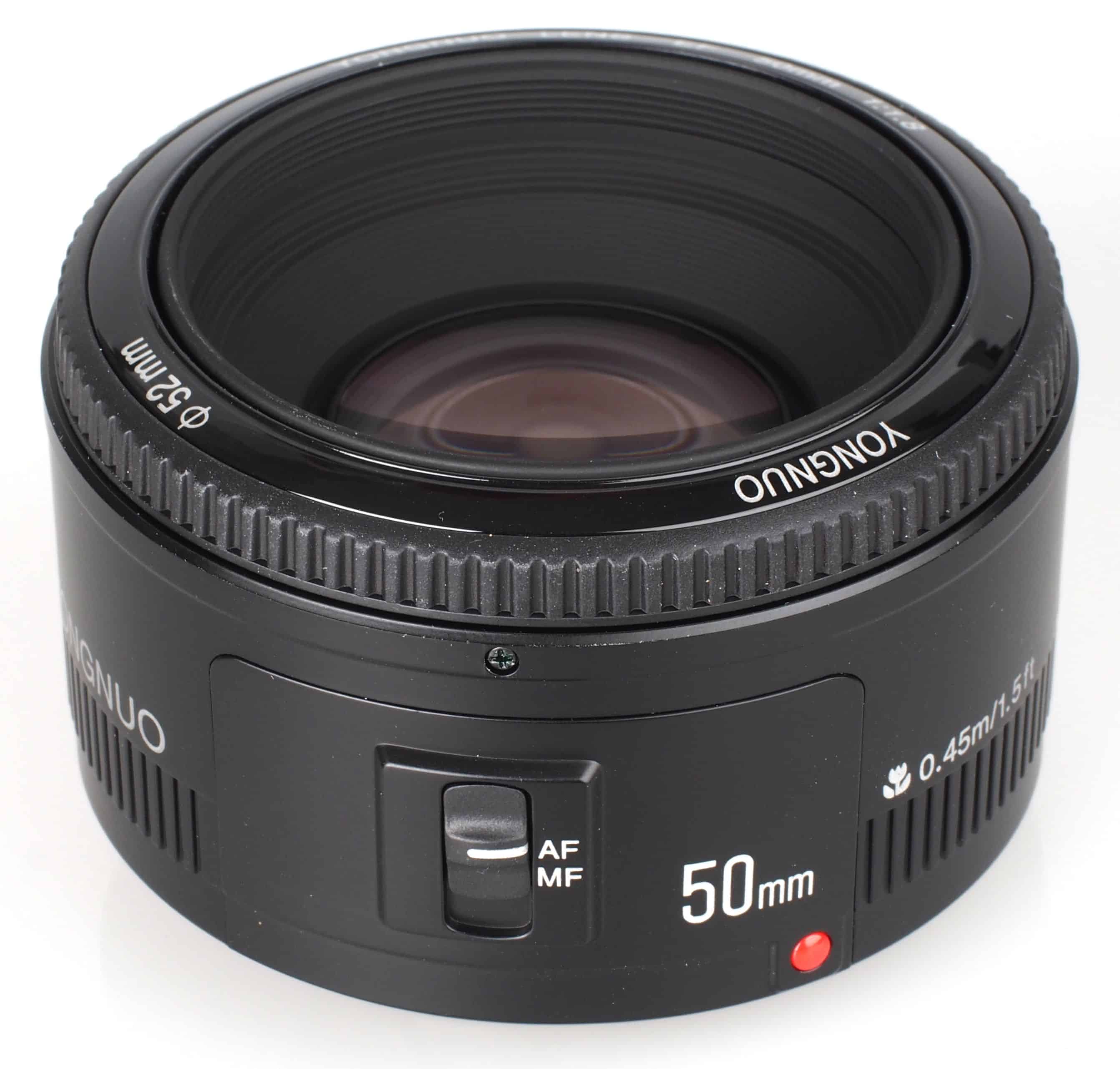
Optical Performance
Despite being cheaper compared to other lenses, the Yongnuo 50mm f/1.8 accomplishes good optical performance. This is accomplished with a 6-elements and 5 groups layout very similar to the Canon EF 50mm f/1.8 II. With an aperture of f/1.8, the best low-light performance can be obtained, along with the shallow depth of field.
Sharpness and Resolution
With decent resolution, the Yongnuo 50mm f/1.8 gives sharp images in the center, in particular. The image sharpness at maximum aperture is certainly not the best. Some softness may also be visible at the edges or corners of the frame. However, stopping down the aperture to f/2.8 retrieve almost all of the sharpness fully across the frame, while at f/4, the lens renders great sharpness and resolution.
Chromatic Aberration and Distortion
There is some chromatic aberration or color fringing particularly at the edges of high-contrast scenes. It is a problem common to budget lenses, but a little of post-processing can minimize that. There is faint barrel distortion present, which is actually normal for a 50mm, but it would hardly be troublesome in the day-to-day field applications.
Bokeh and Background Blur
One of the good things about the Yongnuo 50mm f/1.8 is the bokeh and background blur. The large f/1.8 aperture provides very good isolation of the subject. This results in soft and creamy-looking out-of-focus areas. The round bokeh highlights created by edges of the 7-bladed diaphragm are impressive, particularly for portraits.
Autofocus Performance
The 50mm 1:8 Autofocus Yongnuo lens uses basically a DC motor and attains quickly accurate focusing. It lacks a bit in silent or smooth focus in contrast to the ultrasonic motor on the higher-end lenses. The performance of the autofocus could be noisy which can get in the way in quiet settings or during video work.
Autofocus Accuracy
In sunny weather, the autofocus illy performs locking fastly and accurately onto its subjects. It tends to suffer in low-light conditions however, once in a while in hunting and with slower clock acquisition. This is something that is expected from cheaper lenses but keep that in mind if you’re shooting in those lighting conditions quite a bit.
Manual Focus
Manual focusing with the Yongnuo 50mm f/1.8 can be a bit problematic. The manual focus ring is a little too thin and somewhat too loose to offer good positional feedback. Once mastered, however, one can manually attain perfect focus. There is also no full-time manual focus override, so switching over to manual focus mode might be necessary for precision adjustment after autofocusing.
Usability and Handling
As a compact and lightweight prime lens and being Yongnuo 50mm f/1.8, this lens is undoubtedly going to be a top choice for those photographers traveling light or simply wanting a less conspicuous lens for street photography. It balances really well in entry-level and mid-range DSLR bodies, thus, is very comfortable to shoot.
Versatility
Fifty millimeters, a number commonly referred to with the phrase “nifty fifty,” is recognized as one of the most versatile focal lengths on earth. This is because, in a full-frame camera, the focal length mimics human vision’s natural field of view, so it has broad applications in photography – portrait, landscape, street, or taken snapshots on an everyday basis. On APS-C crop sensor cameras, the working focal length increases by around 75 to 80 mm, which is another good option for getting portrait photography perspective compression.
Low-Light Performance
Shooting at f/1.8 is really excellent in terms of low light. What f/1.8 aperture does is provide faster shutter speeds, so less risk of motion blur, and handheld can be achieved with less ISO settings. An indoor or outdoor night photograph would turn out great under bravely challenging lighting.
Image Quality Considerations
At this price, Yongnuo 50mm f/1.8 is a great lens that performs impressively; but, as with all lenses, some things would need to be considered about picture quality:
Vignetting: With the aperture wide open (f/1.8), this lens suffers from noticeable vignetting darkening at the corners. Stopping down to f/2.8 or f/4 will reduce this considerably; it can also be corrected during post-processing.
Flare and Ghosting: This is a great flare and ghosting lens for shooting through strong sun light source. By using a lens hood (separate purchase), it helps mitigate this problem along with careful composition.
Contrast and Color: lenses are good for how they render contrast and color, although they are not truly at the level of the pen-up primal lens glory. It could be enhanced via post-processing to getting the images looking pretty much as desired.
Comparison with Other Lenses
It is very important to compare the Yongnuo 50mm f/1.8 lenses with other lenses in the market for the purpose of deciding if they will meet the specific needs and preferences wanted;
Canon EF 50mm f/1.8 STM
Canon EF 50mm f/1.8 STM directly competes with Yongnuo 50mm f/1.8. However, it’s a fraction more expensive than Yongnuo, but does come with several extra benefits such as better build construction, quieter and faster focus with the STM (Stepping Motor) technology, and much better overall image quality from the lens. In addition, the Canon lens features full-time manual focus override, so minor fine-tuning of focus is now even simpler.
Nikon AF-S NIKKOR 50mm f/1.8G
As an alternative, the Nikon AF-S NIKKOR 50mm f/1.8G ranks higher on build quality and optical performance alongside Silent Wave Motor (SWM) AF. The Nikon lens is more costly than the Yongnuo lens; however, it compensates well for this in terms of better sharpness, contrast, and autofocus speed.
Other Yongnuo Lenses
The Yongnuo catalog does offer additional low-cost offerings in prime lenses, such as the 35mm f/2 and 85mm f/1.8. Depending on your own needs and shooting style, these could also be worthwhile considerations. The 35mm f/2 would work great for wider views and street photography while the 85mm f/1.8 would suit the portraitist with even greater subject isolation.
Worth the Money
This is where the Yongnuo 50mm f/1.8 shines: value for money. Much cheaper than its Canon and Nikon counterparts, this lens holds the key to entering prime lenses for photography without spending too much. It is quite a good buy for amateurs wanting to study the creative aspects of such a fast prime lens, without shelling much cash.
Pros:
Affordable Price: Yongnuo 50mm f/1.8 ranks among the cheapest options available for prime lenses and thus caters to almost every photographer.
Compact and Lightweight: Its small dimensions and lightweight build are a pleasure to carry and handle, making it very travel-friendly and handy for daily use.
Decent Optical Performance: Despite being so cheap, the lens does offer an excellent degree of sharpness and image quality, especially on stopped down apertures.
Wide Aperture: The f/1.8 aperture means good performance in low-light settings and lets photographers celebrate their control of depth of field, yielding stunning background blurs and bokeh.
Cons:
Build Quality: The mostly plastic body seems less durable in comparison with more expensive lenses. The focus ring, too, is relatively thin and somewhat looser.
Autofocus Sound: The autofocus motor is comparatively loud, which would be distracting in muted environments or when filming videos.
Vignetting: Considerable vignetting happens at the widest aperture, while stopping down lessens this, and one can always correct this in post-processing.
Chromatic Aberration: A fair bit of chromatic aberration can be seen when dealing with high-contrast scenes, especially when the aperture is wide.
Flare and Ghosting: The lens is prone to flare and ghosting when shooting towards a strong light source.
User Experience and Feedback
Positive Responses
Value for Money: The Yongnuo 50mm f/1.8 is one lens that has got users all over hype because of its affordability along with gangbuster price to performance. It is considered an excellent entry-level prime lens for beginners and budget-conscious photographers.
Image Quality: With regard to the price, many users find it very impressive when it comes to image quality, particularly stopped down. The lens provides sharp and vibrant images that can be matched to some extent with that of other more expensive lenses.
Bokeh: The possibility of producing very beautiful bokeh and subject isolation makes it a much-used lens among portrait photographers, as mentioned several times in the reviews of users.
Criticisms
Build Quality: Some users indicate that it feels like a cheap plastic lens. One of the biggest complaints is that it’s quite loose with the focus ring, which auto-focus at the very best, especially for the manual focusing ones.
Noise During Autofocus: Mentioned as a negative in relation to what it has about video recording which is expected to soundless.
Vignetting and Aberrations: As expected from a lens of this cost, it is noticed, but to some users, it is annoying and a little too distracting with the vignetting and chromatic aberrations at wider apertures.
Conclusion
This Yongnuo 50mm f/1.8 is an exceptional lens considering how friendly it is on the pocket. It covers the space of a versatile focal length that can lend itself to wider aperture low-light shooting and bokeh. It shows some minor shortcomings in a couple of areas like build quality and autofocus noise, but nothing compared to the overall value it presents.
Who Should Buy This Lens?
Initiates: The Yongnuo 50mm f/1.8 is a good prime lens for new photographers who would like to start experimenting with something without digging so much into savings.
budget-niks: A model great for budget-conscious photographers who need a fast prime lens for portraits, street photography, or low-light shooting without having to be extravagant with expenses.
Travel photographers: It’s a compact little lens, and lightweight to boot, making it a great travel choice for photographers who have to travel light.
Last Word
The Yongnuo 50mm f/1.8 lens has become quite the commercial success. While not quite as good in build quality or performance as more expensive lenses, this lens is a great value for the money. It is perfect as a first prime lens for someone new to photography and yet produces pictures that are not considered flawed by the most subjective standards. For those looking to acquire a good quality fast versatile prime lens without going through the expense, the Yongnuo 50 mm f/1.8 is clearly the one to go for.