

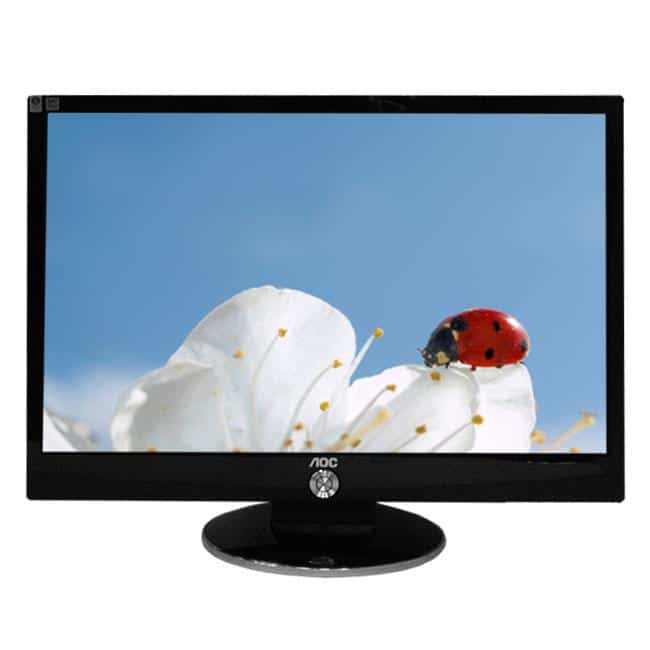
The AOC 2217V is a 22-inch widescreen LCD, and it has been available for quite a few years now. It belongs to the generation where LCDs were an environment in their growth stage and AOC as a brand tried to sell monitors that sat at the budget range without compromising spill onto essentials. I will review design, build quality, performance, display quality, connectivity, usability, and value in the detailed scrutiny of the AOC 2217V.
Design and Build Quality
Design-wise, the 2217V goes on with an utilitarian approach, rather plain for the days that harnessed a bit of the mid-2000s aura in monitors. It had a matte black paint job to suppress glare and fingerprinting, making it practical and easy to maintain with everyday use. The screen bezels are moderately thick, per design trends of that time. However, compared to what we are used to nowadays, they appear a little bulky. The stand is simple; basic tilt-user adjustment is there, but no height adjustment, swivel, or pivot mechanism exists-the very features of a first-rate-priced stand.
Build Quality
Of course, for its price, the build quality of the AOC 2217V is considered decent. The plastic material feels solid, and there were no creaking or weak points while handling the monitor. The monitor is of moderate weight, meaning it will sit very well on a desk but will be light enough to carry around when necessary. The stand is quite rudimentary but does the job; the monitor only wobbles very little when typing or repositioning it.
Display Quality
The AOC 2217V weighs in 22 inches wide, with its native resolution at 1680 x 1050 pixels. This resolution beats the standard 1440 x 900 pixels provided by most 19-to-20-inch monitors at that time and, subsequently, extends screen real estate and precision in images. Its aspect ratio is 16:10, granting a little more space vertically than the now-common 16:9. This is potentially very useful for word processing, web browsing, and multitasking-all situations where the extra vertical space may cut down on scrolling.
The display panel used for the AOC 2217V is a TN (Twisted Nematic) panel, a very common type of panel technology for monitors during its time. A TN panel boasts a quick response time, making it good for gaming or any other fast-paced activities. But short on color accuracy and viewing angles, it is worse than IPS (In-Plane Switching) and VA (Vertical Alignment).
For color reproduction, the AOC 2217V is fine for general uses, but it is not really a monitor for professional photo or video editing. Colors may look a little washed out, and the contrast ratio, which is decent, does not afford those deep blacks and glowing colors that higher-end monitors really possess. The monitor offers a brightness level decent enough for an indoor environment but can have problems in very bright rooms or direct sunlight, where glare may pose a problem despite the matte finish.
One of the limits of AOC 2217V’s TN panel is its viewing angles. With a deterioration in image quality, especially on the vertical plane, such view angles could be rather annoying, though unusual. This name means that it works best while positioned right in front of the user; any shift from that position would cause color shifts and reduced clarity.
Performance
This is the sphere where the AOC 2217V toepass with its ratings, which signify its response times and refresh rates being the stronger side. It has a response time of 5 milliseconds, which was tremendously good back when it was released. This helps a lot in avoiding motion blur and ghosting, making it a good option to use for gaming and watching fast-paced videos. The refresh rate is 60Hz, which is just good for carrying out daily tasks; however, it cannot stand the comparison with the 120 and 144Hz monitors currently quite popular amongst gamers.
On one hand, for office work, web surfing, and entertainment, AOC 2217V does a decent job. The higher resolution of 1680 x 1050 lends a much greater workspace, allowing you to function multitasking more with windows or documents. Text is crisp and easy to read while pictures show adequate clarity. Because of the limitations of the TN panel, this monitor falls a bit short as far as pinpoint color accuracy and wide viewing angles go.
Connectivity
Being from its time, AOC 2217V could muster a very basic set of connectivity options. The monitor offers VGA input as the video mode of choice among most computers back then. It also provides for a DVI-D input that gives digital signaling for better image quality than what VGA can offer. However, it does not have newer connectivity options such as HDMI or DisplayPort, which could limit its compatibility with newer devices.
Both VGA and DVI-D inputs being included makes the AOC 2217V compatible with a large range of machines, from those older ones to those with a more recent graphics card that features digital outputs. However, the lack of HDMI will require users with devices such as laptops, gaming consoles, or media players that primarily use HDMI for video-out to resort to an adapter or converter.
Usability and User Experience
In terms of usability, the AOC 2217V is quite straightforward and simple to set up. The OSD buttons are found on the bottom bezel of the monitor; the menu provides basic adjustments for brightness, contrast, color temperature, and input selection. The OSD is very much working but it is not the best interface in terms of design and can be a bit clunky to navigate through options.
The AOC 2217V’s good feature is its simplicity. It avoids the frills and any unnecessary feature that would make its manipulation difficult. It is a monitor to do its job without too much interference; hence for those who simply want a display for their everyday work-laptop type of work, casual web browsing, or media consumption, this is more than fair. With some viewing these features as essential, though, the monitor does lack some advanced features such as USB ports, inbuilt speakers, or a headphone jack, which would have elevated its slickness and clutter-free design.
The gaming pleasures with the AOC 2217V would be decent, especially for older or less demanding games. The fast response rate in motion blur and gives away ghosting that the 16:10 aspect ratio somewhat alters its field of view from the more common 16:9 monitors. However, if a gamer into the present day finds a little limitation in anything, it would be the 60Hz refresh where the faster refresh rates generally mean smoother and more-responsive gameplay in higher-paced and most competitive arenas.
Value for Money
The backdrop against which the price point of this item is calculated is very important. Monitors are priced and put up in the market keeping in mind certain dates or periods in time, as the price directly depends on the technology included. That is why a time-dependent price cannot be considered to be fair. Thus, this monitor provided a great deal of value for the price at that time-it could boast of a resolution higher than many others, had faster response rates, and better build quality, all at budget-friendly prices. For the average user just looking for a simple and solid monitor to run everyday applications, the AOC 2217V was a value-for-money purchase.
However, the AOC 2217V has become somewhat dated these days. Current monitors come with higher resolutions, better panel technologies (IPS or VA, etc.), and more advanced features such as higher refresh rates, adaptive sync technologies like G-Sync or FreeSync, and a wider range of connectivity options. Even then, the AOC 2217V might still be usable for less demanding tasks; it sure cannot hold its own against the competition these newer offers bring.
Strict restrictions on budget can be an encouraging situation for the AOC 2217V to come in handy as a secondary monitor or for casual use on some everyday tasks; its plain design, dependable performance, and display quality make it suitable for users that don’t necessarily like the latest features to fulfill their needs. However, if your budget will allow a little more expenditure, some truly good options are available-a few with much-improved image quality, some with higher-feature sets, and others with better flexibility.
Conclusion
Being a product of its time, the AOC 2217V claimed to be marketed in the mid-2000s with an ostensibly split decision of performance and affordability. It has a plain, functional design, offers just enough power for your everyday tasks and casual gaming, while the display quality, though not great, suffices for the greater majority of uses. Nowadays, its TN panel already makes users squint at it, and then coupling that with a lack of modern connection, an absence of features… is a really hard sell!
For owners of the AOC 2217V, it continues to be a reliable and functional display for basic usage. However, a new purchase will require higher quality, more features, and more flexibility from newer models.- Overall, the AOC 2217V is an inexpensive monitor that made good in its day. Now, it has no competition with new ones, but it stands testament to the monitor technology of once-upon-a-time and shows how tastes and requirements of the consumer have evolved over time.
where can you get a AOC 2217V online
AOC 2217V 22″ Widescreen LCD Monitor – Black: Buy it now


Tech Reviewer & Product Analyst
Định Bia has spent over 10 years testing consumer electronics with a focus on smart technology. He work as a product advisor at Biareview where he helped customers find the right devices for their needs. He personally tests every product featured on this site using a consistent evaluation framework covering quality, durability, and value. All reviews are based on experience, not influenced by the manufacturer.