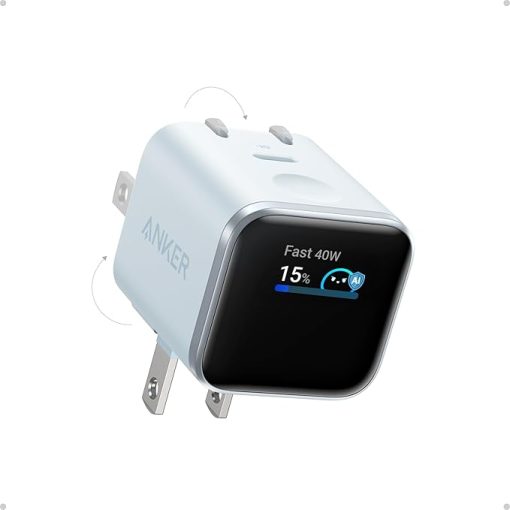
Anker Nano 45W A121D puts a Smart Display on a charger small enough to sit in your palm, tunes its output for iPhone and iPad, and gives you prongs that pivot instead of sitting in one fixed position.
Small body, prongs that move
The Anker Nano 45W (model A121D) is built to travel. It sits in your palm, and it takes up almost no room in a backpack or an accessories pouch.
The more useful change is the plug itself. Most compact chargers have prongs that are either fixed or fold through 90 degrees. Anker’s swing through a full 180.
The prongs swing through 180 degrees, which is what saves you in a cramped socket
Cafes, airport lounges, hotel rooms. The socket is always wedged behind something, or on a strip where somebody’s laptop brick has already eaten the space next to it, and your charger won’t go in.
180 degrees of travel fixes that. Set it at whatever angle the socket leaves you and it still sits tight, and you can aim the USB-C port and the screen at yourself instead of at the wall. The cable comes out without a hard kink in it too, which is how cables die. Folded in, the prongs sit flush and stop gouging whatever else is in the bag.
The Smart Display, and watching a charge happen
The color LCD on the front is what separates this from every other small charger. Instead of guessing how charging is going from how fast the battery percentage climbs, you can watch the power going in.
The interface has some personality to it. Plugged into the wall with nothing attached, the screen runs idle animations: a little character playing baseball, or a fortune cookie. None of it affects how fast the charger works, but it does make the thing more pleasant to have around.
The display gets clever once you connect a phone, especially an Apple one. A chip inside reads the charging handshake and shows the name of the device on screen. That works with iPhone 15 and newer, and with iPad Pro models from 2020 on.
Once it has identified the device, the screen shows the wattage going out in real time along with the battery percentage. Seeing the actual wattage is a quick way to check whether your phone is pulling the fastest charge it can, and an indirect way to tell whether the cable you are using is still in good shape.
What the screen shows tracks Anker’s three stage charging logic. With the battery low, the charger pushes its full output and the screen reads Fast, with an animation to match. Once the battery is in a comfortable range it switches to Steady and holds an even rate. Near full it drops to Trickle, cutting the current right back to spare the cells.
The charger matches its output to how full the iPhone or iPad battery is, which keeps the charge quick and safe
A touch button next to the USB-C port handles everything on screen. One tap moves between readouts, so you can check the charger’s temperature or change the charging mode.
The touch button runs every screen on the charger
Hold the button down for two seconds and the display flips 180 degrees. With the screen able to rotate and the prongs able to swivel, there aren’t many sockets that can leave the numbers upside down.
The screen switching itself off after a few seconds to save power is the one thing that wears thin. Each look costs you another tap.
Nano Phone Charger, 2-Pack 45W GaN USB C Charger Block (Black): Check Availability on Amazon
Performance, and the ActiveShield 3.0 thermal system
As a general purpose charger it does the job. Output tops out at 45W, and it handles the fast charge protocols that matter: Power Delivery (PD), Programmable Power Supply (PPS) and Quick Charge (QC). On an iPhone 17 Pro it went from flat to 50% in under 20 minutes, and to 100% in about an hour and a quarter. The current held steady the whole time, with no stutter or phantom touches on the screen while it was plugged in.
45W takes an iPhone 17 Pro from 0 to 50% in under 20 minutes
On a Galaxy A57 it worked with Samsung’s 45W Super Fast Charging 2.0, taking the 5,000 mAh battery to about 65% in 30 minutes and filling it in roughly an hour and ten.
It works with Samsung’s Super Fast Charging 2.0 (45W), filling the Galaxy A57’s 5,000 mAh battery in about an hour and ten minutes
45W also covers thin and light laptops that charge over USB-C. It will not replace the big brick that came with a performance laptop, but it earns its place on a short trip. Working from a cafe, or away for a couple of days without the laptop’s own charger, this is enough to keep the battery from running down on you.
Pushing high wattage through a body this small produces heat, and Anker’s answer is ActiveShield 3.0. Along with the cooler running of newer GaN parts, the system keeps reading ambient and internal temperatures and adjusts the current as it goes. That is what guards against overheating, overcurrent and short circuits.
ActiveShield 3.0 watches the temperature continuously to keep the charger’s surface within safe limits
Even at a sustained 45W, the polycarbonate shell only reached about 57°C, noticeably warm to the touch but within safe limits.
The highest reading after an hour at a continuous 45W was around 57°C, within safe limits for handling.
Care Mode, and what it does for battery life
The most considered feature here is Care Mode. Lithium ion batteries age according to how hot they run and how they are charged and discharged. Standard fast charging pushes the rate as high as it will go to cut the waiting, which is the right trade most of the time. Overnight it is not. Charging a phone fast while you sleep adds heat for no benefit and ages the cells faster than it needs to.
Double tap the touch button to turn Care Mode on. The charger drops its output, trading charging speed for a lower temperature. The feature is certified by TÜV Rheinland. With it on, the controller inside resets its output figures and feeds current along a gentler curve, and the screen shows that it is deliberately holding back to protect the device on the other end.
What Care Mode buys you is lower temperatures across the board. On the measured figures, holding output down keeps the charger itself up to 20°C below international safety limits. More to the point, the phone being charged runs about 10°C cooler than it does on an ordinary 45W charger. If you keep a phone for several years and care about the state of its battery, that is worth having: more cycles before the battery gives up, and one less thing to replace.
Verdict
This is more charger than it looks. It is very small, the 180 degree prongs get into sockets other chargers cannot, and 45W across PD, PPS and QC covers a phone, a tablet or a thin laptop. The Smart Display and Care Mode are the parts nobody else is doing at this size: one shows you what is going in, the other lets you ask for a slower, cooler charge. Most chargers give you neither.
Related Posts