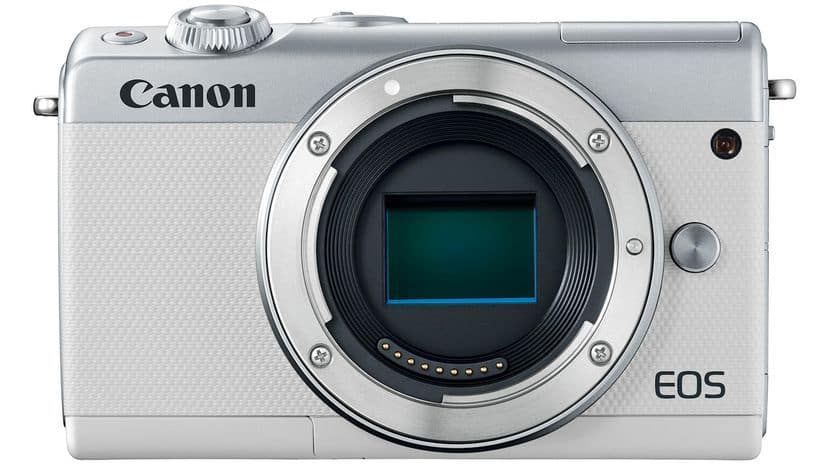
Simply put compact and sleek, Canon EOS m100 really does fit into the category of products like mirrorless cameras with amazing image quality. This, however, is a step from smartphone photography.
Pros:
Dual Pixel 24.2MP CMOS sensor
Very beginner-friendly
Cons:
No electronic viewfinder
Fewer external controls
The Canon EOS M100 was definitely more oriented to the Instagram such as Facebookers and smartphone snappers about features featured. The EOS M100 is indeed a new compact and stylish camera that would be with you anywhere, anytime and has been indeed designed to connect the user flow from a smartphone to that of a camera as seamlessly as possible. There’s also a touch screen, on screen instructions, and that whole 180 operations in selfie mode for beginner-friendly functions on this device.
Indeed, Canon seems to have reserved the new 24.2 megapixel CMOS sensor only for the whole EOS M line, as this is the latest camera designed to adopt this imaging unit. This means, therefore, that the EOS M100 can have a target for this new market. This sensor garners not only ultra fast and convenient automatic focusing performance for shooting still images, but also for motion pictures.
The Canon EOS M100 has great capabilities in producing great capture even under low lights with the aid of its DIGIC 7 processor as well as ISO range of 100-25600. The M100 fits casual shooting well dinner with friends, a party, the kind of stuff you want documented without thinking about camera settings. It also does 6.1 fps, enough to grab a short burst of action without too much lag between shots.
User interface and functions that bring out creative support
In designing the EOS M100, an important component is the big 3-inch touchscreen. Canon’s new user interface and touch-based interface may not be perfect in all cases, but will definitely serve as a great way to introduce newcomers to photography. The user interface is not only touch enabled but customizable as well. You can enable/disable different menu items to customize the simplicity or complexity of your experience, depending on your level of knowledge and interests.
Another feature of the improved simple user interface comes from Creative Assist from Canon. Creative Assist is the feature that allows you to select from different themes, ranging from bombardment to blur, to brighten your photographs up. You select the desired interface, and the camera automatically sets the needed settings, hence, the understanding of what is going on. In hopes that this feature will allow novice photographers to get the shot they want without making this available but also give them an understanding of how to work the camera so as to self-sufficiently set their own settings and skills for shooting. In addition, creative support custom settings can be saved. In sum, Creative Assist allows one to select opacity, brightness, and contrast best suitable.
New sensor Canon M100, from 18MP to 24MP
The M100 looks almost identical to the M10 from the outside. The real difference is under the hood: the M10 has an 18-megapixel APS-C sensor, while the M100 upgrades to the same 24.2MP APS-C CMOS sensor used in the M5 and M6. This sensor has built-in self-cleaning capabilities and records images in 14-bit RAW.
New megapixel resolutions on this sensor will have ranges from ISO 100 to 25,600.
Dual Pixel CMOS AF: Like the M5 and M6, the EOS M100 also has the same AF systems.
With the Dual Pixel CMOS AF, Canon EOS M100 also has an autofocus system like in M5 and M6. But the M10’s AF system is termed Hybrid CMOS AF II. The two have the same 49 automatic selection points. Rating for Pixel CMOS AF ranges from -1 to 18 EV while the M100 has an AF-assisted LED included that supports light adjustment in low light conditions.
The autofocus modes of the M100 include AF Single, AF selection, and auto AF. Simultaneously, the camera provides One-Shot AF and Servo AF. A touch screen is used to shift the focus point automatically, which can be compatible with the modes available.
Canon EOS M100 Mirrorless Camera w/ 15-45mm Lens – Wi-Fi, Bluetooth, and NFC enabled (Black): Buy it now
Canon EOS M100 Mirrorless Camera w/ 15-45mm Lens – Wi-Fi, Bluetooth, and NFC enabled (White): Buy it now
Canon EOS M100 Mirrorless Camera w/ 15-45mm Lens & 55-200mm Lens – Wi-Fi, Bluetooth, and NFC enabled (Black): Buy it now
Canon EOS M100 Mirrorless Camera w/ 15-45mm Lens & 55-200mm Lens – Wi-Fi, Bluetooth, and NFC enabled (White): Buy it now
Better performance from the latest DIGIC 7 processor
The processor in the Canon EOS M100 is the latest DIGIC 7 from Canon. According to Canon, faster shutter speeds were achieved than on the predecessor, even with possible advantages in megapixels. It can shoot with servo AF at 4 fps and One-Shot AF at 6 fps. According to Canon, the maximum continuous shooting is in JPEG format, 89 frames, and for RAW 21 frames.
Shooting modes
The Canon EOS M100 provides creative shooting modes and advanced filters, including HDR and free self-portrait mode. The M100 also supports RAW.
The M100 has Auto, Standard, Portrait, Landscape, Neutral, Monochrome, plus a few other picture modes. If you look at the creative menu, you can pick Grainy B/W, Soft Focus, Fish-eye Effect, Bold Effect, Water Painting Effect, Toy Camera Effect, and Miniature Effect. There are plenty of options to play with, especially if you like experimenting.
Video: Canon M100 records up to 1080/60p, but 4K is still missing.
Transitioning from stills to video on the M100 has been easy. Video record on the camera can be carried out through the dedicated video record button and dedicated video mode. Those that need control can opt for the full manual option for the capture of video with M100, as is found in the mirror cameras M5 and M6.
Performance
Image Quality
With the 24.2-megapixel APS-C sensor of the Canon EOS M100, you have good image quality and can take sharp, detailed photos with good color. The large sensor size relative to the compact body of this camera helps suppress noise and increase image clarity. Thanks to its ISO range of 100-25,600, the M100 functions well in all lighting situations-from very bright to dim light.
Autofocus System
The M100 Dual Pixel CMOS AF greatly improved the focus speed with precision. Phase-detection pixels are built into the sensor itself, so focus locks fast and stays accurate for both photos and video. It handles moving subjects well too, not just stuff standing still. Touch-to-focus works exactly like you’d expect tap the screen where you want focus, and that’s where it goes.
Burst Shooting Mode
The M100 can shoot continuously up to an honest 6.1 frames per second (fps); this burst mode is beneficial for fast action or moving subjects. This is definitely not the fastest frame burst around, compared with some higher-end models, but adequately serves in casual and everyday photography settings.
Video Recording
Video is Full HD, capped at 1080p/60fps — no 4K here, which is really the only thing to complain about. What’s there looks solid: colors are accurate, and there’s time-lapse and slow-motion built in for when you actually need them.
Wi‑Fi, Bluetooth, and NFC are used for the link. Pairing with a phone is usually quick, often just a few seconds. With the Camera Connect app, you can operate the camera right from your phone. You can also send pictures to your phone without a lot of trouble. For most people, that just means you wait less time when you want to post something or save files.
USB and HDMI Ports
This camera has a USB 2.0 port that enables the transfer of files onto a computer or external storage device. Besides, there is an HDMI port to connect to an external monitor or TV. Hence, these ports give some alternative methods to display and manage your images and videos.
Usability
Menu System and Controls
The menu of the Canon EOS M100 is a simple system navigable by the camera’s touchscreen interface. Menus are split into clear categories, so you’re not hunting through everything to find one setting. The mode dial gets you from Auto to Portrait to Landscape in one twist, no menu diving required. Beyond that there’s a decent stack of creative filters and shooting modes if you feel like messing around with something other than the standard shot.
Battery Life
The M100 uses the LP-E12 battery of Canon type, giving it a decent battery life of about 295 shots per charge. This is enough for a casual day of shooting, and yet in case it is extensively used for photography or travel, one may consider carrying a spare one. The battery life is comparable to other cameras in its class and is mostly fine for the ordinary use.
Build Quality and Durability
The M100’s body is plastic but doesn’t feel flimsy — solid enough for everyday use, which is really all you can ask from something at this price point. It’s not going to survive a drop onto concrete, so treat it with a bit of care given how light and plasticky it is, but for normal shooting it holds up fine.
Lens Compatibility
The EOS M100 applies Canon’s EF-M lens mount, allowing for access to an array of dedicated mirrorless lenses. Canon markets several EF-M lenses for a few different applications, ranging from super-wide angle and standard zooms to macros and telephotos. Users can even use an adapter called EF-EOS M-Mount, which will allow attaching EF and EF-S lenses onto the M100, increasing its lens compatibility and versatility.
The M100 usually comes as a kit with the EF-M 15-45mm f/3.5-6.3 IS STM lens. That lens works for a lot of common scenes, from landscapes to portraits, and it handles daily shots well. The camera also includes image stabilization. This helps a lot when the light drops and the shutter speed gets slower. While not the fastest or greatest option out there, the lens goes well with the M100, making it a good beginner’s set.
Pros and Cons
Pros
It is light and compact, so you bring it out with you. It does not end up in a drawer just because a larger camera seemed like a chore. The APS-C sensor has 24.2 megapixels. Photos come out crisp, and the colors look right without you doing much after.
The screen and menu system are not hard to figure out. If you are new to real cameras, you can find what you need without getting stuck in endless submenus.
Focus also comes quickly, using Dual Pixel CMOS AF. It catches the key moment when you are photographing a child or a pet that will not stay put. It also has Wi-Fi, Bluetooth, and NFC. Transfer to your phone is quick, and you do not need cables for it.
Cons
No 4K Video: The absence of 4K video recording may be a deal breaker for some users looking for high-resolution video capabilities.
Battery Life: It is normal; however, you may want to keep an extra battery for extended shooting sessions.
No External Controls: External dials and controls for quick adjustments are non-existent, hammering even on more touchscreen reliance.
Small Grip: Some users with big hands may find that the grip does not lend itself to the most comfortable usability.
Limited Lens Options: The EF-M lens mount does have options but is somewhat limited when compared with many other lens mounts.
Related Posts


Tech Reviewer & Product Analyst
Định Bia has spent over 10 years testing consumer electronics with a focus on smart technology. He work as a product advisor at Biareview where he helped customers find the right devices for their needs. He personally tests every product featured on this site using a consistent evaluation framework covering quality, durability, and value. All reviews are based on experience, not influenced by the manufacturer.