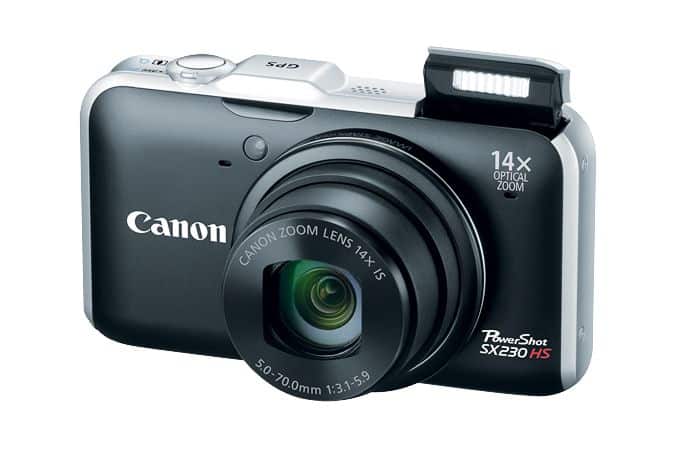
Many of the professional functions available on this point-and-shoot camera include full HD movie recording, GPS positioning, manual shooting modes … making it a “mix” camera between discrete lens and baseline viewer.
The PowerShot SX230 HS camera is very eye-catching, more suitable for women.
The front of the machine is very simple design, rounded corners and lines are quite meticulous design.
Machine is not really compact, but can hold in hand but slightly larger if you put the machine in your pants pocket.
The “toad” lamp on the upper left side of the machine automatically pops up if you shoot in automatic mode but you can also open the flash manually, though the opening is slightly sank and difficult to open.
The back of the machine is simple, with the adjustment knob usually located to the right and the LCD screen lingering behind the back.
The menu interface is quite simple and the right-hand button cluster is very detailed, giving you quick access to the functions you need when shooting.
On the right side is a slot connecting the camera to the computer (USB) and the output slot to the TV (HDMI).
The built-in camera has 14x optical zoom and is quite fast and quiet, vibration-proof.
Battery capacity is 1120mAh and SD memory card is neatly designed on the bottom of the machine.
Overview
Canon’s SX230 HS showed up in 2011 to replace the SX210 IS, built around a 14x zoom, full HD video, and what Canon calls the HS System — a high-sensitivity CMOS sensor and DIGIC 4 processor aimed at fixing the low-light problems most compacts have.
Design and Build
Metal-and-plastic body, sturdy without much heft, rounded edges, a lens that pokes out just slightly. Comes in black, red, or blue. It’s not weather-sealed, so keep it away from rain, but daily handling holds up fine. Controls sit where you’d want them, grip’s comfortable. 105.3 x 60.3 x 31.5mm, 206 grams — fits in a pocket without a fight.
Key Features
The 12.1-megapixel CMOS sensor is the whole point of the HS System — back-illuminated, paired with DIGIC 4, built specifically to handle low light better than a typical compact. Colors come out accurate and detail holds up in most conditions.
14x optical zoom, 28-392mm equivalent. Wide enough for landscapes, long enough to reach something far off, with optical stabilization keeping the shake down at the long end where it matters most.
The 3-inch LCD is 230,000 dots — fine indoors, harder to read in direct sun. No viewfinder of any kind, so the screen’s your only way to compose a shot.
Video’s full HD, 1080p at 24fps, stereo mics flanking the lens. Sharp enough most of the time, though compression artifacts show up occasionally and manual video control is basically absent.
Every shooting mode you’d expect — auto, program, shutter priority, aperture priority, full manual, scene modes for portrait, landscape, night, sports. A dedicated video button gets you into recording fast.
Built-in Wi-Fi for wireless transfers, HDMI for a TV hookup, USB for wired transfers — a solid spread for a 2011 camera.
Performance
Image quality is strong here — detailed, vibrant, colors that hold up. Low light is genuinely where this camera earns its keep; noise stays controlled until you push the ISO higher, where some grain and softness start showing.
Autofocus is fast, startup’s quick enough for spontaneous shots, burst mode runs about 3.5fps — not fast, but usable when you need it.
Zoom holds sharp across the range, stabilizer doing what it’s supposed to, just a bit softer once you’re all the way zoomed in. Battery’s rated 200-250 shots, but that number drops fast if you’re leaning on the screen, shooting video, or firing the flash a lot.
How It Stacks Up
Canon’s own SX260 HS beats it in most ways that matter — same sensor resolution, but better low light, a newer DIGIC 5 chip, GPS, and video that hits 30fps instead of 24. If price is close, it’s the smarter buy.
Panasonic’s Lumix TZ20 reaches further at 16x zoom with a touchscreen and slightly more resolution, though the SX230 HS still offers more room to control settings manually if you’d rather not tap through menus.
Sony’s HX9V is better on paper almost across the board — higher resolution, longer zoom, sharper autofocus, even a 3D mode — but it costs more, and that gap is really what decides between the two.
Nikon’s Coolpix S9100 stretches to 18x zoom with a better screen, good if reach is your priority, though the HS System still gives Canon the low-light edge.
The Olympus SZ-30MR goes big on both resolution and reach — 16 megapixels, 24x zoom — which suits anyone chasing detail, but low light and interface simplicity stay Canon’s advantage.
Fujifilm’s F550 EXR lands close in zoom range with a sharper sensor and its own EXR mode for low light, though the SX230 HS counters with a simpler interface and stabilization that just works.
Bottom Line
What makes this camera worth it is simple: good zoom range, solid low light, real manual controls, if you want more than a point-and-shoot but aren’t ready to pay for something higher-end. No RAW, no GPS, a screen that looks dated now, and you’ll want a spare battery for a long day. That’s what Canon trimmed to keep the price down. Everything it does, it does well enough.
Canon PowerShot SX230 HS 12.1 MP CMOS Digital Camera with 14x Image Stabilized Zoom 28mm Wide-Angle Lens and 1080p Full-HD Video (Black) (OLD MODEL): Buy it now
Canon PowerShot SX230HS 12.1 MP Digital Camera with HS SYSTEM and DIGIC 4 Image Processor (red): Buy it now
Canon PowerShot SX230 HS 12.1 MP CMOS Digital Camera with 14x Image Stabilized Zoom 28mm Wide-Angle Lens and 1080p Full-HD Video (Blue) (OLD MODEL): Buy it now
Canon PowerShot SX230 HS 12.1 MP Digital Camera, Black 5043B001: Buy it now
Canon Digital Camera PowerShot SX230 HS Black PSSX230HS (BK): Buy it now
Related Posts


Tech Reviewer & Product Analyst
Định Bia has spent over 10 years testing consumer electronics with a focus on smart technology. He work as a product advisor at Biareview where he helped customers find the right devices for their needs. He personally tests every product featured on this site using a consistent evaluation framework covering quality, durability, and value. All reviews are based on experience, not influenced by the manufacturer.