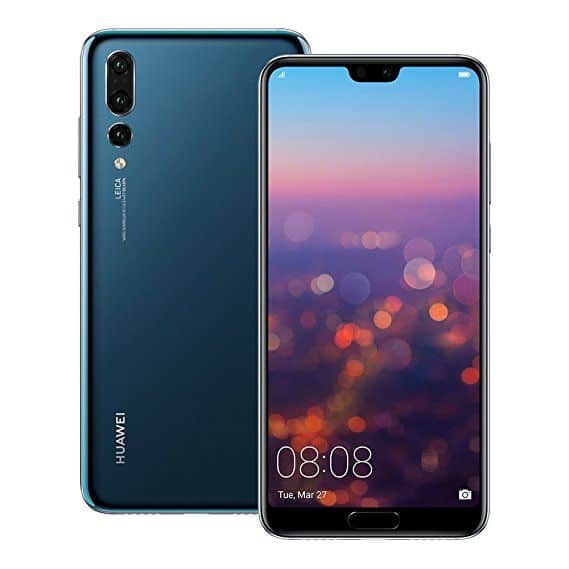
- Design
If you are an antifan of rabbit earflow on the front, the Huawei P20 Pro does not really disappoint you because the rabbit ears of the machine is very small compared to the iPhone X.
In addition, the P20 Pro uses a seamless desgin design that seamlessly translates between the front and the back. The overall finish is also very good, deserves a premium product.
Surprisingly, the P20 Pro still owns the home button cum finger sensor on the bottom edge as many manufacturers have moved the unit to the back to optimize the display area. But in general, the design of the latest flagship of the P line is still appreciated.
- Color tone
Although the metal frame incorporating two tempered glass is not new in the smartphone industry, but Huawei has made the P20 Pro more fancy with the color version Twilight (sunset) is the blend of blue and purple, exudes a charismatic beauty.
- Display: Full HD + display is sufficiently sharp
As many other smartphones on the market, especially the Samsung flagship, have been upgraded to 2K resolution, the Full HD standard is still used by Huawei for the P20 Pro. However, with the most advanced technology today, enough is enough to 6.1 inch screen on the P20 Pro to experience the visual experience.
In particular, rabbit ears – detailing the hide, causing the screen to appear on many of the people set by Huawei can hide, bringing the device back to normal shape and more familiar.
- Configuration
Huawei loads the P20 Pro with a Kirin 970 CPU, it’s an eight core setup, plus up to 6 GB of RAM and 128 GB of built in storage, and no, you do not need a memory card. Just keep in mind the Kirin 970 uses a dedicated microprocessor style design (it’s more like an NPU chip) and it’s made for machine learning style work, including artificial intelligence tasks.
It will take more time to verify the power of the P20 Pro when compared to the current top superstars like the Apple iPhone X, Samsung Galaxy S9 + or Google Pixel 2, but the performance it brings is better than any other daily needs.
Most of the heaviest games, you know the ones people brag about, can handle themselves pretty well on the highest graphics level with the P20 Pro. And at the same time, multitasking stays smooth , like you can move from game to heavy apps without that awkward pause or anything like that.
Also, the P20 Pro comes with face protection, built-in IP67 water resistance, and a battery that goes up to 4,000 mAh. There’s USB Type-C fast charging too, so it’s supposed to keep battery life feeling decent.
Performance
The Huawei P20 Pro uses the Kirin 970 chip set, an octa core kind of deal. You get four Cortex-A73 cores running at 2.4 GHz, plus another quartet of Cortex-A53 cores at 1.8 GHz or so. After that, there is 6GB of RAM, and 128GB of internal storage, which is pretty much fixed. And yeah, unfortunately it isn’t expandable either. Overall, the Kirin 970 is meant for steady performance, especially when it’s working together with Huawei’s EMUI software , and that partnership is pretty obvious.
For everyday use, the Huawei P20 Pro feels smooth enough, responsive too. Between the Kirin 970 and 6GB of RAM onboard, the phone takes care of multitasking, app launches, and regular stuff in a pretty easy way. Apps pop up fast , and switching between things stays fluid. Even with heavier applications, or when usage stacks up over time, it doesn’t normally fall behind. No big lag, no strange stutter moments, most of the time.
And in gaming, performance is also quite good, largely due to the Mali-G72 MP12 GPU that is responsible for graphics work. The P20 Pro can handle well known games like PUBG Mobile and Asphalt 9 on higher settings , without running into constant frame drops. The GPU isn’t the top choice compared to the very best chips out there, but it still gives a pretty satisfying gaming experience for most people.
Benchmarks
In benchmark tests , the Huawei P20 Pro looks pretty good, honestly. On Geekbench 4 it lands around 1,910 for single core performance and roughly 6,820 for multi core performance , so it winds up among the top tier in its category. And yeah, those numbers seem to show the P20 Pro can manage demanding workloads and still keep things moving smoothly across different situations .
As for graphics, the P20 Pro also posts decent results in 3DMark tests, showing it can work with more intricate visual effects and graphics heavy applications. Put together, the Kirin 970 processor and the Mali-G72 GPU offer a sort of balanced execution, which fits the needs of most users.
Camera Performance
One of the more noticeable bits of the Huawei P20 Pro is, honestly, the camera system. People have really praised how it looks in design terms and how well it actually performs in real use, like in day to day situations it just doesn’t feel basic. On the P20 Pro, you get this triple-camera setup on the back , sort of a 40MP main sensor up front, then there’s a 20MP monochrome sensor following it, and finally an 8MP telephoto sensor. With that arrangement going on, the phone can manage pictures that feel more sharp and vivid, across lots of different moments, not just one particular lighting or scene.
Rear Camera
The 40MP primary sensor is kind of the headline attraction here. It uses a f/1.8 aperture along with optical image stabilization ,OIS for short, to keep images sharp and readable even when the light is kinda rough. The bigger sensor footprint helps it gather light better, which usually means cleaner low-light shots with less visible noise, and overall more confident exposure.
The 20MP monochrome sensor kind of teams up with the main sensor to lift finer image detail and contrast. It captures black-and-white photos with a lot of clarity, and the info from it is then used to improve the color depth and sharpness in images that are ultimately produced by the primary sensor. So instead of feeling like two separate cameras doing two separate jobs, the end result looks like a more layered final picture, more texture in the scene, and slightly stronger definition.
Then there’s the 8MP telephoto sensor, this one gives you 3x optical zoom, so you can shoot faraway subjects without immediately seeing that big drop in detail. That telephoto lens also includes OIS, which helps cut down on hand shake, and it makes zoomed shots look steadier. Beyond that, the P20 Pro’s zoom reach goes up to 5x hybrid zoom too, mixing optical and digital methods to get more magnification while trying to keep the detail level fairly high.
- The unique 3 rear camera system offers many functions
The 3 cameras (40 MP camera, 20 MP monochrome camera and 8 MP telephoto camera) of the P20 Pro have autofocus system including: laser focus, depth gauge, focus sensor contrast and focus in the phase, accompanied by AI optical image stabilization and color temperature sensor to enhance the ability to distinguish color.
With a lot of modern hardware, the device can capture brightness , black-and-white, up to 5x zoom , and up to ISO 102,400, exposure up to 4 seconds without a tripod. You can also change the aperture using math or slow motion at 960 fps + with HD resolution.
Another interesting thing on the P20 Pro is Ultra Snapshot which lets you grab quick frames when the screen is off, in around 0.3 seconds. That makes it easier to catch those instant moments , without needing to unlock or anything.
Camera Features and Software
The P20 Pro’s camera software is packed with features that kind of lift the whole photography experience. The AI-assisted camera system uses artificial intelligence to spot different scenes and then tweak settings automatically. It aims to improve exposure, color balance, and focus based on what it detects, whether you are looking at a landscape , a portrait, or a night scene.
In the camera app there’s like a bunch of shooting modes, such as Night Mode , Portrait Mode , and Pro Mode. The Night Mode option leans toward longer exposure captures, so it pulls in more light and also manages to keep finer detail even when things are dim. Meanwhile Portrait Mode uses the telephoto lens type for that bokeh vibe , so the background gets sort of softly blurred , and the subject feels like it pops out more. Pro Mode gives manual control for ISO, shutter speed , and focus, which means you get extra creative room.
The video recording side of the P20 Pro is honestly kind of impressive too. It can capture 4K footage at 30fps, so you get sharp, high resolution clips that still look pretty detailed. On top of that the camera comes with multiple video recording modes, like slow-motion and time-lapse, so you can play around with different “cinematic” kind of effects without it feeling too complicated.
Front Camera
For selfies the Huawei P20 Pro uses a 24MP front sensor with an f/2.0 aperture. This front facing setup is built to give you crisp, well defined selfie shots, plus it tends to keep colors fairly accurate, even when the lighting is not that great. It also has AI enhanced beauty options, which means it can smooth skin a bit and sharpen up facial features, so your selfies usually come out more flattering than you might expect.
Software Experience
The Huawei P20 Pro runs Android 8.1 Oreo, with Huawei’s EMUI 8.1 sitting on top. EMUI is kind of famous for having lots of ways to tweak things, and those extras usually improve day to day comfort.
User Interface
EMUI 8.1 feels clean and pretty easy to navigate, though you can still customize a lot. You can set up the phone the way you like, with things like a customizable home screen, an app drawer, and also solid notification control. There are also multiple themes and icon styles, so the look and feel can be changed without much fuss.
There are additional features as well, for example Huawei’s App Twin. This lets you create a second instance of apps like WhatsApp and Facebook , basically so you can juggle multiple accounts on one device. The P20 Pro also supports GPU Turbo, a feature aimed at boosting gaming performance by optimizing how the graphics get processed during play.
Performance and Usability
EMUI 8.1 feels like it was made to fit the Huawei P20 Pro hardware pretty well, so most of the time you get that smooth, efficient kind of experience. The software basically handles resources in a smart way , so the device keeps up nicely across different situations. Day to day stuff looks steady too, like switching apps, multitasking, even gaming, there’s minimal lag or that stuttering feeling you sometimes notice on weaker systems.
There are also some practical extras , like one handed mode. it kind of shrinks the interface and makes it easier to operate the phone with just one hand. This can be pretty handy because the display is on the larger side. EMUI also throws in gesture controls, where you move around using swipes and taps , it can feel more natural than relying on the usual on screen buttons all the time.
Security and Privacy
The Huawei P20 Pro comes with a handful of security features, designed to protect your data, more or less. The fingerprint sensor is under the front glass, and it gives fast, reliable biometric verification. It’s positioned where most people can reach it easily, and it generally works fine across different situations. Recognition is quick , and it feels pretty precise, so unlocking the phone or confirming payments usually goes with little hassle.
Also, the phone supports face detection, which is like a second protection option. The front camera checks your face and unlocks when it matches the stored profile. That said, it’s convenient sure, but facial recognition isn’t as strong as fingerprint security, and it can feel a bit less steady when the lighting is dim.
Battery Life
The Huawei P20 Pro comes with a 4,000mAh battery, it’s a pretty substantial capacity for something that still feels relatively slim. That big power cell helps the phone hang on for a long time too, so in real life it can usually get you through a full day even when you’re using it a lot, like all day long.
Battery Performance
When you actually use it, the Huawei P20 Pro tends to show strong battery results. Most people will see a full day of usage even if it’s moderate to heavy, think web pages, social stuff, plus watching videos and general multimedia. If you push it harder, for example you keep streaming video nonstop or you game for a long stretch, the charge clearly drops quicker, but it still feels dependable enough, with decent stamina.
There’s also Huawei’s SuperCharge tech, so charging is not a slow, drawn out affair. Using the included charger, the P20 Pro can jump from 0% to around 58% in about 30 minutes, then it goes to 100% in roughly 90 minutes. Basically, this speed matters a lot, especially for folks who need a quick top up, and don’t want to sit around waiting around.
Charging Speed
With SuperCharge on board, the device recharges quickly and that cuts down on downtime. You spend less time plugged in, and more time just getting on with whatever you were doing. It’s one of those advantages that stands out, particularly if you’re always traveling, moving around, and you want your phone ready fast.
Connectivity and Features
As for the rest, the Huawei P20 Pro supports a good variety of connectivity options, so it feels flexible for different daily needs, depending on what you use it for.
Connectivity
The phone also brings 4G LTE support, so when it connects to compatible networks you get fast, mobile web access, fairly smoothly. On top of that it has Wi‑Fi 802.11 a/b/g/n/ac, which gives steady wireless connection and it even handles both 2.4GHz plus 5GHz bands, for connections that tend to feel quicker and a bit more stable. Bluetooth 4.2 is there for pairing with wireless accessories, and GPS also helps with accurate location tracking.
Something a bit notable that the P20 Pro does not include is NFC , meaning Near Field Communication. NFC is often used for mobile payments, and it can also support a few file‑sharing type apps. NFC is getting more common these days in modern smartphones, so not having it might feel like a downside for people who depend on tap to pay style contactless transactions.
Audio Quality
In terms of audio, the Huawei P20 Pro has a single bottom-firing speaker. It sounds pretty clear for everyday use and casual listening. That speaker works well enough for notifications, calls , and video playback, but it doesn’t really have the depth or richness you might expect if you are looking for a more immersive vibe. So for many users, headphones or an external speaker will still be the better pick.
Good news, though the device has a 3.5mm headphone jack, and it’s pretty handy if you still prefer wired listening, basically. The audio quality through the headphone jack is usually solid, with clear sound output and a more balanced tone, which is sort of nice. Huawei has also built in a better audio codec, and that kinda helps to keep the whole listening experience fun, enjoyable, and steady.
Software Updates and Support
At launch , the Huawei P20 Pro came out with Android 8.1 Oreo and EMUI 8.1. After that point , it did get moved along with newer Android builds , including Android 9.0 Pie and Android 10. The whole update process on Huawei devices can be kind of mixed bag, where some releases show up faster ,and others take a bit longer.
Future Updates
Huawei’s approach for the P20 Pro has looked pretty solid overall , with the brand sending along major Android upgrades and ongoing security patches. That said, as the handset gets older the cadence and the ease of finding those updates might get weaker ,so it can be worth thinking about for people who really want the newest software and the freshest security fixes. For long term value , this factor matters.
Pricing and Value
When it first landed , the Huawei P20 Pro was treated like a premium flagship, with a price level that matches that idea. The device brought a nice stack of essentials , like a sharp display, a very capable camera system, and snappy day to day speed. Even with the premium positioning , its cost was still fairly on par with other flagship phones around the same era ,so it stayed appealing for anyone after a top shelf smartphone experience, at the time.
Current Value
Right now, in the market, the Huawei P20 Pro still feels like a real option for people who want a really solid smartphone, without paying the newer flagship kind of money. It kinda stays relevant because the camera setup is still top tier, and the general day to day performance is good enough that it doesn’t feel “old” the moment you pick it up. If you care about taking photos , and also watching or sharing multimedia, this phone keeps doing the job.
Final Thoughts
The Huawei P20 Pro is one of those overall, well balanced flagship phones, with a premium look, a camera that actually impresses, and performance that holds up. You get that high-resolution AMOLED screen, the Kirin 970 engine , plus the triple camera arrangement, and all together it becomes a noticeable pick in a crowded smartphone world.
Now, it’s not perfect. The missing NFC and the fact it doesn’t get the newest software updates anymore could matter for some users. Still, the full package feels pretty attractive. The device is sleek, the display quality is excellent, and the camera output stays strong enough that you can enjoy a high quality experience even after a few years have passed since it first came out.
So, if you’re after a trustworthy and feature rich phone, and you mainly care about photography , the Huawei P20 Pro remains a very recommended choice. Its long lasting strengths, plus the pricing that’s usually easier on the wallet, make it a smart way to get a premium smartphone feel without that latest-generation price tag, you know.
Huawei P20 Pro 128GB Dual-SIM Factory Unlocked 4G/LTE Smartphone (Black) – International Version: Buy it now
Huawei P20 Pro 128GB Single-SIM Factory Unlocked 4G/LTE Smartphone (Black) – International Version: Buy it now
Huawei P20 Pro CLT-L29 128GB – Dual SIM [Android 8.1, 6.1″ AMOLED, Triple 40.0MP+20.0MP+8.0MP, 6GB RAM, Kirin 970] (Black): Buy it now
Huawei P20 Pro CLT-AL00 – Dual SIM [Android 8.1, 6.1″ AMOLED, Triple 40.0MP+20.0MP+8.0MP, 6GB RAM, Kirin 970] (Black, 64GB): Buy it now
Related Posts





Tech Reviewer & Product Analyst
Định Bia has spent over 10 years testing consumer electronics with a focus on smart technology. He work as a product advisor at Biareview where he helped customers find the right devices for their needs. He personally tests every product featured on this site using a consistent evaluation framework covering quality, durability, and value. All reviews are based on experience, not influenced by the manufacturer.