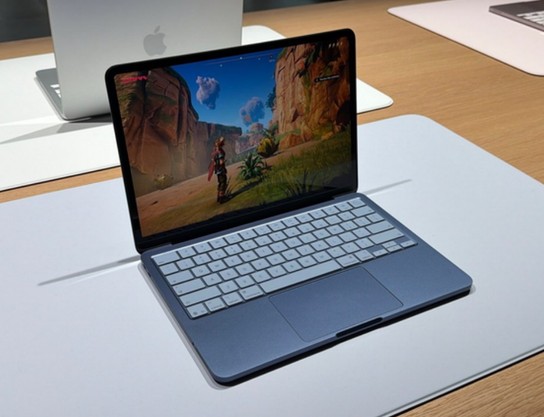
The design of the MacBook product appears to be both compact and durable yet maintains its essential MacBook characteristics. Apple provides the MacBook Neo in four distinct color choices which include the Citrus variant that showcases an eye-catching new light yellow shade. The new color which Apple introduced as a laptop color option creates an appearance that is both fresh and distinctive. Users who want to maintain a simple appearance can select the standard silver option.
Apple uses device color to synchronize both the rubber feet and the macOS interface according to machine design elements although users have full control to modify this feature through settings. The keyboard of the Citrus version displays a faint yellow tint which produces a discreet design element that does not draw too much attention.
The MacBook Neo construction process uses unibody aluminum frame technology which matches the build standard of premium MacBook devices. The device achieves an exceptional premium feel because its construction materials exceed what people generally expect from a laptop priced at 16.5 million VND. The body displays strong durability while the screen lid maintains its original position and the device shows minimal deformation when someone applies force to the back panel.
The hinge shows excellent tuning because its strong construction prevents wobbling yet enables users to open the device with one hand until it reaches a 135-degree opening limit. The removal of the “notch” design element from the screen created a more streamlined appearance for Apple products although their screen bezels remain noticeably wide.
The MacBook Neo reaches a thickness of 12.7 mm which exceeds the MacBook Air thickness of 11.3 mm but its weight of 1.235 kg allows for convenient portability.
Apple 2026 MacBook Neo 13-inch Laptop with A18 Pro chip: Built for AI and Apple Intelligence, Liquid Retina Display, 8GB Unified Memory, 512GB SSD Storage, 1080p FaceTime HD Camera, Touch ID; Indigo:
Connectivity: Minimalist
Apple has reduced its port system to basic components because it needs to maintain lower costs. The MacBook Neo only has two USB-C ports, one of which only supports USB 2.0. The port functions as a charging option which prevents its complete loss of usefulness.
The other USB-C port supports USB 3.2 Gen 2, allowing connection to external displays with a maximum resolution of 4K at 60 Hz. The system can transmit external display images while charging and connecting multiple devices through a single cable according to testing results with an external monitor.
The chassis has two USB-C ports which users can find on its rear left section, while the 3.5mm headphone jack is located at the front section.
The MacBook Neo supports Wi-Fi 6E. The tests showed download speeds between 1.1 Gbps and 1.3 Gbps, which remained stable during file downloads and game downloads and online video streaming.
The 1080p FaceTime HD camera provides fairly good image quality during video calls, and the built-in microphone works clearly; however, the machine does not support the Center Stage feature.
Repairability: A positive step forward
Technicians can easily remove the MacBook Neo bottom panel because it uses pentalobe screws to secure its components. Users can replace battery and speaker and connector components because these parts use screws to secure them instead of adhesive.
The system allows users to easily repair their devices which represents a major development for Apple products.
Apple published an extensive environmental assessment document for its MacBook Neo computer. The company reports that the basic model produces approximately 103 kg of CO₂e emissions, while its production processes and packaging materials incorporate numerous recycled elements.
Keyboard and Trackpad: A Familiar Experience
The MacBook Neo keyboard delivers a typing experience that matches the feel of contemporary MacBooks. Users will find the key travel distance to be shallow yet it delivers effective tactile feedback which enables them to type for extended periods without discomfort.
The basic version lacks a Touch ID fingerprint sensor and uses only the standard power button. The missing backlighting feature represents the most significant disadvantage because it creates difficulties for users who need to operate in dimly lit spaces.
Apple introduced a new mechanical trackpad system to replace its existing force-sensitive haptic trackpad system. Users still maintain the ability to touch any part of the trackpad because the buttons exist in the center section of the device which permits them to make contact with the entire trackpad area.
The 11.5 x 7.2 cm trackpad size is slightly small by current standards, but the click response is consistent and accurate.
The display shows Sharp IPS technology which provides high brightness capability. The 13-inch IPS display of the MacBook Neo delivers a 2408 x 1506 resolution at a 16:10 aspect ratio and 60Hz refresh rate. The images display sharpness which provides a level of color accuracy. The removal of the notch means the macOS menu bar directly occupies a portion of the 16:10 screen area, unlike the MacBook Air where the menu bar is located on either side of the notch.
The display performance shows excellent value because of its affordable price. The screen uses a light sensor system which automatically controls brightness levels while it does not include True Tone functionality. The Neo’s glossy finish reflects more light than other MacBooks which creates discomfort when users access the device outside.
The device produces maximum brightness which exceeds 500 nits but its black level measurement reaches 0.48 nits which results in a contrast ratio of 1150:1 which causes dark areas to appear as dark gray. The screen shows minimal backlight bleeding which occurs at the corner areas.
CalMAN software analysis demonstrates that the screen maintained acceptable factory calibration standards. The colors present a slight bluish hue which remains difficult to detect without using visual observation. The recalibration process results in better color accuracy together with improved grayscale performance. The screen displays the entire sRGB color gamut which provides sufficient capability for basic photo and video editing work.
The screen operates without using PWM technology to regulate brightness levels but it employs temporal dithering as its brightness control method. The display starts to show flickering during slow motion recording at 240 Hz when the grayscale level reaches 74% and the flickering becomes more evident at 60% and lower. The display causes slight discomfort to people who experience sensitivity towards this particular type of screen.
Performance: The A18 Pro chip delivers performance results which exceed all expectations set for it.
The MacBook Neo uses the Apple A18 Pro chip, which previously appeared in the iPhone 16 Pro. This chip has 6 cores, including 2 high-performance cores which operate at their peak speed of 4.0 GHz and 4 power-efficient cores which function at 2.4 GHz. The system reaches its highest power usage during multi-core testing at 6 W and maintains a steady power draw which ranges between 3.8 W and 4 W during extended testing. The single-core tests show power usage which falls between 3.5 W and 4 W.
The system achieves impressive performance results through its extremely low power usage. The single-core performance of the system exceeds all mobile CPUs which AMD Intel and Qualcomm produce while its performance approaches Apple’s M4 and M5 series processors. The system shows lower multi-core performance than Intel Core Ultra 5 Lunar Lake chips yet the two systems demonstrate comparable performance because the MacBook Neo operates without any cooling fan.
Users can expect quick system response times during their regular activities. The system achieves high benchmark scores which enable it to surpass numerous Snapdragon-based laptops during CrossMark testing and browser performance evaluations. 8GB of RAM isn’t exactly overflowing but if you mainly use Apple’s native apps it’s still sufficient for most everyday tasks.
GPU and Gaming Capabilities The A18 Pro includes a 5-core GPU which has a maximum power consumption limit of 6W. The system operates at 4.4W power usage after extended usage yet it maintains stable performance levels which only drop 10% during stress testing. The GPU outperforms Adreno X1-45 and approaches X1-85 performance levels on the 13.8-inch Surface Laptop 7. The system delivers better performance than Intel’s integrated graphics through its Iris Xe Graphics G7.
The system supports only basic gaming functions despite its current capabilities. The game Cyberpunk 2077 requires its most basic settings together with MetalFX which produces low-quality graphics and frame rate drops that go below 30 fps. The MacBook Neo functions better with Apple Arcade games and streaming services than with other types of software.
Operation: Completely Silent
The MacBook Neo uses a passive cooling design because it operates without fans which enables the device to function without creating noise. The tests showed no electronic sound emissions from the equipment. The aluminum chassis maintains a low temperature after the system operates under maximum load conditions. The maximum temperature point reached 40°C while most parts of the chassis maintained safe operating temperatures. The A18 Pro chip consumed 8.8 W of power during stress testing until it reached its stable operating point of 5 W. The two speakers inside the chassis are quite large which results in excellent sound performance that matches the price range of the product. The audio output can reach high volumes which produce clear sound, but it does not match the power level of the MacBook Air.
The screen brightness causes the device to consume power which reaches 9 watts during idle time at maximum brightness settings. The system starts with a power usage of 24 watts but then maintains a constant consumption rate of 18.5 watts. European markets receive products without chargers from Apple but customers can use a 30-watt charger for their devices.
The battery holds a total energy capacity of 36.5 watt-hours. The device provided almost 13 hours of operation during a Wi-Fi web browsing test which used 150 nits screen brightness. Users who need to work in bright settings will find it difficult to operate their devices because battery life decreases to less than 5 hours when users increase screen brightness. The 65 watt adapter requires about 2 hours to complete a full battery charge which includes reaching 50% after 45 minutes and 80% after 76 minutes.
The MacBook Neo provides a user experience that matches the typical MacBook experience found in standard Apple MacBooks. Users experience no limitations because all three elements of build quality and typing experience and screen quality remain accessible to them. The Neo IPS panel delivers impressive performance at its price point because it produces high sharpness and generates precise color reproduction although it does not match the MacBook Air display quality.
The A18 Pro chip shows unexpected results because it outperforms multiple Snapdragon chips in single-core processing and graphics computing while delivering silent operation. The laptop provides smooth performance for regular activities until users attempt to operate heavy simultaneous tasks which exceed the capabilities of its 8 GB RAM.
The MacBook Neo offers users some fundamental drawbacks which prevent them from using the device to its full potential. The device features two USB-C ports but one port only permits USB 2.0 connection. Touch ID is only available on the more expensive 512 GB storage version. The most important drawbacks of the product include the absence of a backlit keyboard and the extreme reduction of battery life which occurs when users operate the device at maximum screen brightness.

Tech Reviewer & Product Analyst
Định Bia has spent over 10 years testing consumer electronics with a focus on smart technology. He work as a product advisor at Biareview where he helped customers find the right devices for their needs. He personally tests every product featured on this site using a consistent evaluation framework covering quality, durability, and value. All reviews are based on experience, not influenced by the manufacturer.