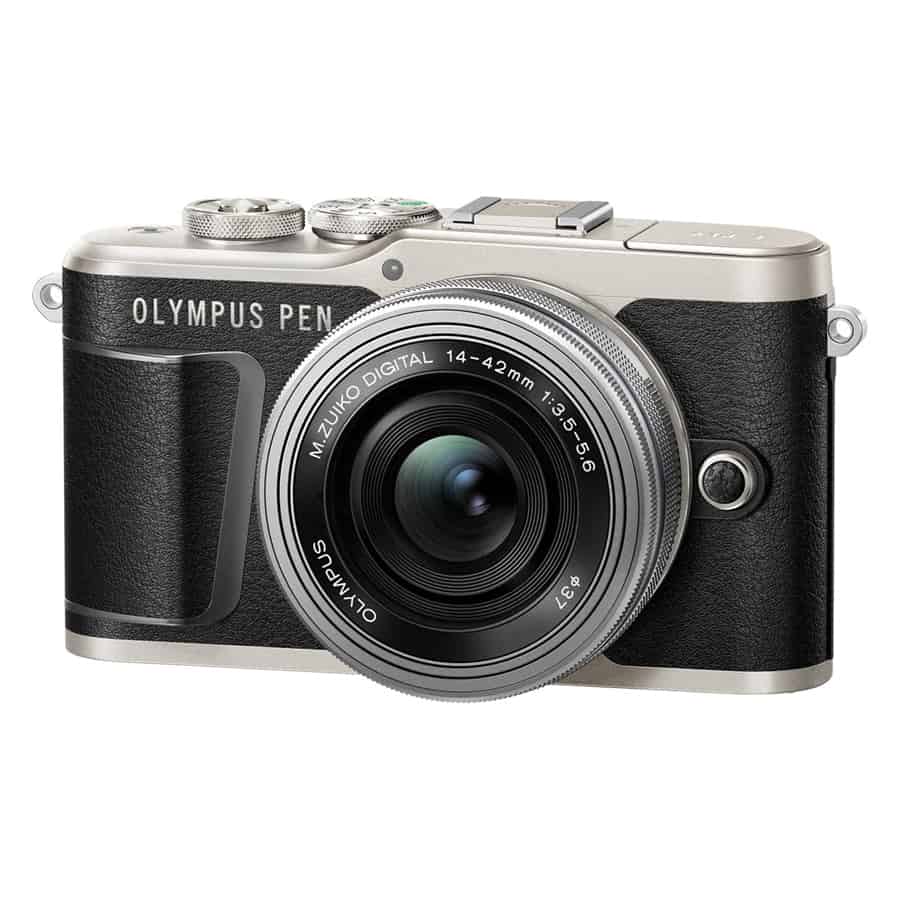
Machine specifications
– 16.1-megapixel Micro Four Thirds CMOS sensor
– Having Micro Four Thirds lens mount
– 3-axis sensor-shift (movement of the sensor the time)
– 3-inch flip touch screen
– 4K video recording ability at 30/25/24fps
– FullHD 60p video recording, stereo sound-ISO100 to ISO25600 (extended)-
– Bluetooth and Wi-Fi connection
– Continuous shooting at 8.5fps-HDR, Focus Peaking-There are
– 31 Art Filters-Black/silver, white/silver, coffee brown/silver
Unpacking
As usual with the exterior, there’s some information about Olympus Pen E-PL9; my main impression on opening it, had it been book manuals as are most interior stuff. If one has time to do nothing, flecking through a book about 2cm thick could take care of it, at least kill some time.
And here is our protagonist Olympus Pen E-PL9.
Many upgrades fit the market such as higher video recording capability 30/25/24p-4K or Full HD 60p. Improved from the previous E-PL8, the focus system is up to 121 instead of just 81 with the other cameras.
Next, change the exterior; there is an upgrade in the E-PL8 and back to an even older design that is the E-PL7, in which the grip has a similarity to create a firmer grip position. Compared to older versions, this one has an advantage of being fitted with a flash already on the camera body.
The interface system has also been changed with many similarities with the E-M1 II. Still, with fewer options, the interface is intuitive and easy to change the appropriate customizations according to the user’s needs.
Unlike the E-PL8, which includes only Wi-Fi, the E-PL9 has added Bluetooth and Wi-Fi for speedier and easier connectivity.
Olympus PEN E-PL9 Kit with 14-42mm EZ Lens, Camera Bag, and Memory Card (Onyx Black): Buy it now
Olympus PEN E-PL9 Body Only with 3-Inch LCD (Pearl White): Buy it now
Olympus PEN E-PL9 Body only with 3-Inch LCD (Honey Brown): Buy it now
User Interface & Controls
The E-PL9 splits the difference well: real buttons where your thumb expects them, touch where it actually saves time. Mode dial, power switch, shutter button, and a function button you can rewire to whatever — all up top, all within reach. Spin the dial past the usual modes Auto, Program, Aperture and Shutter Priority, Manual, Scene and you land on the Art Filters, which is where Olympus has always had fun.
The back’s a different story. It’s almost entirely screen, three inches, 1.04 million dots and it swings up 80 degrees or folds down a full 180, which is the difference between “technically has a flip screen” and “you’ll actually use it for selfies or vlogging.” Tap to focus, tap to shoot, tap through the menu none of it lags. What you don’t get is a viewfinder. First sunny afternoon you’re outside with it, you’ll be squinting at a washed-out screen wondering why you can’t just look through something instead.
Sensor and Image Quality
The 16.1-megapixel Micro Four Thirds sensor, really, is the same sensor as in the E-PL8. Despite being outdated in sensor technology, the E-PL9 has great image quality, with excellent color quality, dynamic range, and detail.
Same processor as the OM-D line. TruePic VIII dropped into a body at half the price. That’s most of why the E-PL9 shoots and processes faster than you’d expect for what it costs. ISO’s rated 200-6400 out of the box, and you can stretch it to 100 on the low end or 25600 on the high end if you’re desperate. Realistically you’ll never touch the extremes, but it’s nice to know they’re there. Push it to ISO 3200 and images still hold together detail’s intact, noise isn’t a problem yet. Past that it starts to fall apart like most cameras in this class. At higher ISOs, there is more noticeable noise, but not so much that it’s unmanageable in post-processing.
Probably the best feature of the E-PL9, the in-body image stabilization works on a 3-axis system, compensating for camera shake to deliver sharper images even when shooting in poor lighting conditions or using longer focal lengths. Compared to the 5-axis stabilization of higher-end models, this system is not quite as advanced, but it certainly beats a camera with no stabilization system at all.
Autofocus Performance
The focus system of E-PL9 is a contrast detect autofocus senses with a total of 121 focusing points, thus making very wide coverage. In good light, autofocus performance is fast and accurate enough for everyday photography. In low light, AF speed is just a little slower but still good enough.
It also includes face and eye detection AF, which are very useful for portraiture. The camera helps perfectly lock onto the face and eyes of subjects. For further control, the touch screen allows the users to manually select any focus point, which is quite convenient while shooting at difficult scenarios or to have very shallow depth of field.
Capabilities Related to Video
The Olympus Pen E-PL9 is indeed a capable video camera. Features a 4K video recording option at 30, 25, and 24 frames per second, as well as Full HD and HD. And, video 4K, that looks really sharp and detailed, true in color, and dynamic in range. The in-body image stabilizer works well to smooth the handheld footage while reducing camera shake.
In addition to that, it also features several advanced video features like a mode dial dedicated for video, manual exposure control, and Art Filters in video mode. More than that, the lack of microphone input hampers more serious videographers in need of high-quality audio.
The flip-down screen of the E-PL9 is a good feature for easy framings and to check recording condition. The size and weight of the camera are meant to make the portability more obvious in travel and vlog-type videos.
Connectivity and Battery Life
Connectivity comes in the form of built-in Wi-Fi and Bluetooth. The Olympus Image Share app makes it easy to transfer photos and videos to a smartphone or tablet and control the camera remotely. Bluetooth further connects the camera and mobile device, thus keeping a constant connection for easy sharing of pictures in the midst of social networking.
It has rated battery life of approximately 350 shots per charge, which is quite good for a camera of this size. If you are going to shoot for a long time, you better take a spare battery with you. The camera also charges through the USB port, allowing charging even when you are traveling.
Easy to Use
Olympus designed this camera to be very easy to use for beginners, as well as for more seasoned photographers. It has an intuitive user interface with a well-organized menu system available on it so that accessing even the most well-known features is straightforward. The Super Control Panel, accessible directly through the touchscreen interface, offers speedy one-push access to commonly-used settings, therefore, adjustments are fast and simple.
For all the newbies, particularly interesting, is the Advanced Photo, or AP, mode. This is the part that allows the user to get those more complicated pictures, such as long exposures, HDR, panoramas, and multiple exposures, very easily. Each of the modes includes on-screen guides to assist users towards the right outcomes.
Art Filters and Creative Features
One feature of Olympus Pen series is an overwhelming amount of Art Filters and creative shooting modes that the camera could support. The E-PL9 has 16 Art Filters inside: Pop Art, Soft Focus, Grainy Film, Diorama are only a few among the many you can explore and experiment with on still and moving images, thus making each work unique and making it a touch more creative.
A similar variety of Scene modes can be found in the camera, for example, Portrait, Landscape, Night Scene, Sports, and so on. The Scene modes take care of setting parameters that apply for those matchless occasions. For those who enjoy in-camera editing, the E-PL9 provides all settings for saturation, contrast, and other image parameters on the camera itself.
Lenses and Expandability
The vast panorama of additional lenses follows the footsteps of a versatile E-PL9 camera that can fall in line with varied shooting conditions within the Micro Four Thirds system. It makes no difference whether one is interested in portraiture with a prime lens, wide-angle scenery vistas, or even telephoto distance for wildlife; the Micro Four Thirds mount will handle it all.
The E-PL9 isn’t locked into Olympus glass — Panasonic and Sigma both make Micro Four Thirds lenses that work fine on it. And because the whole system runs small, it stays true to the E-PL9’s actual selling point: something compact enough to carry everywhere.
Comparison with Competitors
Panasonic’s GX85, Fujifilm’s X-A5, Sony’s a6000 that’s the competition, and honestly none of them makes this an easy call. Depends what you’re actually after.
The GX85 is the more serious camera, full stop. Sharper EVF, 5-axis stabilization built right in. Next to it the E-PL9 feels almost like a toy in a good way. More Art Filters, more willingness to let you mess around.
Fujifilm went a different direction with the X-A5: bigger APS-C sensor, 24.2 megapixels, real low-light advantage. Then you hit the video spec and it falls apart 4K at 15fps is barely video at all. The E-PL9 was never built to win a spec sheet fight like that anyway. It’s aimed at somebody picking up a “real camera” for the first time and wanting to have fun with it.
The a6000 is showing its age but people still love it for autofocus speed and burst shooting. What it’s missing — 4K video, in-body stabilization happen to be two things the E-PL9 actually has going for it.
Value for Money
The Olympus Pen E-PL9 was a great value. It represents a stylish yet performance-oriented camera packed with creative features – all at a sensible price. Compact, easy to use, and full of Art Filters, the E-PL9 is a natural choice for the beginner and casual photographer. Beyond a great image quality, it also allows more advanced users to dabble with Micro Four Thirds lens options.
Nobody’s buying the E-PL9 for cutting-edge sensor tech or class-leading resolution that’s not the pitch. What it does is just work, shot after shot, in whatever light you throw at it. 4K video was a nice surprise for a camera in this class, and the autofocus is genuinely better than you’d expect. If you’re looking at entry-level mirrorless cameras, it’s worth putting on the list.
Advantages:
– Has a cute ergonomic shape that is very compact.
– Great image quality.
– 3-axis in-body stabilization for still shots and videos.
– 4K videos.
– Very simple UI.
– Abundant Art Filters and creative features.
– Plenty of Micro Four Thirds lenses available.
– Built-in Wi-Fi and Bluetooth.
Disadvantages:
– No integrated viewfinder.
– No microphone jack, as such.
– Can go with an extra couple of hours of battery for prolonged shooting.
– Slow AF system in low light.
Related Posts



Tech Reviewer & Product Analyst
Định Bia has spent over 10 years testing consumer electronics with a focus on smart technology. He work as a product advisor at Biareview where he helped customers find the right devices for their needs. He personally tests every product featured on this site using a consistent evaluation framework covering quality, durability, and value. All reviews are based on experience, not influenced by the manufacturer.