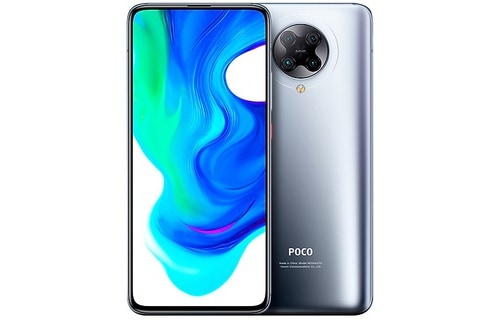
Two years ago, Xiaomi surprised the global mobile industry when it launched the Poco sub-brand with the first product using the Snapdragon 845 processor, the top CPU of the time. Recently, the Poco brand has returned with its second product, the Poco F2 Pro.
Poco F2 Pro also has a very powerful configuration with the flagship Snapdragon 865 chip, but the price has changed, the Poco F2 Pro is now approaching the high-end segment.
Of course, the price increase has a reason. Poco F2 Pro has been improved in many aspects. Not only the top-of-the-line chip, this phone now has a more advanced design with metal/glass frame material, edge-to-edge OLED display, large capacity battery with impressive charging speed, 5G network support, and a camera cluster. The following contains all the types of focal lengths that are required in today’s smartphones. It should be added that the price of high-end smartphones at the present time has increased a lot compared to 2 years ago.
Design
Xiaomi fans may not be unfamiliar with the Poco F2 Pro because this is in fact the renamed Redmi K30 Pro. The two machines have the same design and configuration. The front and back are made of Gorilla Glass 5 with a monolithic metal frame sandwiched in the middle. This is a big change from the previous Poco F1 which had a polycarbonate body.
Glass metal material gives the machine a very solid feel and is also quite glossy. However, the large 4,700 mAh battery and the indented cluster make the body of the Poco F2 Pro quite thick and heavy (8.9mm and 218g). So, if the buyer is women should consider this point.
With the selfie camera cluster recessed from the camera body, the front screen is completely liberated from the notch or hole. This year, the indented camera is less popular than a year or two ago. Most have switched to a punch-hole, mole design to place the front camera. However, I think that an indented camera is still a good solution for a full bezel-less display. In particular, the protruding mechanism of the Poco F2 Pro has nothing to complain about, is very light and smooth. Xiaomi also added a notification LED to this indented camera cluster, details that many companies are no longer paying attention to.
The Poco F2 Pro features an in-display fingerprint sensor, and it works just as well as any other company’s solution today. The recognition speed is fast and the accuracy is quite high, not much different from traditional fingerprint sensors. In this product, Xiaomi put the fingerprint sensor a bit high compared to other brands. Usage is a bit of a mess at first, but after a few weeks of using it, I find it more handed than placing it low down.
On the back, the 4-camera cluster is designed very differently, not a popular square kitchen, but placed in a circle, the inside is arranged like the letter X. This design is quite similar to the Huawei Mate 30 Pro. The back is designed as a matte glass but not rough, so it is easy to hold sweat and fingerprints. The edges are strongly curved, hugging hands, but also quite slippery if not used. As usual, Xiaomi comes with a clear plastic case.
On the sides, the machine has a USB C port, infrared port, dual SIM slot, audio jack, and a single speaker. The phone does not have an external memory card slot but 128GB and 256GB storage capacities are probably enough for most users. The sound from the loudspeaker is loud, vocals are reproduced well, but the bass is almost absent and there is no surround sound effects like smartphones with stereo speakers.
Overall, the highlight of the Poco F2 Pro is the premium material design and the thin bezels without water droplets or holes. However, the body is quite thick and heavy. Besides, the product is also reduced to something that is usually present in the high-end segment to lower costs. Specifically, the device does not support wireless charging despite the glass back and is not water-resistant.
Another point that should be mentioned in this phone is that it supports 5G.
Screen
Apart from the absence of high refresh rates, the display of the Poco F2 Pro fulfills most of the important factors in display quality. This is a large 6.7-inch screen, 4-sided borderless design, Full HD + resolution with enough details, OLED panel displays vivid colors with high brightness.
Notably, in the auto-brightness mode, the screen of the Poco F2 Pro will automatically crank up the brightness to a level that’s higher than what you can reach with the maximum brightness in manual mode . So when you tap into the automatic brightness section, the phone looks pretty crisp and it is easy to read outdoors, even when it is full sunshine.
Xiaomi also brought in 3 color modes for people to tune things around. If you prefer flattering colorfulness, you can pick the Saturation mode, while in Auto mode (the preset), the colors come off a bit less striking. In Natural mode, the colors get more faithful, yet the inherent vibrancy of the OLED panel kind of fades out. Plus , the HDR10 + standard is also there, and it fully handles HDR content on YouTube and Netflix.
Performance and software
Performance is where the Poco F2 Pro shows its high-end side , with a flagship-class Snapdragon 865 chip. That chip is built on a 7nm process , and it includes 8 CPU cores (1 Kryo 585 core at 2.84GHz, 3 Kryo 585 cores running at 2.42GHz, and 4 Kryo cores clocked at 1.8GHz). The Adreno 650 GPU is more than enough for graphics-heavy workloads, even for the kind of demanding stuff you run on today’s Android platform.
Besides, the amount of RAM is also plentiful, a 6GB RAM version, and an 8GB RAM version. Particularly, the 8GB RAM version uses the LPDDR5 memory standard which is efficient and faster than the LPDD4X standard on the 6GB RAM version (also the version I use in this review). Both versions do not have an external memory card slot.
In real-world use, the Snapdragon 865 delivers a smooth experience as expected. I have tried with some popular games today, which are PUBG Mobile and Call of Duty, at the highest settings and use the Perfdog application to monitor the frame rate (fps).
In PUBG Mobile it can get a pretty stable frame rate, sitting near 60 fps quite easily. With the Call of Duty game though, the device seems to hold a solid 60 fps all through the actual matches, but once you are in the lobby, or while the toy map is downloading, it drops down to 30 fps. This is basically for saving battery power. Because of that, the average fps rate during gameplay ends up around 52.7 fps, so it is really not close to a steady 60 fps anymore.
In terms of software, Poco F2 Pro runs Android 10 with the customizable interface Poco Launcher. The Poco Launcher is essentially MIUI 11, except with an extra app tray. The presence of the app tray feels like the phone’s software interface is quite similar to pure Android. As the MIUI version, Xiaomi’s familiar software features are available on this phone such as Game Turbo game mode, second storage space, Dark Mode, comprehensive gesture controls, Always-On display.
Xiaomi Poco F2 Pro 128GB, 6GB RAM, 6.67” AMOLED, 64MP Quad Rear Camera, Qualcomm Snapdragon 5G LTE Factory Unlocked Smartphone – International Version (Phantom White): Buy it now
Battery time
As expected with 4,700 mAh battery capacity, the Poco F2 Pro has a very impressive battery life with a powerful smartphone performance. In the familiar test of BiaReview with activities of watching movies, surfing the web, and playing games, this phone all outperformed products in the same high-end segment. With this result, users can be completely assured of the battery of the Poco F2 Pro, even for those with a high demand for gaming.
Not only has a long battery life, but the charging time of the device is also quite impressive. The 33W charger according to the Power Delivery standard (PD) included takes a total of 65 minutes to fully charge the battery of this phone, of which the first 30 minutes of charging 60%. Besides, Xiaomi’s support of the universal PD standard is also an advantage. You can use any charger that supports the PD standard with a capacity of 33W or more to take advantage of the fast charging speed of the Poco F2 Pro.
Camera
The camera is also the point where the Poco F2 Pro is not inferior to products in the same price range. It has 4 rear cameras including a 64MP main camera using Sony IMX686 sensor, 13MP super wide-angle camera, 5MP macro camera, and 2MP secondary camera. The selfie camera is in the indented cluster from the body with a resolution of 20MP.
The main 64MP camera focuses quickly and gives detailed photos, but the colors are a bit vibrant. Contrast is also pushed up, so at a glance, you will see a bright, flattering image, but a closer look will realize less natural colors. When shooting in low light, color, sharpness, and color are reduced. In scenes with a lot of low light, image colors are purplish and details are slightly flat. Luckily, the Night mode handles these well in low light.
The main camera erases fonts fine. Photos are detailed, wide bands, natural skin tones, and subject borders are separated smoothly. Even the curls are not mistakenly deleted. In addition, Xiaomi also allows users to customize the level of font removal during and after shooting.
Photos from super-wide-angle cameras tend to treat colors similar to the main camera with quite good detail and light band. The camera also handles distortion caused by the wide-angle effect effectively. By default, the camera will activate distortion correction due to wide-angle lenses. However, as with many ultra-wide cameras on mid-range cameras, you should not expect low-light shooting from the ultra-wide camera on the Poco F2 Pro.
Recent Xiaomi devices such as Redmi Note 9S and Note 9 Pro all have 5MP macro cameras for better photo quality than many similar products of Samsung and Oppo. This continues to repeat on the Poco F2 Pro. With the autofocus, macro photography from the Poco F2 Pro is easy. The photo is sharp, natural color.
The 20MP pop-up camera delivers highly detailed selfies and bright skin tones. When the font deletion mode is turned on, subject borders are detected and erased quite smoothly, not much smudged.
Summary
The Poco F2 Pro has a significantly higher price than the old generation, but the improvements in the design, camera, battery, and especially the edge-to-edge OLED display can be said to be completely commensurate with the price increase.
To match the low-end price tag, this phone has some cutbacks like a normal 60Hz refresh rate screen rather than a smoother 90Hz or 120Hz. It is not waterproof, does not support wireless charging, and does not have a telephoto camera like many other high-priced smartphones.
However, given the product’s price level and its correlation with competing products, these reductions are not of concern. In other words, Xiaomi has cut a lot to have a smartphone that balances good price and basic experience, not just leaning towards the power of the first-generation Poco F1.
Related Posts






Tech Reviewer & Product Analyst
Định Bia has spent over 10 years testing consumer electronics with a focus on smart technology. He work as a product advisor at Biareview where he helped customers find the right devices for their needs. He personally tests every product featured on this site using a consistent evaluation framework covering quality, durability, and value. All reviews are based on experience, not influenced by the manufacturer.