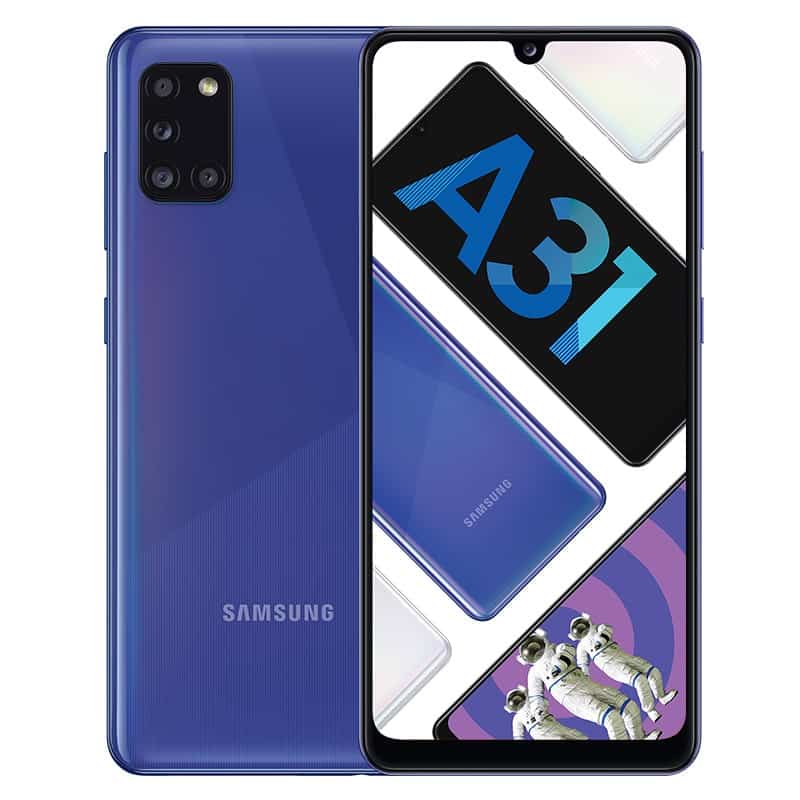
Design: still a drop of water
The design of the Galaxy A31 looks like, basically a merge of the Samsung Galaxy A51 and the Samsung Galaxy M31, kind of , at least in my eye. The front has that water drop screen like the Galaxy M31 and it feels like a oddly confusing choice since the newer Galaxy A lineup such as Samsung Galaxy A11 and Samsung Galaxy A21s already went for a hole punch display. In other words, it’s like they took one route, then came back and picked another, and you notice it right away. So looking at the front of this phone is not with the freshness of 2020.
Meanwhile, the back of the product is like Galaxy A51 with 4 L-shaped camera cluster. It still uses the back and frame made of plastic material like other mid-range products of Samsung. The Galaxy A31’s body is slightly thinner than the Galaxy M31 (8.6mm and 8.9mm), mainly due to the smaller capacity battery.
The form part of the Galaxy A31 is nothing new and eye-catching. However, the plus point in Samsung’s mid-range machines is that the screen components, bezels, and chassis are seamlessly mounted, comfortable to hold, and not uncomfortable. So is the Galaxy A31.
The Galaxy A31 has an in-display optical fingerprint sensor kind of like what the Galaxy A51 already uses. This year, Samsung sort of stepped things up a lot with the on-screen fingerprint sensor on mid range phones compared to last year, and it’s noticeable. As a result, the sensor’s recognition speed stays quick and pretty accurate, and honestly, that’s a big plus point, especially when you consider the price range of the A31.
On the sides, the machine is full of familiar things: USB Type C charging port with 15W fast charging capability, 3.5mm audio jack, two SIM slots, and independent memory card.
Screen: vivid colors, comfortable outdoor use
Galaxy A31 uses a 6.4-inch Super AMOLED display, with a Full-HD + resolution, and a 20:9 aspect ratio . In the usual setup (vivid mode), the panel looks genuinely good: bright colors, deep blacks, and it keeps good viewing angles from almost anywhere. Samsung also includes a Natural color mode, if someone wants the screen to mimic colors more faithfully, though in return the saturation feels a bit more flat or fading.
Also, the brightness is really on the high side. When you take photos outside in the sun, the Galaxy A31’s screen stays bright enough that you can still make out what you captured. This is the place where the Galaxy A31 sits noticeably above many other smartphones in the same price bracket , especially those that use IPS LCD panels.
Camera: All 5 cameras show round shoulders
Galaxy A31 has a cluster of 4 rear cameras including a 48MP main camera, an 8MP super wide-angle camera, a 5MP macro camera and a 5MP secondary camera to capture depth of images that support font capture mode.
At the front, this device runs with a 20MP camera. The Galaxy A31 camera specifications are almost the same as that mid range product we checked recently, the Galaxy M21. The camera setups on both handsets have only 1 real difference, the M21 just doesn’t come with a 5MP macro camera.
So it is not really surprising that the overall experience and photo quality from the main shooter, the super wide-angle camera, the portrait capture, and even the selfie camera on the Galaxy A31 don’t feel much different than on the Galaxy M21. Bright enough photos from that 48MP camera do deliver solid quality, but the detail and the color kind of end up worse than what you get from the 64MP camera on the Galaxy M31. In a lot of situations the main camera seems to push colors , and that color saturation ends up looking darker than the actual shade, so the whole image feels a little bit off, almost like it is trying too hard. This trend can be seen clearly in photos with a sky or green background, and the blues are often pushed greener. There may be people who like natural shots with true scenes, but often pushing the color saturation up a bit more eye catching.
In a low-light environment, the A31’s main camera still goes up with good colors and especially the brightness is often pushed up. Samsung also uses algorithms to limit noise for photos, even in very low-light situations. Of course, the consequence of that treatment is the detail that will have to be traded. But this is a reasonable orientation when most users today view and share photos on mobile devices, do not require too much detail as viewing on a computer.
The font deletion photo is not much different from the recent Galaxy M21. The font deletion image separates the subject and background quite well, the border is erased relatively smooth, sometimes the hair is still slightly blurred, but must be enlarged to notice.
The 8MP ultra-wide-angle camera also tends to handle the same color as the main camera, pushing saturation even more strongly. In a well-lit environment, the photo taken is not inferior to the main camera. The colors are bright, the saturation is high and the details are pretty good. That impression, however, is only available in favorable bright conditions. When shooting in low light or the context of strong difference, the camera angle immediately shows weakness, flat image and broken details.
This year, Samsung is equipping a 5MP macro camera for many mid-range products. In practical use, the macro camera works quite effectively, delivering creative close-ups. However, due to the lack of support for autofocus, the process of taking photos will require patience or blurring.
The selfie cameras of the A31 and M21 are the same, with a resolution of 20MP and the image quality is similar. Selfies are more detailed, wide brightness bands and colors are handled naturally. The font deletion image also has good transparency, less blurry border. Samsung also allows users of this phone to adjust the level of font deletion before and after shooting. The camera also has a wide native mode to capture groups of people or need to get more of the background behind.
In general, the entire main camera, super wide angle, font removal and selfie of the Galaxy A31 are shown at a role, giving the quality of the photo is quite good. Images tend to be processed that push the color saturation a little higher than it is.
Samsung Galaxy A31-128GB / 4GB – A315G/DSL Unlocked Dual Sim Phone w/Quad Camera 48MP+8MP+5MP+5MP GSM International Version (Prism Crush White): Buy it now
Samsung Galaxy A31 64GB / 4GB – A315G/DSL Unlocked Dual Sim Phone w/Quad Camera 48MP+8MP+5MP+5MP GSM International Version (Prism Crush White): Buy it now
Samsung Galaxy A31 (128GB, 4GB) 6.4″ FHD+, Quad Camera, 5000mAh Battery, Dual SIM GSM Unlocked US + Global 4G LTE International Model – A315G/DSL (Prism Crush Blue, 128GB + 128GB SD + Case Bundle): Buy it now
Samsung Galaxy A31 (128GB, 4GB) 6.4″ FHD+, Quad Camera, 5000mAh Battery, Dual SIM GSM Unlocked US + Global 4G LTE International Model – A315G/DSL (Prism Crush Black, 128GB + 128GB SD + Case Bundle): Buy it now
Samsung Galaxy A31 (128GB, 4GB) 6.4″ FHD+, Quad Camera, 5000mAh Battery, Dual SIM GSM Unlocked US + Global 4G LTE International Model – A315G/DSL (Prism Crush White, 128GB + 128GB SD + Case Bundle): Buy it now
Performance and software
Galaxy A31 basically rolls with a Helio P65 processor instead of a Samsung Exynos chip, so it feels kinda different right away. Overall it hangs around that middleish zone between the Exynos 9611 in the Galaxy A51 and the Exynos 850 you can find on the Galaxy A21s, it’s not quite one side or the other. This isn’t the first time Samsung has leaned on a Mediatek chip, but it is the first time we’ve actually seen that in the Galaxy A line-up.
When you toss performance test apps at it , the Galaxy A31 ends up scoring quite a bit lower than the phones running on the Exynos 9611, and Samsung has been putting that Exynos in more mid range devices since late last year. I mean , for instance, handsets like the Galaxy M31 can reach close to 200,000 Antutu points while the Galaxy A31 kind of hovers around 155,000 and yeah that gap is pretty noticeable.
Also, the Helio P65 inside the Galaxy A31 turns in a weaker result than the M31 Exynos 9611. In the piece that checks the GPU and graphics speed on the GFXBench app, the Galaxy A31 hit only about 13 fps at the screen’s real resolution (onscreen) , whereas the Galaxy M31 managed 24 fps.
It can be said that the configuration of Galaxy A31 is quite weak compared to the same price range of over $500. The Helio P65 chip is only enough to meet the needs of general use or play basic games, not enough to burden games with heavy graphics. However, the plus point in the performance of this phone is that the memory is quite ample with 6GB RAM and 128GB of internal memory.
For software , the Galaxy A31 is currently delivered with Samsung’s newer One UI 2.1 customized on top of Android 10 . Still , because there’s a new chip platform in the mix , it’s also possible the phone won’t include a few of the functions that you might find on other models. Previous mid-range smartphones from Samsung such as screen recording function or the hyperlapse and slow motion feature in the camera app.
Battery time
With a large capacity battery, power-saving Super AMOLED screen and a non-powerful chip operating on a 12nm process, it’s not surprising that the Galaxy A31’s battery life is at a very good level. In the familiar measurements of BiaReview, this phone is only inferior to the Galaxy M31 with a 6,000 mAh battery but much higher than other smartphones of the same price range.
In terms of charging time, the 15W charger comes in about 2 hours and 15 minutes to fully charge the phone, of which the first 30 minutes charge 27% and 1 hour charge 55%.
Summary
Galaxy A31 is a smartphone with a beautiful screen, strong battery life, good camera, abundant memory, and a design that does not follow the trend but has good perfection, easy to hold. However, these advantages are very common in this year’s mid-range smartphones from Samsung. We can see it on products like Galaxy M21 or Galaxy M31. Meanwhile, the performance of the Helio P65 chip of Galaxy A31 is much more drowned than the same price range machine, including Samsung or other manufacturers.
The Galaxy M31 has many advantages: a larger battery, the main camera taking better pictures, and significantly stronger performance. The plus point of the Galaxy A31 is quite lackluster, just a slimmer body and a more trendy in-display fingerprint sensor.
Related Posts



Tech Reviewer & Product Analyst
Định Bia has spent over 10 years testing consumer electronics with a focus on smart technology. He work as a product advisor at Biareview where he helped customers find the right devices for their needs. He personally tests every product featured on this site using a consistent evaluation framework covering quality, durability, and value. All reviews are based on experience, not influenced by the manufacturer.