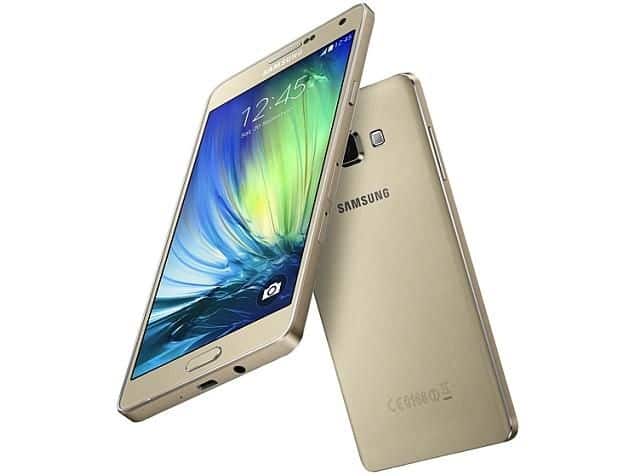
Galaxy A5 A7 has the same design, including how to design and manufacture. Instead of just using the external aluminum frame as the other manufacturers, the Samsung use an aluminum thin pieces fastened to the platform framework for the components inside. With this design, the A-series machines will be durable, but do not understand why they do not use other pieces made of thin aluminum back cover which continues to use plastic, reduced premium feel of the machine.
Galaxy A7 screen 5.5 “, ie the size of the current quite popular but it is still slightly larger than most users hand. Anyway, when placed next to the iPhone 6 Plus, the A7 has a little more compact design as well as the slightly thinner screen border. Smaller but the feeling is not good holding A7, part of the chassis slightly convex edges up, separated from the glass screen is saying a lot from Alpha Galaxy, Galaxy Note 4 will continue to appear on the A7. But it is no longer protruding too much but still is a need to overcome weaknesses. Moreover, the edges slightly choke does not feel comfortable holding something that Samsung is also a need to improve.
On the screen, the display quality of the A7 is at a good level, it’s not too bright as before. Indeed comment on Samsung on the computer screen is difficult because their test or implement the changes when the machine sold. For this reason so maybe I will not say much about the screen.
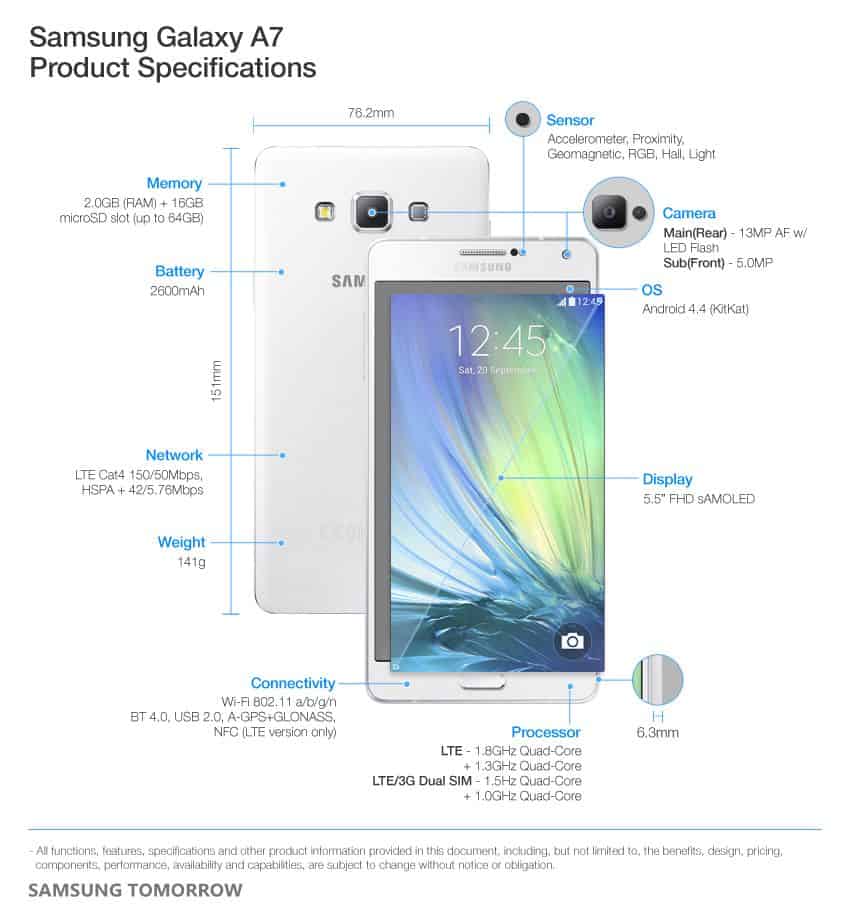
There are two versions of the Galaxy A7 exist on the market: the Snapdragon 615 and Exynos 5430. Using Both 2 chips have 8 cores and are very powerful chip: Snapdragon 615 but lower clock is the advantage of using the new architecture: 4 1.7GHz Cortex A53 and Cortex A53 1GHz 4 Exynos 5430 also has higher clock: 4 1.8GHz Cortex A15 and Cortex A7 1.3GHz 4. Samsung has used Exonos 5430 for their high-end device in recent times and it is rated quite high so we do not need to worry too. However, you should note is that the Snapdragon supports 2 SIM, or if to accept it only spend 16GB of internal memory, you can sacrifice a microSD memory card slot, SIM slot 2 as also the Exynos does not support that. In return, the Exynos have NFC while Snapdragon not.
Fortunately, the A7 has 2GB of RAM, but not as much as the Note 4 still better than a lot compared to the A3 and A5 1GB 1.5GB. RAM will help the machine run better applications.
Samsung Galaxy A7 Duos Sm-a700yd Gold (Factory Unlocked) 5.5″ , 13mp ,16gb International Version – No Warranty: Buy it now
Samsung Galaxy A7 Duos A700H Black (Dual SIM, 3G) Unlocked Factory INTERNATIONAL VERSION NO WARRANTY: Buy it now
Samsung Galaxy A7 Duos A700yd Black (Factory Unlocked) 5.5″ , 13mp ,16gb International Version – No Warranty: Buy it now
Samsung Galaxy A7 Duos A700H White (Dual SIM, 3G) Unlocked Factory: Buy it now
Performance
Processor and Performance
The Samsung Galaxy A7 (2018) runs on the Exynos 7885 chipset, and it has an octa-core CPU, split in a kinda standard layout. Like, two Cortex-A73 cores that hit 2.2 GHz , plus six Cortex-A53 cores at 1.6 GHz, which is a pretty typical setup. For visuals , there’s the Mali-G71 MP2 GPU handling most of the usual graphic chores , so interface effects and normal rendering , aren’t really a big deal.
Performance, or how it feels day to day:
General performance : overall it’s pretty solid for daily stuff like web browsing, social media, and that light multitasking you do while maybe texting and watching videos. Most apps feel smooth, with only minor hiccups here and there, the system doesn’t constantly stutter.
Gaming: for games, the Galaxy A7 (2018) can handle the usual popular stuff like PUBG Mobile and Asphalt 9 , most of the time on medium settings. When you go after tougher games, or you insist on holding the visuals at higher levels, the fluid feel can slip a bit. Still its a fine experience for casual gaming, not really for folks hunting for max quality 24/7, you know.
Multitasking: it comes with 4GB of RAM, and that actually counts. Switching between apps usually feels pretty steady, not so many big slowdowns most of the time. But if you stuff in too many weighty apps running all together, the background work starts to stack up, and later you might notice a kind of sluggishness, kind of delayed.
Benchmark scores: in benchmark tests the Galaxy A7 (2018) lands in the mid-range area, pretty competitive for its class. It won’t be able to trade blows with flagship phones, of course, but for typical use cases it has enough power to stay usable, and that’s the main thing.
Camera Performance
Triple Camera Setup
One of the standout features of the Samsung Galaxy A7 (2018) is its triple-camera setup on the rear. The camera system includes:
24 MP Main Sensor, with f/1.7 aperture so it can snag detailed and vivid images even when the lighting looks kinda tricky.
8 MP Ultra-Wide Sensor, it offers a 120 degree field of view, so you can pull in huge scenery and broad angle scenes without feeling cramped.
5 MP Depth Sensor, this one helps portrait mode by giving more convincing background blur and depth effects, that extra pop you notice right away.
Camera performance analysis:
Daylight photography, the main 24 MP camera kind of helps you get sharp, crisp shots, with pretty good color reproduction when there’s solid light. The ultra-wide sensor adds a bit of flexibility for capturing wider scenes, yet you might still notice a small edge distortion here n there, it’s not too much but it shows up.
Low-light performance : in darker settings, the Galaxy A7 (2018) holds up decently. The main camera tends to deliver relatively clear images with only modest noise. Still, the ultra-wide and depth sensors may have a harder time, especially when the light drops further.
Portrait mode: the depth sensor does a decent job producing a bokeh effect. In most cases you get a nice, soft background blur that puts the subject out front. However, the edge detection can be a little off from time to time, so small parts of the outline may look slightly imperfect.
Selfie camera : the front camera uses a 24 MP sensor with an f/2.0 aperture. It captures detailed, lively selfies, which makes it handy for social media posts and video calls. There are also multiple beauty and enhancement modes, so you can tune the look a bit more before sharing.
Battery Life, or the way it feels day to day
Battery Capacity and what it can actually do
The Samsung Galaxy A7 (2018) comes with a 3,300 mAh battery, and in practice it gives a pretty steady experience for everyday routines. It works with normal charging, but there is no fast charging , so you should not expect those quick “top up” moments.
Battery Life Analysis (kinda the real story)
Usual day: When you’re doing a moderate mix of things like browsing , social apps, and a bit of casual gaming, the Galaxy A7 (2018) usually gets you through most of the day on one charge. Most people tend to see roughly 8-10 hours of screen-on time depending on how they use it , and well how they manage brightness and apps.
Screen time: If your routine is more light tasks and not too many hours staring at the display, the autonomy feels fine. But if you’re a heavy user, recharging before the day ends might become a normal habit.
Charging: Standard charging works just fine, even if it tends to be slower than phones that support fast charging. For folks who regularly need power in a hurry, not having fast charge can feel like a small nuisance.
Software and User Interface
Samsung Experience UI
On the Samsung Galaxy A7 (2018) you’ll find Android 8.0 Oreo, plus Samsung’s Experience UI sitting above it. This custom layer gives a bit more room for features, and yeah, more tweaks than the default Android vibe. So it’s not just “the same UI”, it feels sort of expanded, even if it’s still familiar.
UI Features:
Customization: Experience UI comes with a whole menu of personalization stuff, themes, icon packs, and various home screen layouts, and sometimes that makes it easier to make the phone match your habits. You can shape the look and feel, almost like a small art project.
Bixby Assistant: The phone also includes Samsung’s Bixby virtual assistant, it can do voice commands, reminders and other helpful functions. Still, Bixby is kinda less advanced or at least not as broadly supported as some rivals, like Google Assistant. It can be good, but it’s not always the “best” choice.
Performance: The Experience UI tends to feel smooth and responsive. There’s not too much extra junk, so bloatware is limited, and you still get a clean-enough software experience. Navigation is pretty straightforward too, with an intuitive flow, and quick access to the stuff you actually use.
Updates and Support: The Galaxy A7 (2018) might get software updates and security patches, not every time or not, as fast as the flagship line, so yeah it’s kind of slower sometimes. Still, users should look for updates on a regular basis so the device stays protected and current, because security stuff doesn’t wait for anyone.
Connectivity and Additional Features
Connectivity Options
The Samsung Galaxy A7 (2018) has a pretty full set of connectivity choices, such as
Wi‑Fi: It supports Wi‑Fi 802.11 a/b/g/n/ac, and that usually means quick wireless performance with decent reliability.
Bluetooth: Bluetooth 5.0 is there, for pairing with different devices, it tends to have better range and steadier behavior than older versions.
GPS: You also get GPS plus GLONASS, Beidou, and Galileo, so location tracking and navigation should be more accurate overall.
USB: There’s a USB Type‑C port, useful for charging and also file transfers, and it’s reversible which is always nice.
Additional Features:
Fingerprint Sensor: The fingerprint scanner sits on the side, and that makes unlocking fairly safe and handy at the same time. It’s generally quick in response and accurate, giving you an extra protection layer.
Face Recognition: The Galaxy A7 (2018) also includes face recognition as another unlocking option. It’s convenient though, but it might not be as secure as the side fingerprint sensor, depending on lighting etc, you know.
Comparisons with Competitors
Samsung Galaxy A7 (2018) vs. Xiaomi Mi A2
So, Xiaomi Mi A2 it’s basically a rival in the mid-range category and it brings a nearly similar set of features. The whole story is, there are a few key differences, and they matter in daily use. Like, display, camera, speed, and that kind of stuff
Display: Both phones come with good panels, still the Galaxy A7 (2018) leans on a Super AMOLED setup, so contrast and color saturation look more punchy. The Mi A2 has a high-quality display too, it just doesn’t have that same “deep” look.
Camera: The Mi A2 goes with a dual-camera arrangement, 12 MP as the main sensor, plus a 20 MP secondary sensor. Galaxy A7 (2018) does not match exactly here, because it includes an ultra-wide lens, which the Mi A2 doesn’t provide. On balance though the Mi A2 tends to deliver strong photos overall, especially in normal lighting.
Performance: Xiaomi Mi A2 uses the Qualcomm Snapdragon 660 chipset, which usually performs a bit better than the Exynos 7885 found in the Galaxy A7 (2018). So for gaming, and multitasking, the Mi A2 could feel slightly faster. That said, both devices should be fine for everyday tasks, and you’re not constantly “waiting” for apps.
Software: Mi A2 runs on a near-stock Android experience, plus the Android One program which helps with timely updates and a clean layout. In comparison, Galaxy A7 (2018) uses Samsung’s Experience UI. It’s packed with features but it can be slower to receive updates, compared to what you get on the Android One approach.
Price and Value: The Mi A2 is usually priced under the Galaxy A7 (2018). So if cost is the big deal for you, the Mi A2 starts to feel like a more budget-friendly choice. Still, the Galaxy A7 (2018) can kind of justify its value with extra touches, like an ultra wide camera lens, and also a more vibrant display.
Another real competitor, is the Huawei P20 Lite, yknow. It’s worth looking at how it stacks up against the Galaxy A7 (2018) across a few areas, because they both try to look premium but still cut corners.
Design and Build: Both phones, come with glass backs and dimensions that feel pretty close. The Galaxy A7 however, feels a bit more polished, with thinner bezels, and the fingerprint reader is placed on the side. The P20 Lite instead goes for that top notch vibe, with the front camera sitting right in the notch at the top of the screen, so it’s a different style.
Display: The Galaxy A7 uses a Super AMOLED panel, and that typically means stronger contrast plus better color accuracy. Meanwhile the P20 Lite sticks to an IPS LCD display, so for media watching , it’s usually the A7 that wins, with more vibrant visuals and deeper blacks.
Performance: The P20 Lite is driven by the Kirin 659 chipset. The Galaxy A7’s Exynos 7885 is in the same general neighborhood, so day to day use should feel alike. That said, the Galaxy A7 may still edge ahead a bit, especially when apps get more demanding, like graphics heavy games or more intense camera processing.
Battery Life: The P20 Lite has a 3,000 mAh battery, which is a little smaller than the A7’s 3,300 mAh cell. So yeah, the Galaxy A7 tends to last longer, particularly if you’re on it for longer stretches, like videos , browsing and GPS stuff.
Software: Here’s where things get a bit messy. The P20 Lite runs EMUI, which is Huawei’s very customized Android skin, so some users might find it less familiar, if you really want a near stock Android feel. On the other hand the Galaxy A7 uses Samsung’s Experience UI, with extra features and customization options that some people will like more than Huawei’s approach.
Pros and cons
Pros:
High-Quality display: Super AMOLED delivers sharp colors, really deep blacks so the whole viewing, thing feels smoother than it really should.
Triple camera setup: The triple-camera arrangement, especially the ultra-wide lens, gives you more flexible picture options and kinda broader scenes.
Good build feel: Glass and metal construction looks premium and it feels pretty sturdy when you hold it,like solid engineering.
Fingerprint sensor: The side mounted sensor is convenient, it reacts quickly enough that unlocking feels more dependable.
Battery life: The 3,300 mAh battery usually gets you through a full day if your usage stays moderate which is genuinely reassuring.
Cons:
No fast charging: It does not include fast charging support, so for some people that means more often plugging it in.
Slippery back glass: The glass rear panel can feel a bit slick , so accidental drops seem slightly more likely.
Performance limits: It handles everyday tasks okay,but the Exynos 7885 chipset might sweat with heavier apps and games when you compare it to higher-end chips.
Software updates: Experience UI may not get updates as quickly as stock Android, so long term support might feel a slower pace.
Price: In some areas, the Galaxy A7 (2018) can be priced higher than rivals with similar specs ,and that makes the value seem less attractive overall.
Conclusion
So, the Samsung Galaxy A7 (2018) feels like a pretty solid pick in the mid range smartphone arena, it brings together good quality features, and also a look that feels more premium than youd expect. What really jumps out is the bright Super AMOLED display, that triple camera setup which is also pretty flexible and the overall build quality that doesn’t feel flimsy. If someone wants a mid range phone with a little elegance, plus practical day to day functionality, then the Galaxy A7 (2018) honestly is a commendable choice.
But of course, it isn’t cruising alone. There’s tough competition from phones like the Xiaomi Mi A2 and Huawei P20 Lite, and they can be strong alternatives especially when you compare price. The Galaxy A7 (2018) does well in screen quality and camera versatility, yet the higher price tag and the missing fast charging option may turn into real weak spots for certain buyers. Not everyone will care, but it’s still something to notice.
In the end , the Galaxy A7 (2018) gives you this balanced kind of experience, and honestly it makes it a solid option for people who want a feature loaded mid range smartphone. It sort of balances performance, visual design, and everyday usability at the same time, for folks who care about that premium feel , but also want advanced extras without paying the flagship tax.
Related Posts






Tech Reviewer & Product Analyst
Định Bia has spent over 10 years testing consumer electronics with a focus on smart technology. He work as a product advisor at Biareview where he helped customers find the right devices for their needs. He personally tests every product featured on this site using a consistent evaluation framework covering quality, durability, and value. All reviews are based on experience, not influenced by the manufacturer.