
Design
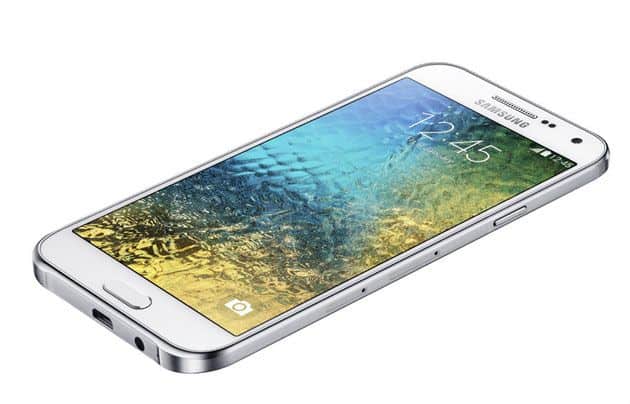
Feel first when on the hands of the Samsung Galaxy E7 it is very thin and lightweight. The weight of the machine is about 141gr and the thickness of the machine is only 7.3mm thin. Machine inherited the design from the Samsung Galaxy Note 4 and Samsung Galaxy Alpha so the machine looks very sturdy.
On the front, the machine is 5.5 ” HD 720x1080pixels resolution. Although the machine owns a 5.5 “screen but due to the thin border design, it is easy to handle and operate with a hand.
The machine still uses Samsung’s familiar Home button and two touch buttons on both sides. The top of the screen is a camera and sensors and no LEDs.
On the right side of the machine is the power button and two two sim slots (one with a sim card or micro sd card), the nano sim. The left is the volume up and down buttons, this button is quite high to operate a little difficult.
Although it has a slim design, the camera on the back does not protrude much more than previous Samsung products. The back has an aided light, camera in the center, and finally a speakerphone.
The dorsal surface of the machine is made of a material that does not stick to sweat and fingerprints.
Screen
The Samsung Galaxy E7 has a 5.5 “screen with HD resolution, using Super AMOLED display technology. The 267 ppi pixel density satisfies the familiar user requirements. Super AMOLED technology makes the display very deep black, and the brightness goes from very low to very high (in outdoor display mode).
Wide viewing angle, due to the characteristics of AMOLED technology, the color of the display is slightly brighter.
Galaxy E7 lacks automatic brightness adjustment. But Samsung has compensated for its outdoor display mode (increasing its brightness to better display better in the sun), but the light sensor is a must-have feature for any mid-range phone. This is also a pity omission.
Display
The Samsung Galaxy E7 comes with a 5.5-inch Super AMOLED screen, giving you 720 x 1280 pixels, so you end up with roughly 267 PPI. Even if that resolution may look a bit modest now, back when the E7 first launched it was pretty normal for mid-range phones ,not something unusual at all.
Super AMOLED has always been one of Samsung’s strong points, and the Galaxy E7 absolutely leans into that. The panel shows lively colors, nice deep blacks, and strong contrast, basically the usual AMOLED signature. So whether you’re streaming videos , gaming for a while, or just scrolling through the web, the overall look stays pleasant and easy on the eyes.
That 5.5-inch footprint is a pretty solid fit for both media time and work type stuff. The display gets bright enough for outdoor use too, but if you’re in direct sunlight you may notice extra reflections and a bit of glare. The viewing angles feel genuinely good, with very little color drift even when you’re looking from pretty off angles. The “lower-res” part can stand out if you’ve used a higher-resolution device before, yet for day to day tasks it still works well enough.
If there’s one real drawback, it’s the absence of Full HD resolution, because that would have made everything look sharper , especially when reading small text or staring at intricate images. Still, when you balance that against the Galaxy E7’s price, the display feels like a fair bargain thanks to its color handling and general screen quality.
Camera
The E7’s main camera has a resolution of 13 megapixels, the front is 5 megapixels and the resolution of the video is Full HD. Except for the resolution, the modes and adjustments in the E7 imaging software are identical to Samsung Galaxy E5.
The sunny morning shots have detail, bright colors flatter the eyes. Slow motion machine, unfortunately the machine does not have manual focus mode that is all auto therefore shoot in the night conditions are difficult to capture.
The E7’s 5 megapixel front camera offers fast shutter speeds, and hand-held shooting with gesture to hand in front of the camera. Samsung also added facial beauty adjustments such as tightening chin, smooth skin or big eyes. Photographs in poorly lit conditions are light and slightly yellowish.
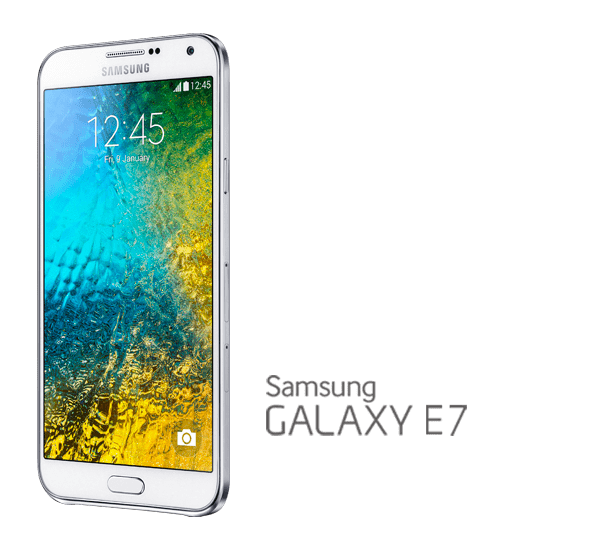
Samsung Galaxy E7 E7000 Blue 16GB Factory Unlocked – International Version GSM Phone: Buy it now
Samsung Galaxy E7 E7000 White 16GB Factory Unlocked – International Version GSM Phone: Buy it now
Performance and battery life
The E7 is a midrange phone, so it also has a midrange configuration, including a quad-core Qualcomm Snapdragon processor of 1.2GHz, Adreno 306 graphics and 2GB of RAM. This configuration works well for basic tasks such as surfing the web, watching online video or playing heavy games.
The Galaxy E7 has a pretty high capacity, 2950 mAh. If you just surf the web or watch movies, the battery life can be up to 8 hours onscreen superior to the Samsung smartphone. If you use a lot of time E7 still meet the day quite comfortable.
Software and User Interface
The Samsung Galaxy E7 comes with Android 4.4.4 KitKat right out of the box, and over that you get Samsung’s TouchWiz UI sitting on top. Back when it was released TouchWiz was kinda famous for its deep customization, plus a big collection of features . Still people also said it was a bit too heavy and occasionally, sluggish , depending on what you were doing.
On the Galaxy E7, TouchWiz feels like a pretty typical Samsung setup, with bright icons, a home screen you can tweak, and plenty of widgets. The interface is mostly easy to navigate , especially if you’ve owned Samsung phones earlier. It also includes things like Multi Window, which lets you use two apps in parallel, and there’s a built-in theme store so you can download and switch looks pretty fast , if that’s your kind of thing.
A major part of the software side is that Samsung bundles its own proprietary apps such as S Health , Smart Manager, and Galaxy Apps. These add useful tools, but they’re also part of what many people call overall “bloatware” on the handset. The good thing is that a number of them can be switched off, if you don’t really care for them.
As for performance, day to day it tends to feel smooth, but you do get random stutters, especially during multitasking or when you jump into apps that are more demanding . This is likely because TouchWiz is pretty resource-hungry, and the hardware isn’t exactly top tier. The 2GB of RAM is enough for normal use, but if you keep too many apps active at the same time, you’ll see some noticeable slow responses.
The Galaxy E7 got an update to Android 5.1.1 Lollipop, and it sort of brought improvements to performance, battery life, plus a more refined TouchWiz, version too . It also added things like enhanced notifications, smoother app permissions management, and a more thoughtful security setup. Still , after that , the device didn’t really get any further major upgrades , so it stayed there on Lollipop. For some people this may be a bit of a downside, especially if you want the most current software updates and the freshest security patches.
Even though it’s kind of stuck on Lollipop, the Galaxy E7’s software kinda delivers a decent everyday experience for users who do not care that much about the very latest features. You still get that familiar Samsung ecosystem, and because Android is usually pretty stable, the whole device feels reliable for daily tasks. But if you’re the type who cares about newest Android capabilities or frequent security updates, you might see it as a limitation.
Connectivity and Audio
The Samsung Galaxy E7 comes with a fairly normal set of connectivity options for its time. You get 4G LTE, so mobile data stays fast, plus 3G and 2G when LTE is not around. It also supports Wi‑Fi 802.11 b/g/n, Bluetooth 4.0, and GPS that uses A-GPS alongside GLONASS, for navigation.
A standout detail here is the dual SIM slot arrangement, which helps if you need to juggle two numbers at the same time. The SIM tray is shared with the microSD card so you have to pick between dual SIM or expanded storage, and yeah both can’t be used together at once.
On the Galaxy E7 the call quality is pretty clear, no real problems with signal reception or audio clarity during calls. The earpiece is loud enough even when you’re in noisy places and the noise cancellation function does its job, it filters out the background noise pretty cleanly.
About the speaker though, on the Galaxy E7 it’s on the rear side of the phone, right beside the camera module. It can get loud for everyday media, and for hands free calls it works fine, but the overall audio quality feels only average, honestly. The sound has little depth and once you raise the volume it can turn a bit tinny, like thin. If you want a nicer audio experience, you’ll be better off with headphones or even external speakers.
Good thing is the Galaxy E7 still includes a 3.5mm headphone jack, which is now becoming less common on modern smartphones. That’s a nice point for people who prefer wired earbuds, without dealing with adapters, or those extra little dongles.
Storage
The Samsung Galaxy E7 arrives with 16GB of internal storage, it was pretty typical for mid range phones back then. Out of the box, the operating system plus pre installed apps take up a slice of that space, so you usually end up with roughly 11GB you can actually use. For light users it may feel ok, but for heavier routines , like installing lots of apps, shooting many photos and videos, or keeping music and other files on the device, that amount might fall short.
Fortunately, the Galaxy E7 does let you add expandable storage with a microSD card , and it can handle up to 64GB. So basically users can bump up their capacity a lot, which makes it less annoying to save more videos photos, and other things ,without constantly stressing about space running out. Of course, there’s a catch as mentioned before: the microSD slot is shared with the second SIM slot, so you end up choosing ,expanded storage or dual SIM functionality.
For most people, the 16GB built in memory plus the chance to add a microSD card should feel pretty ok, but heavier users may have to keep a more careful eye on what’s taking up room.
Competitors
When it launched, the Samsung Galaxy E7 got matched up against a bunch of other mid range phones. A few of the better known ones are
Motorola Moto G (3rd Gen): The Moto G lineup has usually been a tough rival in this price tier. The 3rd Gen model brought a display size that’s close, decent everyday performance thanks to its Snapdragon 410 chipset, and there was also that extra bonus of water resistance. Still, it often offered a smaller internal storage , like 8GB or 16GB, and the camera resolution was a bit lower.
Huawei Honor 4X: The Honor 4X was also fairly popular in the mid range crowd and it offered solid specs. You got a bigger 5.5-inch display , dual SIM support, and a 13MP rear camera. It also had a somewhat larger battery, so in practice it delivered better battery life than the Galaxy E7.
HTC Desire 820, you know, it kind of came in with a bit more muscle than some rivals, with that Snapdragon 615 chipset , and the screen was a bigger 5.5-inch 720p one as well. So overall it felt like a strong competitor, not just a simple “meh” upgrade. It also brought dual SIM support which is always handy , plus a better front camera , so yeah it was pretty tuned for selfie fans. Still though, the HTC Desire 820 was priced a bit higher than the Galaxy E7, so not everyone would be willing to stretch that extra amount.
Sony Xperia C3: This one was pushed pretty hard as a “selfie phone” like really directly marketed that way, and it had a 5MP front camera with an LED flash. It also had a 5.5-inch display and a Snapdragon 400 chipset, which is pretty similar to what you’d find on the Galaxy E7. The main thing that made the Xperia C3 feel different, was honestly that front camera flash, it was for people who care about taking selfies even when lighting gets a little worse.
So in the end, each device had its own bright spots and weak points, but the Samsung Galaxy E7 did manage to stand out thanks to its AMOLED display, its solid build quality, and just… Samsung brand value too. Of course some competitors maybe delivered better performance, or had special features that could easily sway certain users, depending on what they really wanted.
Value for Money
The Samsung Galaxy E7 was priced pretty competitively at launch, positioning itself as an appealing choice for people who wanted a large screen and decent speed without spending too much. It struck a pretty reasonable balance of features for the price, including that quality display, solid battery life, and expandable storage , which is one of those things people tend to notice later.
That said, it wasnt perfect. The plastic build is fine and sturdy, but it misses that premium vibe you get from metal or glass. Also performance was okay for everyday stuff , but when you start leaning into heavier apps it can feel like it falls behind. Plus, it didnt have a Full HD display, and it also missed out on fast charging , and those are areas where the Galaxy E7 generally looked weaker versus several competitors.
Even with these limitations, the Galaxy E7 still managed to land a decent user experience for the people it was aimed at, like those who really liked Samsung’s brand and its software personality, for example TouchWiz and the broad, almost everywhere you look, ecosystem of Samsung applications.
For folks who could live with a few of its weak spots, the Galaxy E7 looked like a solid deal. But once the smartphone scene moved ahead, the device started to feel dated, mostly because fresher and more capable phones showed up for not much more money.
Conclusion
At the time it launched, the Samsung Galaxy E7 felt like a pretty well balanced mid-range smartphone, with a large Super AMOLED screen, a respectable battery routine, and a straightforward software experience that most people could handle quickly. The look and feel, though not exactly revolutionary, was still practical , and it stayed comfortable for daily use. It also seemed to fit a wide mix of users, from casual smartphone owners to people who wanted a dependable secondary phone.
Still, the Galaxy E7 wasn’t flawless. Its performance, while okay for everyday activities, fell behind when you tried heavier apps, especially newer ones. The plastic body , while it was firm and not flimsy, didn’t really give that premium vibe some users might be expecting. The camera was fine when lighting was good, but in darker scenes it struggled, and the software side, although packed with features, ended up weighed down by TouchWiz’s limits , plus the plain fact that major updates eventually stopped.
As the smartphone market kept changing , the Samsung Galaxy E7 had some real trouble in a tight race with other makers that were pushing out devices with more punch while still matching similar price points. Back when the Galaxy E7 debuted , it looked like a great deal , honestly , but over time it got kind of pushed into the background by newer and much more advanced phones.
Looking back , the Samsung Galaxy E7 kind of shows how Samsung was thinking about the mid-range space at that time. It brought a dependable , straightforward smartphone feel for people who liked Samsung’s brand and its whole ecosystem, but it also sort of underlined the difficulties mid-range phones have when they need to stay relevant in a world where smartphones evolve fast, really fast.
If you had the Galaxy E7, it probably turned into a steady sidekick for everyday stuff, and it delivered a balanced mix of capabilities for its era. Now it sits more like a snapshot of the mid-range smartphone market from before , a place that has only become more crowded, and more varied since then.
In short, the Samsung Galaxy E7 was a decent mid-range smartphone for its time , with a good bundle of features, though it couldn’t quite match the speed of innovation in the industry. Because of that , it was a sensible pick for many buyers at launch but later felt better suited for folks with smaller, modest needs or for people who were simply loyal to Samsung and what that meant for them.
Related Posts





Tech Reviewer & Product Analyst
Định Bia has spent over 10 years testing consumer electronics with a focus on smart technology. He work as a product advisor at Biareview where he helped customers find the right devices for their needs. He personally tests every product featured on this site using a consistent evaluation framework covering quality, durability, and value. All reviews are based on experience, not influenced by the manufacturer.