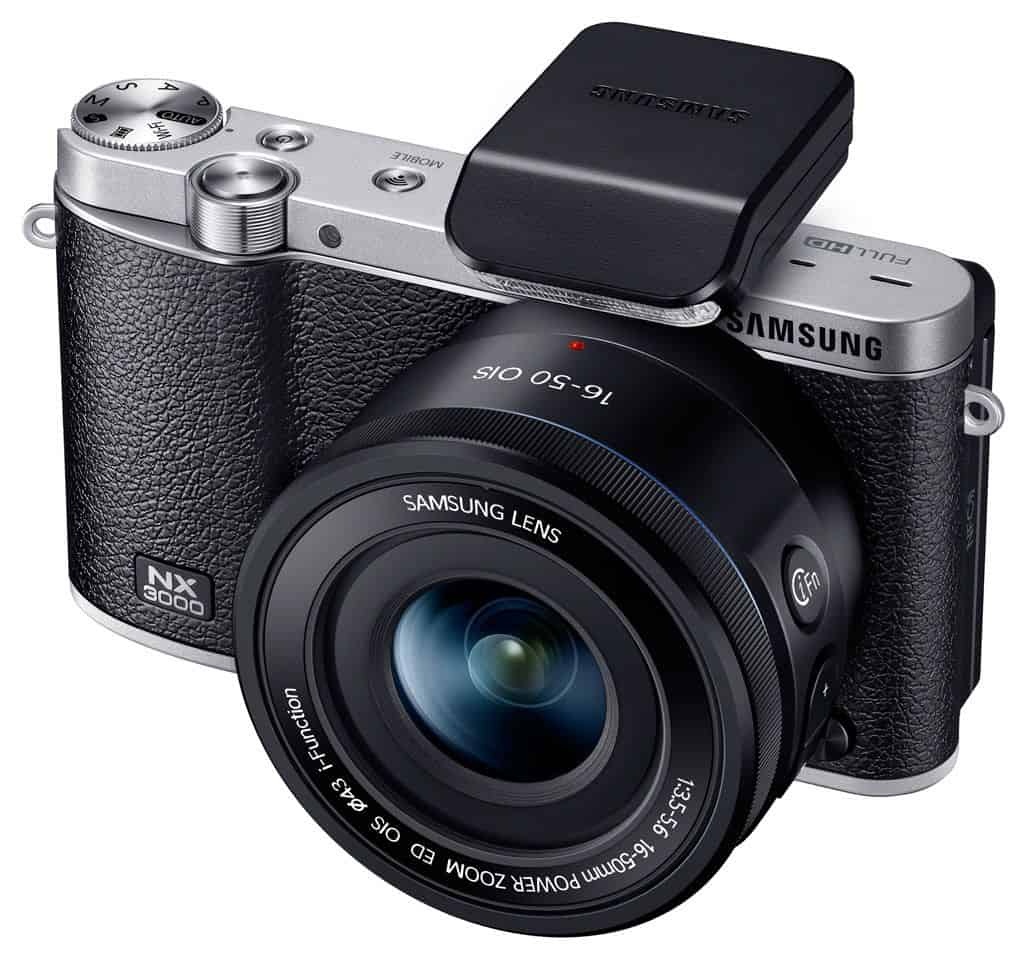
It carries much similarity with that predecessor model, built-in APS-C CMOS sensor that resembles a 20.3-megapixel DSLR like Samsung NX2000. The camera can produce 5 frames per second continuous shooting.
The Samsung NX3000 comes with the flexible flip screen as well as Wi-Fi technology with Tag & Go sharing. Users can transfer multiple images at the same time to their mobile device via Mobile Link, can transfer them to up to 4 devices at the same time via Group Share as well as remote control and capture with Remote View Finder.
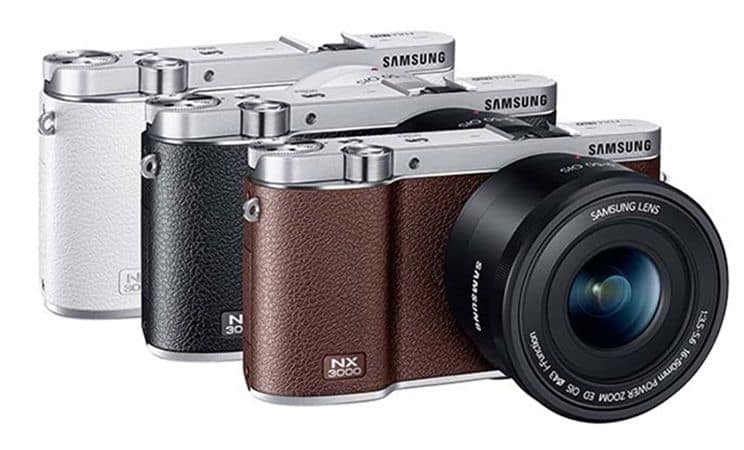
Being a mirrorless model, Samsung NX3000 is compact in size. The design of the machine is classic with black and silver body. Even though made of plastic, it is also light in weight, which makes it easy to hold the camera while shooting oneself with one hand. Although the plastic is made very well, it will feel that the machine is made of steel. Casing made in artificial leather-black leather with slight raised design with design for mirrorless models. These two will easy make the handling more reliable.
NX3000 control system is fairly basic: there are only top section buttons for external power and shutter rotation modes, and a Wi-Fi button allowing the camera to share images or control itself from the device
The camera does not have a viewfinder and built-in flash, but even these things can be attached to the machines by hotshoe. A plus point in the Samsung camera over others is the built-in function button on the lens by which the user can quickly and conveniently change parameters of the machine like ISO, EV, WB, speed, and even the aperture while taking.
The back of the body is a 3-inch screen that has a resolution of 460,800 pixels much lower than its predecessor NX2000. But the screen on the NX3000 compensates for true colors and better visibility outdoors. A further merit of the NX3000 compared to his predecessor is the 180-degree swivel to allow users to take selfies and tricky angles.
Samsung NX3000 Wireless Smart 20.3MP Mirrorless Digital Camera with 16-50mm OIS Power Zoom Lens and Flash (Black): Buy it now
Samsung NX3000 Wireless Smart 20.3MP Mirrorless Digital Camera with 20-50mm Compact Zoom and Flash (White): Buy it now
Samsung NX3000 Wireless Smart 20.3MP Mirrorless Digital Camera with 20-50mm Compact Zoom and Flash (Black): Buy it now
Samsung NX3000 Wireless Smart 20.3MP Mirrorless Digital Camera with 16-50mm OIS Power Zoom Lens and Flash (Brown): Buy it now
Samsung NX3000 Wireless Smart 20.3MP Mirrorless Digital Camera with 16-50mm OIS Power Zoom Lens and Flash (White): Buy it now
Cheaper than the NX2000, the NX3000 uses a 21 point contrast focus system which can be extended to as much as 35 points for close up photography. The results are high contrast subjects, and therefore users will have to resort to using the focus mode to make it work for them. Manual focus augments the viewfinder with an increase of focus area to that specified by the user, 5x or 8x, for ease in the process of focusing. However, focus on the low resolution display of the NX3000 will sometimes make manual focusing a bit difficult for users.
With both JPEG and RAW firing snapshots, it continues to shoot at 5 frames per second using a 20.3 megapixel APS-C CMOS sensor and DRIME IV processor. But if you select both types of image files at the same time, the machine takes 10 seconds to process and then can capture next. Continuous shooting speed is up to 5 fps. The camera works between ISO 100 and 25,600, the highest speed of 1/4000 and the slowest speed of 30 seconds.
The NX3000 is proud of producing good quality images under ISO ratings of 100 through 800 and in good lighting conditions, as ISO 800 and above signals the start of noise levels – for small files, picture quality remains good up to 6400. Only in very low-light situations, where there really is no concern for image quality due to all the broken detail and oversaturated with color in many places, can ISO levels such as 12800 and 25600 be found.
‘Designed specifically for the novices’, says Samsung, ‘NX3000 brings on a full bunch of variety in the shooting modes, allowing the user to snap such tricky situations as exposure and fireworks, among others. Just that it gets easy, rather than tweaking all the supposed-to-be complicated parameters.
All in all, then, it is for users who love to travel a lot and love sharing. And on top of the good prices and features of the integrated technologies, Samsung’s NX3000 also proves a good buy for beginners.
Sensor and Image Quality
The major part of this camera is a 20.3 MP APS-C CMOS sensor on a big sensor, normally within the reach of few the largest sensors in its class. This implies an impressive image quality, with lots of detail, range, and low-light performance at hand. This, even, improves the camera’s ability to capture fine details and sharper images through the absence of an optical low-pass filter.
Colors out of the NX3000 are vivid without looking oversaturated — this is one area Samsung’s processing actually gets right straight out of camera. ISO tops out at 25600, but in practice you’ll want to stay under 3200; past that, noise starts showing up fast.
Lens and Autofocus System
It works with the full Samsung NX mount lineup, so swapping lenses for different situations isn’t a problem. The kit lens is a 16-50mm f/3.5-5.6 Power Zoom ED OIS — compact, light, and covers a decent everyday range. It also carries its own optical image stabilization, which helps with handheld shots at slower shutter speeds.
The camera has a contrast-detection type autofocus system with 21 points for stills shooting and 35 points for shooting video. While slower than a fast action-phase detection system, this autofocus will be good most of the time when adequate lighting conditions are available. So it’s possible to have face detection and subject tracking that would be excellent for portrait as well as moving subjects. The autofocus struggles in low-light situations, running comparatively slower and occasionally hunting.
Shooting performance
Keen scenes shooting in times and modes different from each other; Samsung NX3000 boasts all of that from shooting modes and features. At the top of the camera is four modes for selecting the Program, Aperture Priority, Shutter Priority, Manual, and several scene modes. And besides, the camera has a Smart Auto, which will automatically select settings from the scene being photographed.
Burst shooting takes place at up to 5 frames per second- a reasonable speed for capturing fast-moving subjects in most normal situations. The camera buffer can take quite a few shots before slowing down, with action and candid moments just begging to be caught within those few seconds.
Video Capabilities
The NX3000 shoots Full HD at 30fps, and it’s decent footage — sharp, with colors that look right without much correction needed. The flip-up screen is really the reason to consider this for vlogging: you can see yourself while filming instead of guessing where the frame is. There’s a built-in stereo mic, but no port for an external one, so if audio quality matters to you, that’s a real limitation.
Autofocus during video stays smooth most of the time, though it starts hunting once the light gets low. Nothing here is going to replace a dedicated video camera, but for casual shooting or vlogging, it’s more than enough.
Connectivity and Sharing
Wi-Fi and NFC come built in, which makes getting shots onto your phone or straight to social media painless. Samsung’s SMART CAMERA App — free on iOS and Android — handles the pairing, plus remote control, image transfer, and even lets your phone double as a viewfinder.
There’s also i-Function support: press the button on a compatible lens and you can adjust settings without taking your eye off the shot. Small thing, but it adds up if you shoot a lot.
Battery Life
The BP1130 is rated around 370 shots per charge, which gets you through a casual day but not much beyond that. Worth carrying a spare if you’re traveling or shooting heavily — better than missing a shot because the battery died.
User Interface and Ease of Use
The user-interfacing of the Samsung NX3000 is designed to be intuitive and user-friendly. The menu system is appropriately categorized, with clear-label separated for sections and settings. The 3-inch LCD screen provides a crystal-clear bright display for easy navigation through the menus and to review your images. Its not-so-touch responsive touchscreen allows for rapid adjustments or quick selecting of the focus point, even though it is not as responsive as in other models.
There’s also a set of creative modes buried in the main menu — Panorama, HDR, a handful of scene presets — worth digging into if you want something beyond standard auto shooting.
Pricing and Value
This is what has to be my favorite pricing, and indeed the most attractive, for the Samsung NX3000. Being an entry-level mirrorless camera, the NX3000 balances offers of features as well as performance- quite affordably. It has several of those features normally attributed to the higher-end models: large APS-C sensor, interchangeable lenses, and even wireless; only at a fraction of the cost. This makes this device perfect for starters, enthusiasts, and all those looking for a capable and nifty camera at a budget price.
Comparative Data with Competing Cameras
There is need to
1. Sony Alpha a5100:
Another contender for the NX3000 is the Sony Alpha a5100. This mirrorless camera is a real eye-catcher because of its 24.3 MP APS-C sensor, very quick hybrid autofocus here with 179 phase-detection points, and tilting touchscreen. Since pretty much of the a5100’s superiority is in its autofocus and slightly better resolution, they’ll miss on the retro design and physical controls that some users would like in the NX3000.
2. Canon EOS M10
It is a super-simple compact camera. The 18 MP APS-C sensor, tilt-screen mirrorless camera and built-in Wi-Fi, are all features of a Canon EOS M10. It can be compared to the NX3000 as far as image quality and connectivity because they are all straightforward with a fewer number of physical controls and less complicated design. Probably a good choice for those who want an easy, carry-around camera but will sacrifice advanced features and manual control in the camera.
3. Fujifilm X-A2:
The X-A2 is another entry-level mirrorless camera — 16.3MP APS-C sensor, tilting LCD, Wi-Fi built in, nothing unusual there. What sets Fujifilm apart is its film simulation modes, which mimic the color response of actual film stocks. Shoot in Velvia and you get punchier saturation; shoot in Classic Chrome and colors go muted and understated. It’s a real edge over other brands, not just a marketing line. Moreover, the image quality from the X-A2 is quite good, and it has a somewhat comparable retro design making it to compete highly against the NX3000.
Pros and Cons
Pros:
Retro Design: The NX3000 has a retro-style design with its faux leather texture and compact form factor, making it look good and easy to carry.
Image Quality: The 20.3MP APS-C sensor gives excellent detail, dynamic range, and low-light performance.
Flip-Up LCD Screen: The perfect 3-inch-tips screen creates opportunities for selfies, vlogging, and shooting from several angles.
Built-in Wi-Fi and NFC: For easy sharing and control from a distance, improvement to the user experience features within the camera.
Affordable Price: Balanced feature set and performance at an accessible price tag.
Cons:
Focus in Low Light: The contrast-detection autofocus has a tendency to slow down and hunt in very low light.
No external microphone input: Would be for those who want to record high quality audio integrated to video would find this a disadvantage.
Battery Life: Though good, battery life would require heavy users and travelers to carry an extra battery.
The Conclusion
The NX3000 holds up as an all-arounder, retro styling, compact body, and enough features to work for beginners, enthusiasts, or anyone shooting casually day to day. The 20.3MP APS-C sensor delivers good image quality for the class, and the flip-up LCD is a real plus if you’re into selfies or vlogging. Wi-Fi and NFC round things out, making it easy to get photos off the camera and onto your phone or social media without much hassle.
The trade-offs are real: low-light autofocus struggles, and there’s no external mic input if you’re serious about video. Still, for the price, it delivers more than it has any right to.
Related Posts


Tech Reviewer & Product Analyst
Định Bia has spent over 10 years testing consumer electronics with a focus on smart technology. He work as a product advisor at Biareview where he helped customers find the right devices for their needs. He personally tests every product featured on this site using a consistent evaluation framework covering quality, durability, and value. All reviews are based on experience, not influenced by the manufacturer.