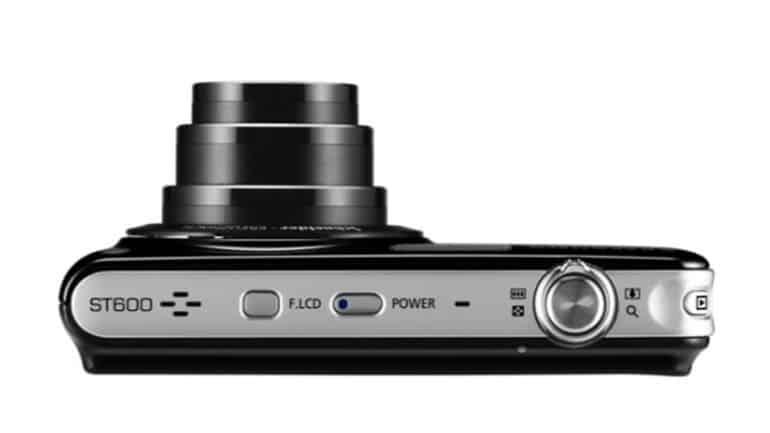
The Samsung ST600 incorporates state-of-the-art imaging technologies, including dual-screen display and touch sensor technology to provide a stylish new look for the owner.
The front of the camera looks quite right-angled, most noticeable is the 1.8″ front screen.
The back of the machine does not have any adjustment button, you adjust directly through the touch screen.
The body thickness is quite thin, but the size is slightly larger than the conventional model-shooting.
Large rear LCD display. The top of the machine is still the basic adjustment buttons. Zoom button integrated with capture button.
Built-in lithium-ion battery and microSD memory card. The 1.8-inch LCD is well suited for align and child photography.
USB cable and adapter attached to the machine to charge the battery.
The Schneider lens uses a 5x optical zoom lens.
Samsung DualView ST600 14.2MP Compact Black Digital Camera: Buy it now
Overview
The ST600’s whole pitch is a second screen bolted onto the front, aimed squarely at people who take a lot of selfies and group shots. Take that away and it’s a fairly ordinary compact — the dual screens are what actually justify a second look.
Design and Build
Slim, rounded edges, easy to hold, slides into a pocket without complaint. Nothing about the shape gets in the way of just carrying it around.
Two screens is the story here. The rear one’s 3.5 inches, 1,152,000 dots — bright, clear, good for previewing shots and working menus. The front one’s smaller, 1.8 inches, and exists for exactly one reason: so you can see yourself while framing a selfie, or check that everyone actually made it into the group photo instead of guessing and hoping.
Build mixes metal with decent plastic. Feels solid, buttons sit where you’d reach for them.
Key Features
14.2-megapixel CCD sensor — CCD was already behind CMOS by this point, but it’s enough for casual shots. 27mm wide-angle lens, 5x zoom, covers wide landscapes through to closer details without much trouble.
The front LCD really is the whole reason to buy this over something else. See yourself while shooting, frame a selfie properly, make sure nobody’s cut out of frame — in a sea of otherwise similar compacts, that’s what sets it apart.
Video caps at 720p, fine when this camera launched, looking dated next to 1080p or 4K now. Autofocus and digital stabilization keep footage from looking too shaky.
The rear screen’s touchscreen, so you’re tapping through menus instead of hunting for the right button combo. Physical buttons still handle power, mode, zoom.
Face detection keeps faces sharp and exposed right. Smile shot fires on its own when it catches a smile — useful for candid shots where a manual shutter press is always a beat too late.
Scene modes — Portrait, Landscape, Night, Macro — adjust settings automatically. There’s also a filters mode and Picture-in-Picture for anyone who wants to mess around.
Storage’s standard SD/SDHC. No Wi-Fi, no Bluetooth — you’re transferring by USB or card reader, normal enough for the time, dated now.
Performance
Image quality holds up for its era — sharp, accurate colors, decent dynamic range in good light. Push into low light or crank the ISO and noise and softness show up fast, same as most cameras this size.
Autofocus is contrast-detection: solid in good light, less sure of itself with fast movement. Shutter speed range covers most everyday scenes fine.
Low light is where it falls apart. Small CCD sensor, modest lens — noise climbs quickly once the light drops. Flash or a longer exposure helps some, but this was never built for shooting after dark.
Battery gets through a normal day of casual shooting. Anything heavier and you’ll want a spare.
How It Stacks Up
The Samsung ST100 runs the same DualView idea, dual screens included, though its front screen has a bit more resolution and a different shape. Image quality’s about the same between the two.
The Canon PowerShot SD3500 IS skips the front screen entirely, but it’s got a stronger DIGIC 4 processor, better low light, and Wi-Fi built in for sharing — a real trade depending on what you actually want out of the camera.
The Nikon Coolpix S80 also drops the front screen in favor of a 3.5-inch touchscreen, with similar image quality and HD video on top.
Bottom Line
If selfies and group shots are what you actually shoot, the front screen alone is worth the tradeoff — nothing else here beats it on that specifically, and everything else about the ST600 is competent without being exceptional. Low light isn’t its strength, there’s no Wi-Fi, and even at launch in 2010 it wasn’t cutting-edge. But for what it’s built to do, it still does it.
Related Posts


Tech Reviewer & Product Analyst
Định Bia has spent over 10 years testing consumer electronics with a focus on smart technology. He work as a product advisor at Biareview where he helped customers find the right devices for their needs. He personally tests every product featured on this site using a consistent evaluation framework covering quality, durability, and value. All reviews are based on experience, not influenced by the manufacturer.