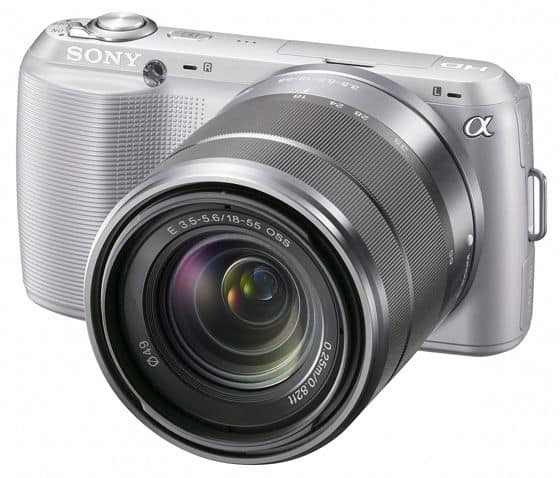
If the Sony NEX-5 has a rugged design with a fairly large and square grip, Sony NEX-C3 is softened with a slim slim profile and a curved, palm-shaped grip. The NEX-C3 also drops the boxy edges of the NEX-3/5 for a rounded body. Dimensions are nearly identical — 110 x 60 x 33mm versus the NEX-5’s 111 x 59 x 38mm — but the rounded shape makes it feel noticeably smoother in hand. It’s lighter too, at 225g compared to the NEX-5’s 269g.
In addition to the exterior design changes, Sony also changed some of the joystick controls on the NEX-C3. The most important change in the NEX-C3 is thinner than the NEX-5’s that Sony has incorporated a shutter button into the trigger switch to save space and create a stylized curve for the slit. In addition, two keys adjust the edge of the screen is also collapsed to help users more airy when using.
In addition, the company also brought the recording mic from the roof of the machine NEX-5 forward near the lens at C3. This makes the sound more clearly recorded during filming.
Sony Alpha NEX-C3 16 MP Compact Interchangeable Lens Digital Camera Kit with 18-55mm Zoom Lens (Black): Buy it now
Sony Alpha NEX-C3 16 MP Compact Interchangeable Lens Digital Camera Kit with 18-55mm Zoom Lens (Silver): Buy it now
Sony Alpha NEX-C3 16 MP Compact Interchangeable Lens Digital Camera Kit with 16mm F2.8 Wide Angle Lens (Black): Buy it now
Even Sony’s traditional battery and memory card locations have changed. Instead of the memory card and the battery being placed in the same place, Sony’s C3, Sony separates into an SD / MS memory card slot and a separate battery slot. This can be explained by the fact that Sony wants the user to be more comfortable with the separate NEX-C3.
In addition to the above design changes, the Sony NEX-C3 basically does not differ much from the NEX-5’s advanced features such as sensor size, processor chip technology. Image, ISO sensitivity, 3 “LCD screen capable of flipping at the same resolution of 921,000 pixels, using the same battery NH-FW50 … Even the shooting modes such as A, S, M, Sweep panorama … also Like the Picture Effect and Focus Peaking of the NEX-C3 also unchanged compared to NEX-5 (using firmware ver.04).
The only point that makes NEX-C3 more prominent than the NEX-5 is the resolution of up to 16.2 Megapixel sensor.
Key Features
16.2MP APS-C sensor. This is the NEX-C3’s real advantage over compact cameras — it’s the same sensor size found in many DSLRs, which translates to better detail, dynamic range, and low-light performance than you’d get from a smaller sensor.
BIONZ processor. Handles noise reduction, color processing, continuous shooting, and startup speed alongside the sensor.
Interchangeable lenses. The E-mount system opens up primes, zooms, macro, and wide-angle options — the biggest thing separating this from a fixed-lens compact.
Full HD video. 1080i at 60fps, or 720p at 30fps, with continuous autofocus during recording and a dedicated movie button.
Picture effects. Toy Camera, Pop Color, Posterization, Retro Photo, High-Key, Partial Color — built-in looks if you want a stylized shot without editing later.
Sweep Panorama. Sweep the camera across a scene and it stitches the shots together automatically.
Intelligent Auto and Scene Selection. Intelligent Auto reads the scene and picks settings automatically — good for beginners. Scene modes (Portrait, Landscape, Macro, Sports, Night) give more targeted control when you know what you’re shooting.
Performance
Autofocus is contrast-detection, with single-shot, continuous, and manual modes. It’s fast and accurate in most lighting, for both stills and video.
Continuous shooting tops out at 5.5fps enough for casual sports or action shots, though not fast compared to dedicated sports cameras.
The image quality looks quite good. The APS-C sensor along with the BIONZ processor brings out fine detail. Colors also seem right, and the dynamic range feels dependable. In darker scenes, it stands out. The camera can go from ISO 100 up to 12800. The larger sensor helps keep noise from getting too obvious, even when the ISO is high. There is also a pop-up flash if you need more light.
Colors look true to life
Skin tones in particular look natural. White balance stays steady when the lighting changes.
Video quality is close to what you’d get from a dedicated camcorder sharp, detailed footage with continuous autofocus and manual exposure control while recording. Stereo sound recording is a nice touch here too.
User Experience
The menu system is simple enough for beginners to pick up quickly, and the rear LCD is responsive for adjusting settings or reviewing shots. Customizable function buttons make frequently used settings quicker to reach.
Battery life is rated around 400 shots per charge — better than average for this class, though a spare is still worth carrying for longer trips.
Connectivity covers USB 2.0 and HDMI, plus an accessory port for a microphone or electronic viewfinder. There’s no built-in Wi-Fi or Bluetooth, so wireless sharing isn’t an option.
Pros and Cons
The APS-C sensor is a strong point. It gives clearer images than most small cameras in the same category. The ability to swap lenses also lets you shape your shots in more ways. The screen that tilts helps too, and the Full HD video adds more options. The body is also easy to carry, so it works well for daily use. There are a few gaps. You do not get a built in viewfinder, so bright midday glare can make shooting feel harder. You also cannot use a wireless setup, so sharing shots on the go takes more effort. The battery lasts well, but it is wise to pack a spare just in case.
Comparison with Competitors
The NEX-C3 stands out from many other small mirrorless cameras thanks to its APS-C sensor. In low light, it usually shows cleaner results. It also keeps more visible detail in both dark areas and bright areas than several models in its class.
Another point is the lens system. The camera lets you swap lenses, so you can adjust focal length as you shoot. You can also move to new lenses later. A compact with a built lens cannot offer that kind of flexibility.
Some rivals add extras like an eye-level viewfinder, touch control, or Wi-Fi. The NEX-C3 skips those. You will have to decide if you can live without what those cameras include.
Bottom line: the NEX-C3 gives solid photo quality in a light body. The interchangeable lenses help it match what you want over time, especially as you learn. The two main downsides are the missing viewfinder and the lack of simple wireless sharing. Even with those trade-offs, it makes sense if you are leaving a basic compact behind and you do not want a large DSLR.
Related Posts


Tech Reviewer & Product Analyst
Định Bia has spent over 10 years testing consumer electronics with a focus on smart technology. He work as a product advisor at Biareview where he helped customers find the right devices for their needs. He personally tests every product featured on this site using a consistent evaluation framework covering quality, durability, and value. All reviews are based on experience, not influenced by the manufacturer.