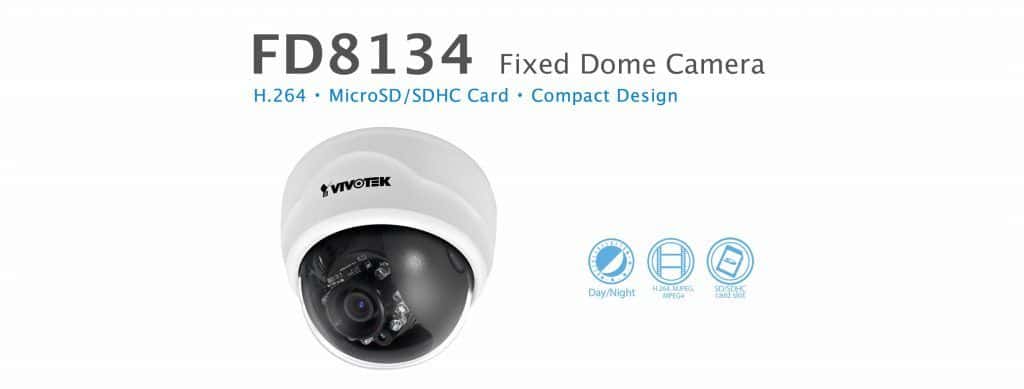
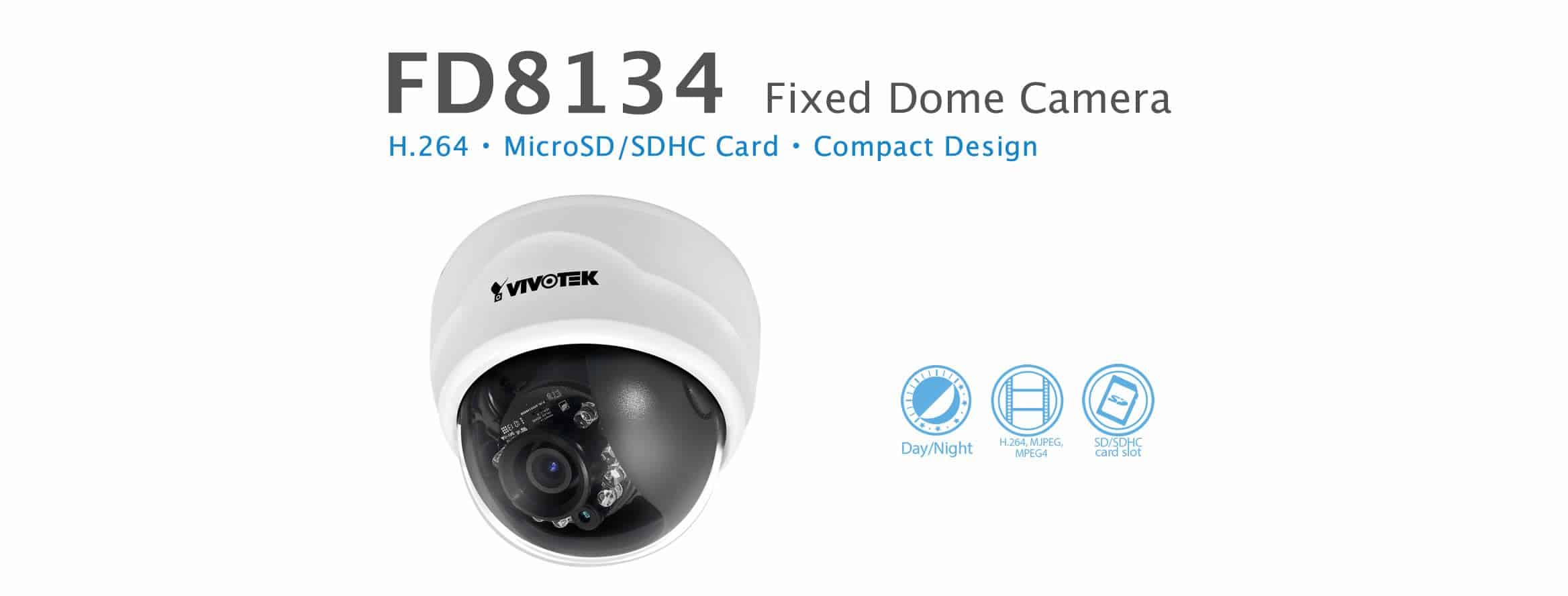
With the Vivotek FD8134 fixed-mount IP camera, a high-resolution sensor for clearer images, you can be sure of peace of mind when monitoring and protecting your office or home.
Vivotek FD8134 is a fixed dome design, suitable for wall or ceiling mounting for indoor surveillance purposes. The FD8134 utilizes a 1/4″ CMOS image sensor supporting up to 1280×800 pixel resolution, 4-channel video transmission in H.264, MJPEG, MPEG-4, and 30 fps.
Camera base of black metal, can be opened easily by hand.
Plastic camera cover with transparent top surround, detachable from the stand base.
Lid inside the lens protection.
The f / 1.8 aperture focal-length lens has a fixed focus of 3.6mm, with a built-in 8 infrared LEDs (within 10m of operating range), incorporating an infrared autofocus lens for functional use. Rotate day and night, adjustable up and down thanks to two screws on both sides.
MicroSD / MicroSDHC card slot for image and video storage.
The communication interfaces of the camera are externally wired by an I / O cable, power port (12V adapter included), ethernet port and grounding wire.
Vivotek FD8134 Surveillance/Network Camera Color – CMOS – Cable: Buy it now
Vivotek FD8134V H.264 Vandal-proof IP66 Dome Network Camera: Buy it now
Design and build
The FD8134 is a small dome camera with a low profile. It doesn’t draw attention, which is what you want in an office, a shop or a hallway at home.
The housing mixes plastic and metal, and the bracket adjusts enough to aim the camera properly. It’s built for continuous operation rather than looks, and it feels solid enough for that.
Specifications
| Sensor | 1/4″ progressive scan CMOS |
| Max resolution | 1280 x 800 (1 MP) |
| Lens | Fixed 3.6 mm, about 73° horizontal |
| IR range | About 10 m (32.8 ft) |
| Compression | H.264, MPEG-4, MJPEG, multi-streaming |
| Power | PoE |
| Weather rating | IP66 (see note below) |
At 1 MP you can recognize a person at a reasonable distance, though not much further. Progressive scan keeps moving subjects from smearing. The 3.6 mm lens is a touch narrower than on some similar cameras, but it still covers a normal room or shop floor. You can’t zoom, so plan where you mount it.
At night the camera switches to IR by itself. Ten meters is enough for a corridor, a storeroom or a front door.
Multi-streaming lets you record at full resolution while sending a lighter H.264 stream to a phone or a slow link.
Setup and daily use
Installation is simple mostly because of PoE: one Ethernet cable carries power and data, so you don’t need an outlet near the camera. That matters when you’re putting up several cameras across a business. Vivotek’s installation guide is clear enough for someone without much technical background.
Everything is configured in a browser, and there are iOS and Android apps for live view, playback and settings. Access is password protected, and the stream can be encrypted with SSL/TLS. Change the default password before anything else.
Software
Vivotek’s software covers the basics. You can set recording schedules, manage several cameras from one screen, and get notified when something triggers an alarm. The motion zones are the most useful part: draw a box around the doorway, and a tree swaying at the edge of the frame won’t wake you up at 3am. Recording can be continuous, scheduled or triggered by motion, to local or network storage, and you can search recordings by time or event.
That covers the basics well. There’s nothing beyond motion detection, though, so if you need smarter analytics, look at other models.
Strengths and weaknesses
What it gets right is the stuff you’d actually use every day. The 1 MP picture is clear enough to see who’s at the door, the night vision works, PoE keeps the wiring simple, and you can check it from a browser or your phone without fuss. The IP66 housing is a nice extra.
Where it falls short is anything beyond that. You can’t zoom, and next to newer cameras the resolution looks noticeably dated. Motion detection is the only analytics it has. If you’re planning to plug it into a third party system, expect more hassle than you’d get with Axis or Dahua.
Compared with competitors
Vivotek FD8136. Its closest sibling. It records at 1280 x 1024 (1.3 MP), uses the same 3.6 mm lens with a slightly wider view, and handles low light a bit better. Motion detection and integration with Vivotek’s software are also improved. If night footage or a little more detail matters, it’s worth the step up.
Axis M2025-LE. It records at 1080p, covers 110° instead of 73°, reaches further with its IR, and handles low light better. Axis software is more capable and works with more third party systems. It costs more, but you may need fewer cameras to cover the same area.
Dahua IPC-HFW4231E. This is the one to look at if you need more than the basics. At 4 MP (2560 x 1440) it picks up far more detail, and the motorized zoom lets you tighten the view after the camera is already on the wall, which the Vivotek can’t do. Its IR reaches further, it has more analytics, and it plays better with video management systems. It’s also the priciest option to set up properly.
Who it’s for
For a home, it’s plenty. Point it at the front door or the driveway and forget about it. It’s small enough that visitors won’t really notice it.
It also makes sense for a small office or shop. PoE helps a lot here, because you can run a few cameras off one switch without an electrician.
On a large site, though, the fixed lens and 1 MP resolution start to hurt. You end up adding cameras to fill the gaps, and at that point a better model is usually cheaper overall.
Verdict
The FD8134 is an unexciting camera that does its job. It’s easy to install, simple to manage, and produces usable footage day and night at a reasonable price. If you need zoom, more resolution or real analytics, pay for a better camera. If you need to watch a few doors and rooms without a complicated setup, it’s a sensible choice.
Related Posts


Tech Reviewer & Product Analyst
Định Bia has spent over 10 years testing consumer electronics with a focus on smart technology. He work as a product advisor at Biareview where he helped customers find the right devices for their needs. He personally tests every product featured on this site using a consistent evaluation framework covering quality, durability, and value. All reviews are based on experience, not influenced by the manufacturer.