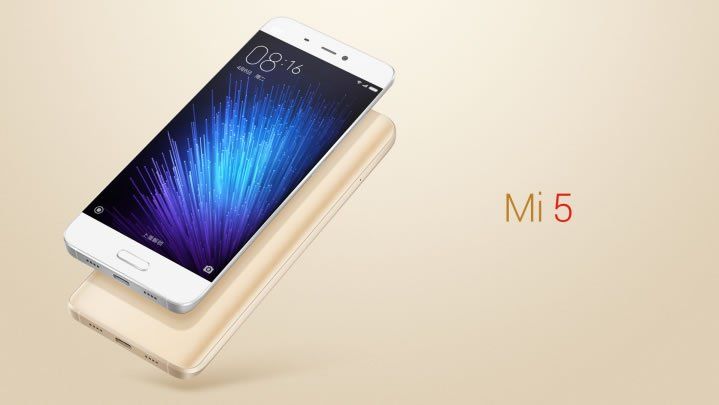
Design
The Xiami Mi 5 uses a 2.5D glass lens similar to the Samsung Galaxy S7 with a bezel around the curved screen. This 2.5D curved glass is not only aesthetically pleasing, it also makes the fingertip easier to touch with the thumb in the rim area when used naturally. Unfortunately, the machine is not equipped with dust and water resistance.
The physical Home button on the Xiaomi Mi 5 supports touch functions. So, just tap this button to return to the Homescreen without having to press it hard. This will help the Home button not paralyzed by too many clicks. What many iPhone users, the iPad is always worried. In addition, the speed of fingerprint reading is very impressive with extremely short time. Besides, the ultra-thin screen border, overflowing to the edge of the machine is also a very attractive design element.
The left side of the aluminum metal frame is a dual SIM card slot.
Mi 5 has two types of back is glass and ceramic. The back of the ceramic is very beautiful, hard, high durability, good resistance to impact. Ceramic back is only available on 128 GB and the back cover is available in more colors including black, white and gold. One design advantage of the Xiaomi Mi 5 is the rear camera does not protrude. That can easily be seen on the table and many users will be satisfied. If the camera protrudes overall design becomes patchwork, the camera does not protrude on the Mi 5 makes the device seamless, complete and defective.
Power and volume keys are located on the right side of Xiaomi Mi 5.
Screen
The Xiaomi Mi 5 can perfectly satisfy a lot of users with sharp resolution, high brightness, brilliant color reproduction, despite the fact that it only supports Full HD resolution.
Xiaomi’s new flagship is equipped with 5.1-inch LCD resolution. Thanks to the LED backlight, the maximum brightness of this screen can be up to 600 cd / m2.
Display
The Xiaomi Mi 5 comes with a 5.15-inch IPS LCD screen , resolution is 1080 x 1920 pixels, so you end up with a pixel density close to 428 PPI. Back when it was released, lots of flagship phones were already drifting toward Quad HD , like 1440p displays, but Xiaomi decided to stay with Full HD. Maybe it was done to keep performance steadier , help battery life, and also hold the cost down. Honestly, this kind of “good enough” tradeoff is something a lot of users tend to like.
On the Mi 5, the display really is one of the stronger perks. The IPS LCD panel manages vibrant colors, solid blacks , and pretty good viewing angles, so it still looks decent even when you’re not staring straight at it. Brightness feels strong too, and the screen stays readable even when you’re out in direct sunlight. Xiaomi also throws in features like Sunlight Display which adjusts contrast and brightness automatically, based on the light around you, which makes outdoor use a little less annoying.
Color handling is also pretty commendable. The panel covers a broad color gamut, and colors look natural rather than overly loud. If you like things more saturated or maybe a touch warmer , there are settings for color temperature and saturation tweaks too. There’s also a Reading Mode , this one cuts down on blue light, so prolonged use feels easier on the eyes. It’s a small add-on but it makes sense, especially for people who read a lot from the phone.
Even if the Mi 5 doesn’t offer the same crisp detail as some Quad HD rivals, it’s still more than enough for daily life. Text is sharp, images are clear, and video looks lively. And sticking to Full HD helps in another way: it eases the burden on the GPU, which can mean smoother performance overall and better battery endurance.
Software
Xiaomi Mi 5 supports 2 ROM versions including Chinese ROM with Play Store installed and other ROMs that support better Google applications. Therefore, users should pay attention when shopping.
Mi 5 works on Android 6.0 Marshmallo interface MIUI 7. This interface reaches 175 million active users regularly. This interface was developed by a group of 750 developers. MIUI is one of the most updated interface on smartphones today.
Performance
Mi 5 works fast and delivers a great gaming experience to the user and is no stranger to the Samsung Galaxy S7. However, Mi 5 again caught many nasty software bugs. Hopefully, future software updates will fix these problems.
The Snapdragon 820 integrated processors in the Xiaomi Mi 5 are, sort of arguably, among the fastest microprocessors in 2016. It gets used on plenty of the older phones, from older makers, like LG with the LG G5 and also Samsung with the Galaxy S7. Mi 5 uses a lot of new features of this chip including a chip that specializes in image processing.
The internal memory on the Xiaomi Mi 5 is also enhanced with the Samsung Galaxy S6’s UFS 2.0 technology. This technology has a speed of 450 MB / s which allows applications to open up much faster.
Xiaomi Mi 5 Dual Sim 4G (Gold, 32GB) – International Version, No Warranty: Buy it now
Camera
Meanwhile, the camera function of Mi 5 is not working as expected. At ideal conditions photos from Mi 5 is quite detailed but under other conditions the image quality is average. The compensation point is that the camera supports optical anti-vibration to make the video smooth, with less vibration. Optical anti-vibration on the Mi 5 operates in 4 axes: 2 horizontal, 2 vertical.
The Mi 5 camera sensor uses the Sony IMX 298 sensor, which supports DTI Pixel to Pixel technology to clarify different areas of color at the same time. Not only that, Qualcomm’s image processing chip will run in the background, processing the image in real time at fast speed. Users will feel the effect of taking self-portrait shots with the 4 megapixel front camera.
Pin
Mi 5 integrated charging technology. With just one hour of charging, the device will have enough power to operate throughout the day to meet the needs of the user. USD Type C connector is convenient, plug in both directions. Basically, the 3,000mAh battery capacity of the machine has fulfilled the task well.
Software and User Interface
The Xiaomi Mi 5 runs on MIUI , Xiaomi’s own custom Android based operating system. When it came out, the Mi 5 shipped with MIUI 7, which was tied to Android 6.0 Marshmallow. Still , Xiaomi has a pretty solid history of rolling out software updates, and the Mi 5 kept getting them, step by step, until it was upgraded to MIUI 10, on top of Android 8.0 Oreo. MIUI is basically famous for a very heavily customized user interface , it strays a lot from stock Android , not just in design, but also in features, and day to day user experience.
MIUI Overview
MIUI is a feature packed and visually different interface, that leans hard into personalization, and everyday functionality. The overall look tends to be tidy, bright, and kind of packed with options, so a lot of people really like it if they enjoy adjusting tuning and basically making the device feel “theirs”. One of the most visible gaps between MIUI and stock Android is the lack of an app drawer, instead apps just go straight onto the home screen, in a way that feels a bit like iOS. At first, that can be awkward for users coming from stock Android, but it’s manageable, especially when you use folders so the home screen doesn’t turn into a chaos zone.
On top of that, Xiaomi has added a set of customization tools, so you can swap themes, icons, fonts, and even wallpapers depending on your mood. The MIUI Theme Store gives you a lot of choices, free and paid too, and some themes can completely reshape the vibe of the interface. That sort of flexibility is really one of MIUI’s biggest strengths, because it lets users craft a distinct experience, something that can mirror their own style, day after day.
Pre-Installed Apps and Bloatware
One thing about MIUI that might seem less charming to a few users is the whole pre-installed apps situation, usually called bloatware. On the Xiaomi Mi 5, there are quite a bunch of Xiaomi’s own apps already there, things like Mi Music, Mi Video, Mi Remote, and Mi Store. Then, there are also a handful of third party apps that get placed on the device ahead of time. For sure some of them end up being handy, and even bring extra functionality, but for other people they can feel redundant, or just plain not needed.
Good news though, Xiaomi basically lets you uninstall, or disable many of those pre-installed apps. That means you can reclaim usable storage and sort of tidy up the phone without too much hassle. On top of that , Xiaomi keeps updating the MIUI system, and it often brings fresh features plus small improvements that come from actual user feedback. This steady software attention sort of helps ease some concerns about bloatware, because people can still expect the overall experience to keep shifting, and getting better, over time.
Performance and Optimization
MIUI is basically tuned to run really well on Xiaomi hardware, and the Mi 5 doesn’t really get treated differently. The UI feels smooth, quick to react, with animations and transitions that come across as fluid, polished , and not laggy. Xiaomi also added a handful of performance oriented aids inside MIUI like RAM optimization, power management utilities, and a bunch of app management options, which together help keep the whole setup efficient.
A big highlight is the Security app, it brings together a range of tools meant for keeping the device in shape, more like streamlining rather than just “cleaning”. Inside you’ll find things such as a system cleaner, virus scanner, battery saver, and a permissions manager, plus a few other utilities. The idea is simple: help the user keep things running fast, and make sure it stays that way over longer periods.
When it comes to software updates, Xiaomi has been somewhat steady with Mi 5 updates, though the schedule and release timing can shift depending on region, or even the local carrier. Also, MIUI updates don’t follow Google’s Android update rhythm, so a Xiaomi device might still get MIUI updates with fresh features and upgrades, even if it isn’t on the newest Android version.
User Experience and Usability
The overall vibe of the Xiaomi Mi 5 is pretty positive and MIUI brings a nice mix of customization , practical tools and sturdy performance . The day to day interface feels approachable , with a layout that makes sense, and navigation that is usually intuitiveme, like it just flows. You can use it without thinking too hard , the screens in general give off a bit of a iOS like feel , only with its own spin. Still, if someone is new to MIUI, there can be a small learning curve, mainly if they were coming from stock Android , or from a different brand’s skin. Once users get past that initial step though , they often end up liking the extra options and the more tailored touches MIUI adds.
What I like most is how MIUI pays attention to the little details and tries to stay user focused. Xiaomi includes a bunch of thoughtful add-ons, for example Dual Apps , which lets you run two instances of the same app, that is handy if you want to keep a personal profile apart from a work one. There’s also Quick Ball, a floating shortcut menu that gives easy access to frequently used functions. And Second Space basically helps you build a separate , more private environment on the phone so sensitive stuff is kept away from the main setup.
MIUI also comes with a fairly complete security toolkit. You get things like app lock, privacy protections, and a secure folder for files you really don’t want visible. The idea is to help users keep more control over their data and privacy, and honestly that matters a lot these days, with everything so connected and always online.
Connectivity and Extras
The Xiaomi Mi 5 has a fairly wide bunch of connection choices, like 4G LTE support, Wi-Fi 802.11 a/b/g/n/ac , Bluetooth 4.2 and even NFC, so yeah it covers most everyday needs. It also runs on dual SIM in a way where two SIM cards can be active at the same time, which is pretty handy for folks who travel often or simply want to keep a work line and a personal line apart.
Also, the infrared blaster feels like a nice extra , because it lets the Mi 5 act like a kind of remote control for a lot of home devices, including TVs , air conditioners , and set-top boxes. With the Mi Remote app it is pretty straightforward to pair, set up, and then control those gadgets, giving the phone that extra practical layer.
Then there is the fingerprint scanner, built right into the home button on the front face. It tends to be quick and reliable, so unlocking happens fast and in a more secure way. Beyond opening the phone, the fingerprint sensor can be used for payment authentication, entering protected apps, and doing other security focused actions.
One spot where the Mi 5 kind of misses the mark is water and dust resistance. A bunch of other flagships from roughly the same period, like the Samsung Galaxy S7, had IP-rated protection, but the Mi 5 does not. So if you are often out and about where the phone might get splashed, or exposed to gritty conditions , this is worth keeping in mind.
Audio and Multimedia
The audio experience on the Xiaomi Mi 5 is decent, though it might not feel as jaw-dropping as some of its rivals. There’s a single speaker, placed at the bottom of the device, it puts out clear, loud sound, still… when you hold it in landscape mode the sound can get a bit muffled, not always, but often enough to notice. Overall the speaker gives balanced audio and there’s a reasonable level of bass, yet it doesn’t quite reach the depth and richness you get from phones with stereo speakers.
If you mostly like music through headphones, the Mi 5 does include a 3.5mm headphone jack, and honestly that’s getting more uncommon in newer smartphones. Through the wired setup the audio comes out good, with clear mids and highs and a bass response that feels adequate. On the software side, Xiaomi has bundled some audio tuning extras in MIUI like an equalizer, and it also supports high-resolution audio formats, so for people who care about that it’s a nice little bonus.
When it comes to video playback, the Mi 5’s screen is really the thing that stands out the most. The 1080p resolution and those vibrant colors make watching videos, movies, kind of enjoyable in a way that feels natural. The brightness holds up well outdoors too, and the viewing angles are wide enough that the picture stays nice even if your perspective shifts a little bit. The device can handle a range of video formats and codecs too, so most media types play without needing a third party app, which is convenient in day to day use.
Conclude
When comparing features, the Xiaomi Mi 5 may be inferior to many other super brands like LG G5 or Galaxy S7. But at a very competitive price, the flagship from Xiaomi will attract a lot of users. Especially when this brand has scored some impressions by the quality equipment, reasonable price.
Related Posts




Tech Reviewer & Product Analyst
Định Bia has spent over 10 years testing consumer electronics with a focus on smart technology. He work as a product advisor at Biareview where he helped customers find the right devices for their needs. He personally tests every product featured on this site using a consistent evaluation framework covering quality, durability, and value. All reviews are based on experience, not influenced by the manufacturer.