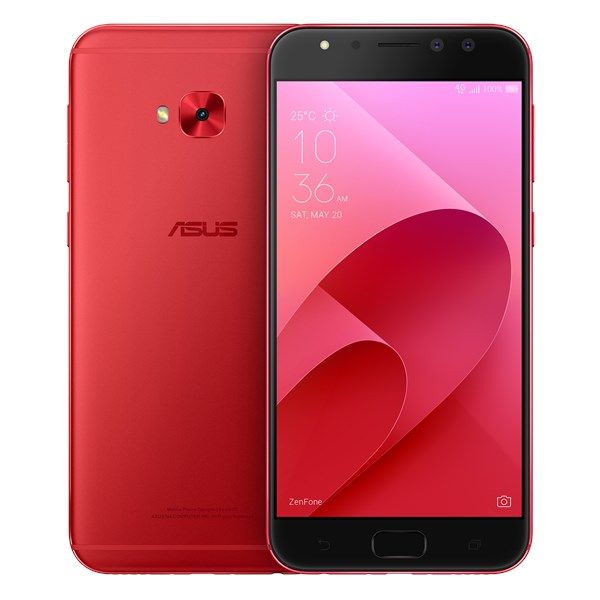
Design, interface is not too old, but safe
Asus Zenfone 4 Selfie Pro still owns the traditional design, but instead of using a plastic case like the Zenfone 4 Selfie, the machine has a frame and a metal-working back. The feel of the hand is quite pleasant despite the large screen size, as well as the frame is not made with touch screen because only the mid price range.
The Asus self-contained smartphone is equipped with an AMOLED screen, a completely different from the LCD on the Zenfone 4 Selfie. Quality display, blazing colors but not too much momentum – When placing Zenfone 4 Selfie Pro next to Zenfone 4 Selfie will clearly see the advantages of AMOLED screen.
This handheld version uses the Snapdragon 625 chip, 64 GB of internal memory, optional RAM of 3 or 4 GB depending on the user. Although not very powerful, the processor still responds well to the task and multitasking, especially when the ZenUI 4.0 interface is optimized to be lightweight, smoother than previous generations to 50%.
Display
Screen Size and Resolution
The Zenfone 4 Selfie Pro comes with a 5.5-inch AMOLED display, and honestly that’s one of its more noticeable, like real standout features. On this screen you get a Full HD resolution 1080 x 1920 pixels, so the pixel density sits at about 401 PPI. Because of that, the picture looks sharp , and details show up clearly, like text too, and images feel crisp , without that fuzzy edge.
Color Accuracy and Brightness
A big plus of the AMOLED tech in the Zenfone 4 Selfie Pro’s display is the way it handles colors. You get vibrant, punchy tones , with deep blacks and strong contrast. It’s really good for consuming media, so videos look lively, photo browsing feels immersive, and even gaming looks more vivid. Also the brightness is high enough that you can use it outside in most situations comfortably, though in direct sunlight you might still notice some visibility issues.
Viewing Angles and Overall Experience
The viewing angles are another strong point. With the AMOLED panel, the screen keeps its color and brightness fairly steady even when you look from far off angles. That helps a lot when you’re sharing content with friends, or just checking things at weird positions. Overall, the display experience is pretty positive, and the AMOLED screen sort of lifts the visuals above what you’d normally expect from a mid-range device, so yeah it feels better than just “basic” in daily use.
Performance
Processor and GPU
Under the hood the Zenfone 4 Selfie Pro runs on Qualcomm Snapdragon 625 chipset , which was kind of a popular pick back then for mid-range phones . It’s an octa-core processor set at 2.0 GHz and it is matched with the Adreno 506 GPU. You could say the Snapdragon 625 is all about this neat balance between performance and power saving , so it felt like a sensible match for people who just want something reliable for everyday stuff not too extreme .
RAM and Storage
On the memory side the device ships with 4GB of RAM , and honestly that’s enough for most multitasking moments. You generally get smooth switching between apps , and for moderate background work it stays pretty steady without heavy slowdowns. For storage, the Zenfone 4 Selfie Pro comes with 64GB built in , and you can extend it with a microSD card (up to 2TB) too. This kind of expandable approach really helps , especially since the phone is pretty focused on photography , with lots of space needed for pictures , videos , and apps that you end up keeping.
Everyday Performance
Day to day the Zenfone 4 Selfie Pro feels solid. The Snapdragon 625 isn’t the absolute fastest chipset you can find, but it still delivers a responsive and fluid experience for browsing , social platforms , and streaming media. Plus the 4GB RAM helps the handset keep multiple apps in the background , so you don’t get that constant stutter or lag when you jump between things, like it’s supposed to.
Gaming Performance
For gaming stuff, the Adreno 506 GPU can handle most casual games, and also several mid-tier titles, usually running fine and dandy most of the time. Things like Asphalt 8 and Clash Royale don’t really cause problems, but when you move into heavier territory like PUBG Mobile then you might need to tweak things a bit, dial down the graphics settings for a more even experience. The device isn’t exactly a gaming beast, not at all, yet it does bring a solid, reliable kind of output that should keep most people happy.
Camera selfie is the greatest strength
As a dedicated smartphone for self-sufficiency, the Asus Zenfone 4 Selfie Pro has a more “bad” camera than the previous lenses due to the built-in Sony IMX361 sensor. The 2 selfie camera systems are quite large in size, so Asus has to use smaller lenses and microspheres divide each pixel on the Selfie Pro to create half a million pixels of 24 MP, The information is aggregated to produce a standard image at 24 MP.
The test shows that the front camera is really excellent, even in backlit conditions or lack of brightness is not a problem. Asus also integrates into the SuperPixel Engine for Zenfone 4 Pro, with its own processing mechanism for high-quality images, video or livestream. Even the front camera system supports 4K video recording, and a 5MP wide angle camera for 120 degrees of selfie.
Battery Life
Battery Capacity and Efficiency
The Zenfone 4 Selfie Pro comes with a 3000 mAh battery, pretty normal for a phone of this size, and the overall setup feels like it’s meant to be calm on power. You get the Snapdragon 625 chipset that is more power efficient, plus an AMOLED display, so the battery should last you a full day even if you are doing a reasonable amount of stuff.
Screen-On Time and Real-World Usage
When you look at real day to day use, the Zenfone 4 Selfie Pro usually sits around 5 to 6 hours of screen-on time, though it really depends on what you do with it. If your routine is lighter , like web browsing, a lot of social scrolling, or just chatting, it can sometimes stretch toward a second day. But once you push it with more demanding stuff like longer camera sessions, or gaming— the battery drains a lot faster, and honestly you’ll notice it right away.
Charging Speed
Charging is handled through Asus’s BoostMaster, which is their own kind of fast charging. With the included 10W charger, you can expect a climb from 0 to around 50% in about 30 minutes. It’s convenient for those “need it now” moments, even if it isn’t the absolute quickest standard out there. Also, the Zenfone 4 Selfie Pro does not support wireless charging, so if that’s something you care about, it could feel a bit limiting.
Software and User Interface
ZenUI : Customization and Features
On the Zenfone 4 Selfie Pro you get Asus’s ZenUI, basically on top of Android 7.1.1 Nougat when it ships. ZenUI is that kind of UI, heavily tweaked and it brings a long list of options, plus a bunch of ways to personalize things. People can change themes and icons, sure, but also play with the way the home screen is arranged, and even how the app drawer looks. In a way it feels like it wants to fit your preferences rather than being fixed in one mode.
Bloatware and pre Installed Apps
One thing that gets mentioned a lot with ZenUI is bloatware. The Zenfone 4 Selfie Pro includes a set of pre-installed apps, and a lot of them are Asus software itself. Some users might think they’re handy, other users might say they’re just unneeded extras. Among the pre-loaded items you’ll find multiple Asus utilities, like a file manager, a power-saving app, and a task manager. Also, there are a few third party apps and games that arrive already there, and those usually can’t be removed unless you go through rooting the device.
Performance and updates
ZenUI is generally pretty smooth, and it does allow a lot of customization, but compared to stock Android it can feel a bit heavier at times. The overall performance stays stable , mostly because the Snapdragon 625 hits a decent balance between efficiency and power. Still, ZenUI sometimes introduces minor slow downs or small stutters, especially when more than a couple of apps are running at the same time, you know, multitasking moments.
Regarding software updates, the Zenfone 4 Selfie Pro ’s update approach can feel like a bit of a mixed bag. When it launched , it arrived with Android 7.1.1 Nougat, and even if Asus usually follows through with updates, the release timing for the bigger Android jumps can end up being slower than what some more prominent brands do. Right now , users might have to keep checking whether Android updates for newer versions, like Oreo or Pie, have actually been pushed out, but it’s also fair to say the phone may not get the newest Android versions right away, or at least not with the same speed some flagships get.
User Experience
ZenUI, has a handful of features that many people find convenient. There’s an Easy Mode that sort of reduces the complexity of things, with larger icons and fewer options so it feels less cluttered, more agreeable for those who want a more straightforward experience. On top of that, the software comes with different gesture controls, for example double-tap to wake, one-handed operation, and shortcuts you can customize, all of which make the daily experience smoother, and not just in theory.
Connectivity
Network and Signal
The Zenfone 4 Selfie Pro comes with 4G LTE, so connectivity is generally pretty solid for most daily stuff like web browsing, streaming, and doing that endless scrolling through social apps. It also has dual SIM so you can handle two separate numbers at once, not really a big hassle. In general, the phone keeps its network links in good shape , with fairly steady signal pickup and call quality that stays clear most of the time even when the surroundings are not exactly perfect.
Wi-Fi and Bluetooth
On the Zenfone 4 Selfie Pro, Wi-Fi tends to perform well, a lot of the time. It supports dual-band Wi-Fi, 2.4GHz and 5GHz, which helps with smoother performance, plus faster throughput depending on your router. All in all, the wireless connection is usually stable , so in everyday locations you should see decent coverage and not too many sudden drops.
For Bluetooth, the device includes Bluetooth 4.1. This brings stable pairings for wireless headphones, little speakers, and other add ons. It might not be the newest Bluetooth version, still it feels adequate for most people, especially for audio and basic accessory use.
GPS and Location Services
When it comes to location, the Zenfone 4 Selfie Pro has GPS with A-GPS and GLONASS support. That mix helps with more accurate tracking and navigation. In real life, navigation tends to behave well, it grabs satellite signals fairly fast and then the directions stay dependable while you’re moving around.
USB Connectivity
Charging and data transfer are handled through a microUSB port, which is kind of old school compared with USB Type-C. It also supports USB On-The-Go (OTG), so you can plug in external storage and certain peripherals if you have the right adapter. Still, the microUSB choice may reduce the device’s longer term “future proof” value, since Type-C is now the more common standard.
Conclusion
The Asus Zenfone 4 Selfie Pro kind of jumps out in the mid range segment , mostly because it really leans into selfie photography, so if you care more about the front camera than the rest it can feel like a natural pick. The dual front cameras do a lot of work here , selfies look crisp enough with solid detail and pretty faithful colors. There’s also that wide angle lens , which helps for group shots or when you want more people in the frame. Still, the rear camera isn’t as convincing, especially once lighting gets dim, it kind of loses that punch.
Design wise, and build too, the phone feels more “premium” than its price tag suggests, thanks to the metal unibody style. But, it doesn’t include any official water or dust resistance, so you have to be a bit more careful than with tougher models. The 5.5 inch AMOLED display looks vibrant and stays bright enough, so streaming and general media watching feels enjoyable.
When it comes to performance, the Zenfone 4 Selfie Pro stays pretty steady. You get a Snapdragon 625 setup plus 4GB of RAM, and that combination handles daily use without drama. Moderate gaming is also workable, though it’s not meant to chase heavy titles at the highest settings. Power comes from a 3000mAh battery, which should cover most normal days, but the charging tech is dated: there’s no USB Type-C , and there’s no wireless charging either.
On the software side, ZenUI gives you a decent spread of tweaks and customization, but it also ships with pre installed apps that some people may not want. The overall experience is usually smooth, even if occasional slowdown show up here and there, not constant, but you can notice it if you pay attention.
So overall, the Asus Zenfone 4 Selfie Pro is a pretty solid choice for anyone whose top priority is selfie shots, and who still wants a balanced mid range phone. Yes it has limits , like the rear camera in low light and the older microUSB port, but for the cost it still bundles selfie performance, a nice looking build, and everyday reliability in one package.
ASUS ZenFone 4 Selfie Pro (ZD552KL) 4GB / 64GB 5.5-inches Dual SIM Factory Unlocked – International Stock No Warranty (Rouge Red): Buy it now
Related Posts





Tech Reviewer & Product Analyst
Định Bia has spent over 10 years testing consumer electronics with a focus on smart technology. He work as a product advisor at Biareview where he helped customers find the right devices for their needs. He personally tests every product featured on this site using a consistent evaluation framework covering quality, durability, and value. All reviews are based on experience, not influenced by the manufacturer.