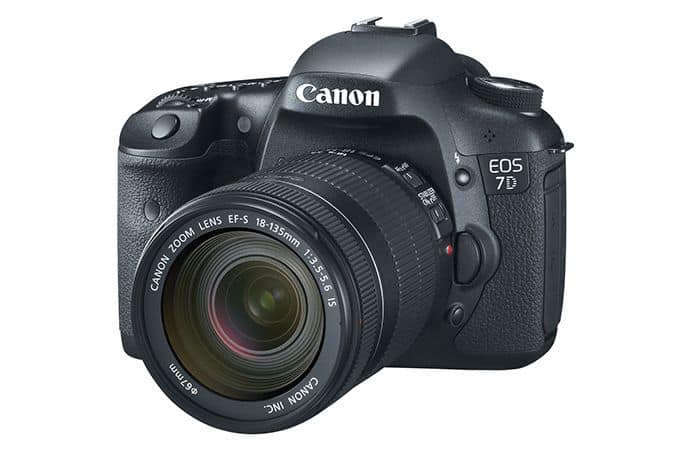
As the latest professional DSLR model from Canon, the EOS 7D offers 100% viewfinder access to the standard viewfinder, with a 19-point focusing system that supports both user-defined areas.
Although only using the 18-megapixel APS-C sensor, the $ 1,700 camera – for the body ($ 1,900 – including the 28-135mm kit) has many features. New and convenient. The product is equipped with Dual DIGIC 4 image processor for 8 frames per second.
The most striking feature is that along with the Nikon D300 and Nikon D300S, the 7D has a viewfinder that represents 100% of the scene recorded by the sensor, which gives the photographer a better picture composition, while other professional cameras only achieve 95%. The live view also shows 100% of this scene.
The 7D has a 19-point focusing system but offers very flexible selection.
In addition to automatic or manual focus, the 7D allows for focus area selection in a variety of ways
Spot AF uses the center of each point to focus more accurately, especially when using telephoto. The AF point expansion section helps to add highlights around the selected focus point
Zone AF groups focus points into five areas to focus on the frame that the photographer wants to be most clear.
The 7D’s filming features are also impressive as users are able to fully adjust their aperture and speed, making the film more professional and artistic. Video at Full HD 1080p resolution can reach 30, 25 or 24 frames per second, while HD Ready 720p resolution is 60 or 50 frames per second.
At first glance, the 7D looks pretty much like the EOS 50D, but as you get closer to it, you’ll see 7D as a big brother rather than a 50D replacement. The 7D has a lot of different designs with the 50D and 5D Mark II, for example bigger keys for winter gloves, with a switch between live view mode on the LCD and Video recording, a stop / start button to participate in this mode. This is an improvement on how video recording is a part of the main functions of the machine, rather than as an extra feature.
Canon EOS 7D Mark II Digital SLR Camera (Body Only): Buy it now
Canon EOS 7D 18 MP CMOS Digital SLR Camera with 28-135mm f/3.5-5.6 IS USM Lens (discontinued by manufacturer): Buy it now
Canon EOS 7D Mark II Digital SLR Camera with 18-135mm IS STM Lens and 64GB Deluxe Accessory Kit: Buy it now
Canon EOS 7D Mark II Digital SLR Camera Bundle with Lens, Cleaning Kit and Accessory (25 Items): Buy it now
Canon EOS 7D 18 MP CMOS Digital SLR Camera with 18-135mm f/3.5-5.6 IS UD Lens (discontinued by manufacturer): Buy it now
The 7D has a magnesium-sheath-like design, like the Canon 5D Mark II, which makes it dustproof and moisture resistant, like the professional-looking EOS-1N lens of the 1990s. No memory card, no battery is 820g, heavier Canon 5D Mark II. But the hands of the machine is designed very well, helping users hold the machine firmly. Like the EOS x0D or xD, it’s not one-handed.
15mm built-in flash type for a wider coverage than previous models. Especially, the 7D is the first EOS with built-in Speedlite transmitter, remote control 3 groups of 4 external flash.
In the shooting mode, 7D also shows its level when the rim on the top of the camera discards the basic scene modes commonly found on cheaper machines. This feature of 7D is very similar to 5D Mark II. The rectangular green button is fully automatic, CA (Creative Auto) provides a simple interface that allows users to set the exposure according to the shooting results they want, not the aperture and speed parameters. But EOS 7D also offers P, Tv, Av, M, semi-auto functions with 3 self-adjusting modes.
The screen of the 7D is 3 inches in size, showing a nice color. Here, the photographer can view images with a variety of histograms, including black-and-white, blue, green, and red for easy adjustment.
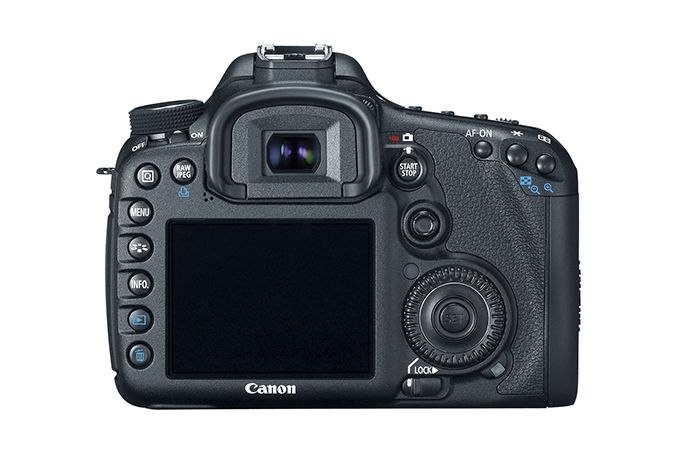
19 autofocus points, all cross-type, locks fast. Doesn’t matter if the subject’s moving or the room’s dim, it keeps up, and the center point especially holds sharp once the light drops.
8 fps burst, plenty for sports or wildlife. Buffer holds up too, which is more than you can say for a lot of cameras from this era that choke after three frames.
Shutter runs 1/8000 to 30 seconds. Optical viewfinder, full frame, 1.0x, so no guessing at what’s happening near the edges.
Video
1080p at 24/25/30 fps, manual control over everything that matters, aperture, shutter, ISO. Looks sharp, colors are accurate. Manual audio level, built-in mic. Compared to what’s out now, though, the video side is thin.
Connectivity
USB 2.0, HDMI, mic input. Basic, but it does the job: get files off, watch footage on a real screen, record decent sound. Menus are fine. Enough buttons and dials that you’re not buried in menus constantly, and you can reshuffle the controls.
Lenses
Full EF and EF-S compatibility, so wide to telephoto is covered. Speedlite flashes work, and the BG-E7 grip is worth it for long shoot days.
How it compares
The 70D came next: 20.2MP sensor, Dual Pixel AF, vari-angle touchscreen. Real upgrades, not a rebrand. The D7000 looks similar on paper, 16.2MP, 39 AF points, 6 fps, but loses to the 7D on burst speed and autofocus. The Sony a77 isn’t even in the same conversation: 24.3MP, translucent mirror, electronic viewfinder instead of optical.
The verdict
8 fps, solid AF, a body that survives bad weather, and stills that still look good at 18MP, that’s the case for this camera. Against that: it’s heavy, the video is dated, no Wi-Fi.
It’s old. For action or wildlife, if you’re not chasing the newest video specs, it’s still worth it.
Related Posts

Tech Reviewer & Product Analyst
Định Bia has spent over 10 years testing consumer electronics with a focus on smart technology. He work as a product advisor at Biareview where he helped customers find the right devices for their needs. He personally tests every product featured on this site using a consistent evaluation framework covering quality, durability, and value. All reviews are based on experience, not influenced by the manufacturer.