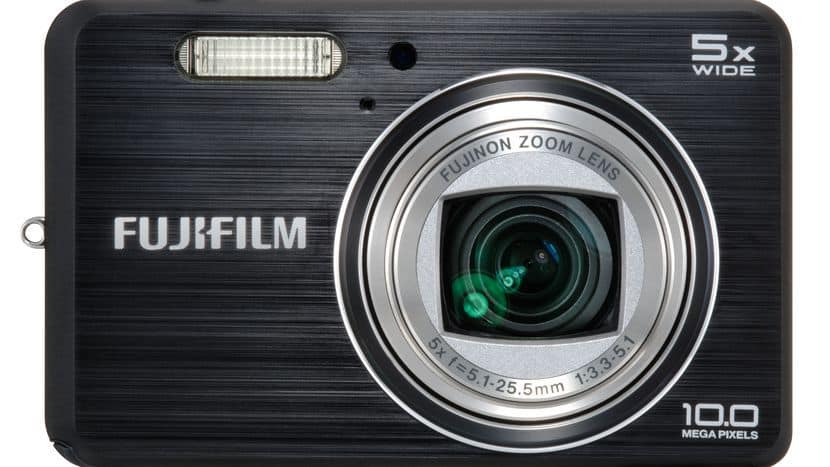
The FinePix J150w has a slick, easy-to-use design, support for high resolution and wide angle.
The FinePix J150w is a 10-megapixel digital camera with 5x (28-140mm) wide-angle zoom lens, but magnification is worth it. The machine features face recognition, anti-shake, LCD large and easy to use in the slick design.
LCD 3″ takes up most of the back, the control system is very compact with wheels selectable shooting mode and 5-way control loop.
The top side has only the power button, the shutter button is covered by the zoom / telephoto.
USB 2.0 interface for both data and video output.
NP-45 rechargeable lithium-ion rechargeable battery, SD memory card.
Fujifilm FinePix J150 10MP Digital Camera with 5x Optical Zoom (Silver): Buy it now
Fujifilm FinePix J150W 10MP Digital Camera with 5x Optical Zoom (Black): Buy it now
Design and handling
Nothing flashy about the J150w — clean, simple lines, which was the norm for a compact back then. 94.8 x 56.4 x 22.6mm, 146g: it vanishes into a pocket. Lens and a small flash take up the front; the back is mostly a 3.0-inch screen, which was genuinely big for the time.
Grip’s comfortable, buttons land where you’d expect and click properly instead of mushing. The mode dial makes switching quick, and the zoom lever sits right next to the shutter button so you’re not fumbling for it mid-shot.
Build
Matte plastic that grips your hand and shrugs off fingerprints. Light, but it doesn’t feel cheap — the battery door latches shut properly, buttons click with real solidity. Someone clearly thought about how this would hold up, not just how cheap it’d be to make.
Key features
10-megapixel CCD, 1/2.3 inches — standard for the era, good enough for everyday shots. Fujifilm’s processing handles color and detail decently. The Fujinon lens covers 5x zoom, 28-140mm equivalent — wide landscapes to moderate telephoto — with an aperture range (f/3.3-f/5.1) that’s typical for the class and puts a ceiling on low-light shots.
The 3.0-inch LCD (230,000 dots) is honestly one of the better things about this camera — bright, clear, roomy enough that the menus don’t feel cramped. Shooting modes cover Auto, Program, and scene presets (Portrait, Landscape, Sports, Night, Beach), plus Scene Recognition Auto, which reads the scene and picks settings for you — a real help if you don’t want to think about exposure. Stabilization is digital rather than optical, so it helps some in dim light or at full zoom without doing what a real mechanical system would. Video’s VGA at 30fps — limited even a couple years later, fine for its moment.
Performance
Daylight’s fine. Enough detail for an 8×10, good enough to post online, colors that look right without going flat. Take it indoors or after dark, though, and the small sensor runs out of road fast. Noise past ISO 400. Softer detail. No manual ISO, shutter, or aperture to fall back on when the auto settings aren’t cutting it.
Using it
This is a beginner’s camera, and it’s good at being one: labeled controls, a menu you don’t need instructions for, a big screen that makes checking your shot easy. Scene Recognition Auto backs that up — point it, shoot, done.
The cost is control. No manual settings means anyone wanting creative input runs into a wall immediately. For casual shooting, though, the automatic modes cover what most people actually need.
Against its era and against today
In 2008 it went up against the Canon PowerShot A2000 IS, Nikon Coolpix S560, and Panasonic Lumix DMC-FX35 — all similar specs, 10MP sensors, 3-inch screens. The J150w’s design and Scene Recognition stood out a bit, but its actual image quality tracked closely with the competition rather than beating it outright.
Next to a modern compact, sure, it’s dated — smaller sensor, no wireless, VGA video where everything now shoots at least Full HD. But if what you want is simple, cheap, and easy, none of that dating actually matters much.
What works and what doesn’t
Good: light, easy to carry, a screen that was ahead of its time, Scene Recognition that removes the guesswork, controls anyone can figure out immediately, and a price that made sense.
Not so good: struggles in low light, no manual controls for anyone who wants them, video stuck at VGA, battery good for a day and not much more.
Bottom line
This camera does exactly what it sets out to do: easy to hold, easy to use, a good screen, and automatic modes that make a decent exposure nearly guaranteed even for someone who’s never touched a camera before. It won’t touch anything modern on video or low light, and it never pretended to offer manual control but for straightforward, affordable, everyday shooting, it still holds up fine.
Related Posts

Tech Reviewer & Product Analyst
Định Bia has spent over 10 years testing consumer electronics with a focus on smart technology. He work as a product advisor at Biareview where he helped customers find the right devices for their needs. He personally tests every product featured on this site using a consistent evaluation framework covering quality, durability, and value. All reviews are based on experience, not influenced by the manufacturer.