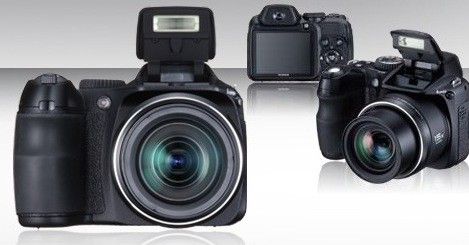
This digital camera is geared towards delivering high-definition (HD-High Definition) image and video experiences.
The S2000HD packs a 10MP sensor, 15x optical zoom (27.6-414mm equivalent), face detection, and dual image stabilization. Video tops out at 720p, 16:9 — solid enough for casual clips, nothing more.
The back panel is a LCD TFT 2.7″ (230,000 pixels), Fujifilm’s traditional button control system, an electronic viewfinder (EVF) with a quick-change button via the LCD.
The back of the body helps to hold the machine firmly. The top of the layout controls the shooting mode, portrait optimizer, continuous shooting, power button, shutter button is covered by the zoom / tele switch.
Side panel layout speakers, USB / AV out, private output to HD signal, flash button.
On the right is the SD / SDHC memory card compartment.
The machine uses 4 pin 3A.
Fujifilm FinePix S2000HD 10MP Digital Camera with 15x Optical Dual Image Stabilized Zoom: Buy it now
Design and handling
The grip is deep and textured enough that the S2000HD stays put in your hand through a long shoot. It’s mostly plastic — keeps the weight at a manageable 426g with battery and card — but it doesn’t feel hollow or cheap the way some plastic bodies do. Dimensions are 111.8 x 78 x 78.9mm: compact for a bag, but with enough heft that you don’t second-guess it. Buttons land where your fingers already are, so after the first roll of shots you stop thinking about where anything is.
The LCD is 2.7 inches, 230,000 dots — bright enough indoors, washes out like most screens do once you’re in direct sun. That’s where the electronic viewfinder earns its keep. 200,000 dots won’t impress anyone coming from a pricier camera. But outdoors, in direct sun, just having a viewfinder at all beats squinting at a washed-out screen — the number undersells it. Build quality is the real surprise here. Buttons click with actual feedback, the zoom racks smoothly, and nothing’s gone loose or rattly even with regular use.
Sensor and image quality
10 megapixels off a 1/2.3-inch CCD sensor — the standard size for a bridge camera of this generation. Enough megapixels for a big print or a heavy crop. ISO runs 64 to 1600 natively; push it to 3200 or 6400 and you’re trading resolution for reach. The color’s saturated, which is just Fujifilm being Fujifilm. Detail at low ISO is genuinely sharp. Once you climb the ISO ladder, the noise reduction gets heavy-handed and starts eating fine detail along with the noise.
Lens and zoom
15x optical zoom, 27-414mm equivalent — the camera’s main selling point, and it earns that billing. Wide end handles landscapes and group shots, the long end reaches distant subjects that would otherwise need you to walk over. There’s digital zoom too, but it costs sharpness, so treat it as a last resort rather than a real option. f/3.5-5.4 — nothing fast, but normal for this class, and it gets the job done in daylight. Stabilization matters more at full zoom or in a dim room. That’s where camera shake would otherwise wreck the shot, and sensor-shift actually pulls its weight.
Shooting modes and controls
Auto does what auto does. Scene modes cover Portrait, Landscape, Night, Sport, and a few others, each tuned for its situation. For anyone who wants to drive manually, there’s aperture priority, shutter priority, and full manual control over both. Continuous shooting tops out at 13.5fps at reduced resolution — useful if you’re trying to catch one good frame out of a fast sequence.
Video
720p at 30fps — dated now, competitive when this came out. You can run the optical zoom mid-recording, which a lot of cameras this size skip entirely, and it’s a genuinely nice touch. Sound is mono through the built-in mic: fine for a casual clip, not something you’d want for anything more serious.
Autofocus and speed
Fast and accurate enough, with single, continuous, and manual focus modes. Shutter lag is minimal and startup takes a couple of seconds, so it’s usually ready before the moment’s gone.
Image quality in practice
Good light is where this camera is at its best: sharp, good contrast, holds detail in both highlights and shadows. Low light is the weak point, same as most cameras at this price — noise shows up past ISO 1600, and 3200/6400 are there for emergencies only. Stabilization can only do so much. It’s not going to fix what a small sensor can’t handle once it’s dark. Macro’s where this thing actually shines — sharp, detailed close-ups. Flash covers close range and fill light fine, but get careless with it and you’re looking at harsh shadows or a blown-out shot.
Battery, storage, connections
Four AA batteries power it, which means you can find replacements anywhere — genuinely useful when traveling, even if it costs more over the long run than a proprietary pack. A good set lasts several hundred shots; video and heavy screen use burn through that faster. Storage is SD/SDHC — get a fast card if you’re shooting bursts or video. USB 2.0 (with PictBridge), HDMI, and AV out cover the connections, and the bundled software handles the basics of transfer and editing on either Windows or Mac.
Extras
Panorama mode stitches a sequence into a wide shot. Face detection keeps portraits properly focused and exposed, and red-eye removal cleans up flash shots after the fact.
What people say about it
The praise lands consistently on the zoom range, daylight image quality, and how approachable the controls are — people across skill levels seem to get along with it. The complaints are just as consistent: noise creeps in at high ISO, the EVF feels underpowered next to pricier bodies, and AA batteries, while convenient, cost more over time than most people expect going in.
Against the competition
The Panasonic Lumix FZ28 is a close match on paper, but the S2000HD usually costs less. The Canon PowerShot SX10 IS beats it on zoom reach and low light, for a higher price. The Sony Cyber-shot DSC-H50 has a better build and a sharper viewfinder, again at a premium. None of the three beat it outright — they beat it on one thing each, at a cost.
Bottom line
This is a real step up from a point-and-shoot without the price or bulk of a DSLR: long zoom, actual manual controls, HD video. Good for travel, family events, casual shooting where you want more control than auto-everything gives you. Low light and the EVF are the two things to know about going in — everything else here punches above what you’d expect for the price.
Key specs
Sensor: 1/2.3″ CCD, 10MP · Lens: 15x optical, 27-414mm equiv. · Aperture: f/3.5-5.4 · ISO: 64-1600 (expandable to 6400) · Stabilization: sensor-shift · LCD: 2.7″, 230,000 dots · EVF: 200,000 dots · Video: 720p, 30fps · Connectivity: USB 2.0, HDMI, AV out · Battery: 4x AA · Dimensions: 111.8 x 78 x 78.9mm · Weight: ~426g with battery and card
Related Posts


Tech Reviewer & Product Analyst
Định Bia has spent over 10 years testing consumer electronics with a focus on smart technology. He work as a product advisor at Biareview where he helped customers find the right devices for their needs. He personally tests every product featured on this site using a consistent evaluation framework covering quality, durability, and value. All reviews are based on experience, not influenced by the manufacturer.