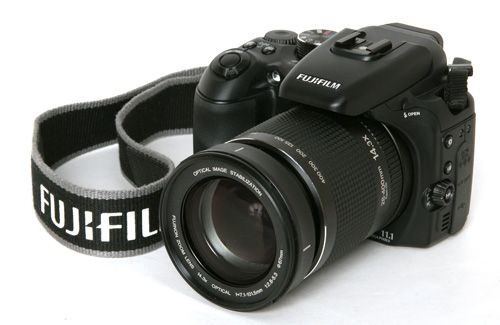
Fujifilm’s FinePix S100FS is a package solution for aspiring digital photography enthusiasts.
The FinePix S100FS features Fujinon 14.3x zoom lens (equivalent to 28-400 mm), Fujifilm’s 8th Super CCD sensor with 11 megapixel resolution, RP III image processor, LCD monitor The 2.5 “can be” tilted “and so on. There is no lack of technologies such as Dual Image Stabilization, Face Detection 2.0 and Fujifilm’s exclusive film emulation.
All controls on the back are arranged neatly to the right in the thumb manipulation area for basic parameters, requiring quick access.
On top of the wheel controls the shooting mode, the wheel parameter adjustment, ISO adjustment button and exposure compensation, shutter button is “hugged” by the power button.
Side panel layout USB 2.0 port, video output port, charging port and control buttons such as focus, anti-shake, continuous shooting. Flash must use the button to turn on.
The right side is designed to handle the grip, as well as the battery compartment, memory card.
NP-140 Li-ion rechargeable battery.
Fujifilm Finepix S100fs 11.1MP Digital Camera with 14.3x Wide Angle Dual Image Stabilized Optical Zoom: Buy it now
FUJIFILM digital camera FinePix (FinePix) S100FS black FX-S100FS: Buy it now
Design and handling
Pick this up and it feels like a small DSLR, because that’s basically what Fujifilm was going for — 133.4 x 93.6 x 150.4mm, 918g loaded. That’s heavier than any compact, but the weight actually helps once you’re holding it up for a shot; it doesn’t wobble the way a lighter body would. Buttons land where your hands already are, and there’s a hot shoe up top if the built-in flash isn’t cutting it.
The body mixes metal and decent plastic, and you can feel it — real heft, nothing that flexes or creaks. Layout is sensible: mode dial and shutter release up top, nav pad and a dedicated video button around back so you’re not hunting through menus mid-shoot.
Sensor and image quality
The 2/3-inch, 11.1MP Super CCD HR sensor is Fujifilm’s own design — a different pixel layout meant to pull in more light and a wider dynamic range than a standard sensor this size would manage. And it works: color and detail both come out ahead of what you’d expect from a bridge camera this old, especially once the light gets tricky.
Max resolution is 3648 x 2736 — plenty for big prints or aggressive cropping. Images come out sharp with noise kept surprisingly in check as ISO climbs. Color has always been Fuji’s calling card, and it holds here too: skin tones look right, not oversaturated, and there are color modes (Standard, Chrome, Black & White) if you want to shape the look in-camera. Dynamic range benefits from the same sensor trick, holding onto shadow and highlight detail that a lot of cameras from this era would just lose. The Film Simulation modes — mimicking classic film stocks — push that further and give you somewhere to go creatively beyond “accurate.”
Lens and zoom
Fujinon 14.3x zoom, 28-400mm equivalent. Wide enough for landscapes, long enough to reach distant subjects, with enough lens elements and coatings that image quality holds up across the range. Aperture goes from f/2.8 wide to f/5.3 at full zoom — that f/2.8 matters for background blur and for shooting indoors without cranking the ISO. Optical stabilization does real work at the long end of the zoom or in dim light, catching the small hand movements that would otherwise blur a slower shutter speed.
Speed and autofocus
Autofocus blends contrast and phase detection across single, multi-point, and continuous modes — quick and accurate in most light. Burst mode hits 7fps at reduced resolution, about 3fps at full size, genuinely useful for a bridge camera from this generation. Startup is fast, shutter lag is basically nothing. You’re not fighting the camera to catch a moment.
Low light
Wide aperture plus Fuji’s noise reduction do the heavy lifting. ISO runs 100-3200 natively, up to 10,000 in special modes — noise shows up at the top end, but the Super CCD holds together noticeably better than most cameras from this period once things get dark.
Video
720p, 30fps, and you can zoom mid-recording — a nice touch a lot of cameras this size skip. Mono audio through the built-in mic is fine for casual clips, but there’s no mic input, so that’s where it stops. Not a workaround, just a ceiling.
Screen and viewfinder
The 2.5-inch tilting LCD (230,000 dots) lets you shoot from odd angles — low, high, whatever the shot needs — though it washes out in direct sun like most screens of its time. The EVF is only 200,000 dots and won’t impress anyone used to modern viewfinders, but outdoors, having it there beats squinting at a bright screen.
Modes and creative tools
Full manual control’s here — Program, Aperture Priority, Shutter Priority, Manual — along with scene modes for Portrait, Landscape, Sports, and Night that handle the settings themselves. Film Simulation is the real strength, though. Provia, Velvia, Astia — each one actually looks different, not just three names on the same “vivid” slider. Bracketing covers exposure, dynamic range, and white balance, and RAW processing happens right in the camera, so there’s plenty to tune before you ever touch a computer.
Battery and storage
The NP-140 battery gets 250-300 shots per charge — average, and video or heavy bursts will eat that faster, so bring a spare for a long day out. SD and SDHC cards work fine (get a fast, high-capacity one); there’s also an xD-Picture Card slot, though that format was already on its way out when this camera launched.
Connectivity
USB 2.0 and AV out, no Wi-Fi or Bluetooth — dated even for when this came out, and it means no wireless transfer or remote shooting. Fujifilm’s bundled software handles basic management and RAW conversion well enough.
Living with it
New shooters won’t get overwhelmed — the layout and on-screen help keep things approachable despite everything packed in here. The zoom range and sensor make it genuinely flexible across landscapes, portraits, wildlife, sports, and the Film Simulation modes give you room to develop your own look instead of just documenting.
The real tradeoffs: it’s big and heavy if you wanted something pocketable, the connectivity is behind even for its era, battery life is average, and both the EVF and the LCD’s sunlight visibility could use work.
Against the competition
Canon’s PowerShot SX50 HS reaches further with 50x zoom and a newer sensor, but the S100FS wins on color and dynamic range through the Super CCD and Film Simulation modes — it’s reach versus character. Nikon’s Coolpix P510 shoots faster bursts and has GPS built in, but the S100FS has better build and color processing if you want something more rugged and customizable. Panasonic’s Lumix FZ200 holds f/2.8 through its entire 24x zoom, a real edge in low light and action, but the S100FS answers with better dynamic range and a sturdier body — it comes down to whether a fast lens matters more to you than overall image quality.
Bottom line
This is a genuinely solid bridge camera — good build, strong image quality, and a feature set deep enough that you’ll still be finding things to try after a year of shooting. The Super CCD sensor and Fuji’s processing add up to real color and detail that holds up.
No wireless, more bulk than newer cameras — neither is a dealbreaker for what you get back: comfortable handling, real stabilization, and shooting modes that reward some curiosity about photography rather than punishing it. If image quality, build, and versatility matter more to you than having the newest features, this one’s worth it.
Related Posts



Tech Reviewer & Product Analyst
Định Bia has spent over 10 years testing consumer electronics with a focus on smart technology. He work as a product advisor at Biareview where he helped customers find the right devices for their needs. He personally tests every product featured on this site using a consistent evaluation framework covering quality, durability, and value. All reviews are based on experience, not influenced by the manufacturer.