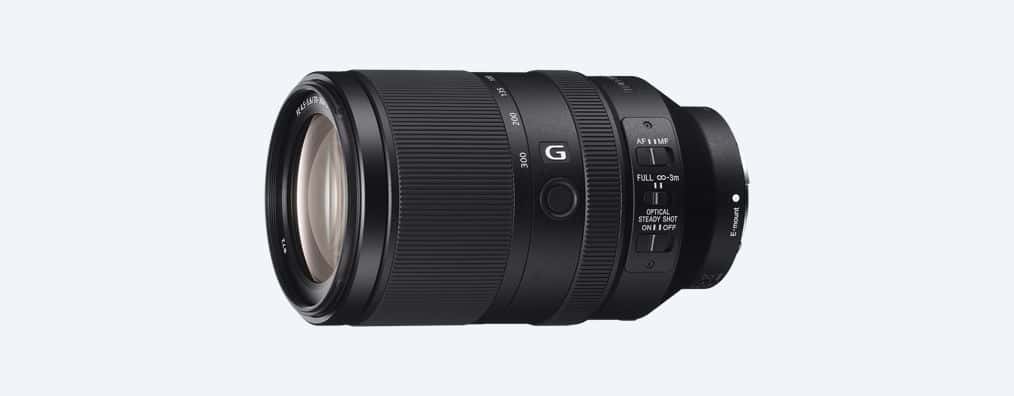
The Sony FE 70-300mm f / 4.5-5.6 G OSS became the first E (or FE)-mounted lens to extend to 300mm in focal length. Not stopping there, with a combination of four aspherical lenses, two extra-low-dispersion ED lenses and Sony’s Nano AR coating is sure to produce good-quality images, reducing aberrations and distortion, among other things. Also, the Sony FE 70-300mm f /4.5-5.6G OSS is designed to match perfectly, or shall I say works like an angel, with high-resolution cameras, particularly the A7R and A7R II.
Another fun point of this lens is focusing very close to 90cm and offering magnification at a not bad 0.31x-macro option. On top of that, quite importantly, in a telephoto lens signage especially two of them, this feature presents shake resistance, and the OSS signage placed on the lens clearly indicates that feature was given here on the 75-300mm f/4.5-5.6.
Sony FE 70-300mm SEL70300G F4.5-5.6 G OSS Lens: Buy it now
Sony FE 70-300mm F4.5-5.6 G OSS Full-frame E-Mount Lens (SEL70300G) + 64GB Ultimate Filter & Flash Photography Bundle: Buy it now
Sony FE 70-300mm f/4.5-5.6 G OSS E-Mount NEX Camera Lens – Bundle With 72mm Filter Kit, Cleaning Kit, Lens Wrap (19×19), Lenscap Leash, Software Package: Buy it now
Sony FE 70-300mm SEL70300G F4.5-5.6 G OSS Lens (SD Card Bundle): Buy it now
Optical Performance
The optical formula is 16 elements in 13 groups, with four aspherical elements and two pieces of ED glass doing the heavy lifting against chromatic aberration and distortion. It’s a big part of why images hold up sharp from one end of the zoom to the other.
Sharpness and Resolution
The lens maintains excellent sharpness from the center of the frame to across the focal ranges. At the wide end (70mm), this lens achieves corner-to-corner sharpness, even wide open at f/4.5. Slight softness begins to creep in as the focal length increases, particularly at the extreme tele lens setting (300mm) and wide open aperture (f/5.6). Stopping down to f/8 shows a remarkable increase in sharpness throughout the frame.
Chromatic Aberration and Distortion
With the help of the extra-low-dispersion glass elements, chromatic aberrations are well controlled, with only little color fringing apparent on the high-contrast edges. Any marginal chromatic aberration available would be easily corrected in post-processing.
There’s some barrel distortion at the wide end, but it’s minor, and it flips to a faint pincushion warp once you zoom in. Neither is bad enough to matter – a quick lens-correction profile in post (or in-camera) handles it fine.
Bokeh
Don’t expect creamy f/1.4 blur out of this – it’s not that kind of lens. But at 300mm, or up close, it separates the subject from the background just fine. Round highlights too, thanks to the 9-blade aperture, instead of the hexagonal shapes you get with fewer blades. You’d probably only catch that on a portrait or a bird shot against a messy background, if you’re the type who zooms in on stuff like that.
Auto-Focus Performance
The linear motor autofocus is quick and quiet, and it barely hunts even in low light – handy whether you’re shooting stills or rolling video. Lock-on is fast enough that you’re not left waiting on the subject to sharpen up.
The lens further benefits from Sony’s Direct Drive Super Sonic Wave Motor (DDSSM) technology for smooth and precise focus control, which is especially handy when shooting videos to reduce focus breathing and ensure smooth focus transitions. The focus hold button can be customized via the camera menu to perform various functions of your choosing, such as engaging eye AF-a feature especially useful in portraiture.
Optical SteadyShot (OSS) Image Stabilization
The built-in Optical SteadyShot is one of the better reasons to like this lens. It counteracts hand shake so you can shoot handheld at slower shutter speeds and still come away with a sharp frame. That’s especially useful zoomed all the way out to 300mm – at that length, even a slight wobble shows up as visible blur, so having stabilization built in saves you from either bumping up ISO or reaching for a tripod you didn’t want to bring.
The real beauty of the OSS comes in how sharp you can get away with shooting images at shutter speeds as slow as 1/60th of a second at 300mm, where previously, because of the risk of blur, you would have to have a much faster shutter speed. It increases the flexibility of the lens and provides a perfect setup for low-light situations and for greater creative control.
The Usability and Handling
It is a design enabling ease of functioning for the user, such as the Sony FE 70-300mm f/4.5-5.6 G OSS, since the zoom and focus rings are well-placed and may be operated even with gloves on. Indeed, it has a perfect balance even across the zoom range, although it extends during zooming, yet it’s a very smooth operation.
The mount is metal, which adds to general durability, while a rubber gasket provides added weather sealing. Tripod collar not included, but both its weight and the built-in OSS make it capable of comfortable handheld shooting.
With a minimum focusing distance of 0.9 meters (2.96 feet) and a maximum magnification of 0.31x, the lens would also be fairly suitable for closer subjects, although it is not a macro lens. This capability is excellent for getting high details on small subjects like flowers and insects.
Compatibility and Versatility
Sony’s A7 and A9 series cameras along with other E-mount bodies can boast of being compatible with the Sony FE 70-300mm f/4.5-5.6 G OSS. It also means that this lens on APS-C cameras delivers an effective focal length range of 105-450mm, which will open the gates to even greater versatility in telephoto applications. Therefore, this lens can be called a good all-rounder, suitable for full-frame and APS-C users of Sony cameras, besides having long reach and delivering good performance across the board.
This is a genuinely versatile lens – sports, wildlife, portraits, landscapes, even the odd close-up, and it doesn’t embarrass itself at any of them. It’s also light enough for a 300mm zoom that it actually makes sense to pack for travel, instead of leaving it home in favor of something smaller.
Image Quality
A couple of quirks show up if you look closely. Vignetting is one – it’s there wide open and especially at 300mm, but stop down a notch or fix it in post and it’s a non-issue.
Flare and Ghosting: The lens resists flare and ghosting relatively well thanks to Sony’s Nano AR coating that reduces reflections and increases contrast; however, any oblique lighting from strong light sources may result in some ghosting artifacts.
Aperture Range: With the variable aperture of f/4.5-5.6, the lens is deficient in applications involving low light or shallow depth of field. This is traded for compact and lightweight construction which is more suited for handheld or long-term use.
Comparison with Other Lenses
Worth stacking this up against a close competitor: the Sony FE 70-200mm f/4 G OSS.
The 70-200mm is sharp and well-built, tripod collar included – no real complaints there. But it caps out at 200mm, so if you need reach for distant subjects, it’s not the one. It’s usually pricier too, which makes the tradeoff even less appealing if reach is what you’re after.
Sony FE 100-400mm f/4.5-5.6 GM OSS
The Sony FE 100-400mm f/4.5-5.6 GM OSS represents the pinnacle of telephoto zooms, benefitting from even longer reach and imposing quality. It includes a super-fast autofocus, optimum optics, and hugely superior mechanical robustness. On the other hand, it is many times more expensive than the 70-300mm and heavier, therefore making it less portable and more demanding for long hours in action.
Third Party Lenses
Sigma and Tamron, among other third-party companies, manufacture telephoto zooms for various E-mount cameras, with differenced available in regard to focal range, specifications, and price.
Conclusion
Versatile and functional, the Sony FE 70-300mm f/4.5-5.6 G OSS is a telephoto zoom that performs extraordinarily well in diverse photographic fields. Its solid construction and excellent optical design, together with desirable image stabilization, make it a useful tool for any photographer’s bag. It might not equate in horse categories under very specialized use against much of the expensive telephoto light in the market, but it does strike a good balance between performance and a modest price tag.
Advantages:
– Flexible focal range of 70-300mm
– Excellent build quality with weather sealing
– Effective Optical SteadyShot image stabilization
– Fast and accurate autofocus
– With good sharpness and optical performance
– Pleasing bokeh effects and background blur
Disadvantages:
– Some amount of vignetting and chromatic aberration
– Minor softness at the extreme telephoto end
– Variable aperture for low-light performance
Final Verdict
The Sony FE 70-300mm f/4.5-5.6 G OSS is an excellent lens for photographers who wish to invest in a top-quality telephoto zoom lens that is versatile enough for almost any shooting situation. Such buying criteria make the lens much more impressive when related to the performance, versatility, and value it offers in amateur and professional environments. It will serve you well, whether you want to capture the intricate details of a landscape, the quick movements at a sporting event, or the quiet moments between subjects in a portrait.
Related Posts


Tech Reviewer & Product Analyst
Định Bia has spent over 10 years testing consumer electronics with a focus on smart technology. He work as a product advisor at Biareview where he helped customers find the right devices for their needs. He personally tests every product featured on this site using a consistent evaluation framework covering quality, durability, and value. All reviews are based on experience, not influenced by the manufacturer.