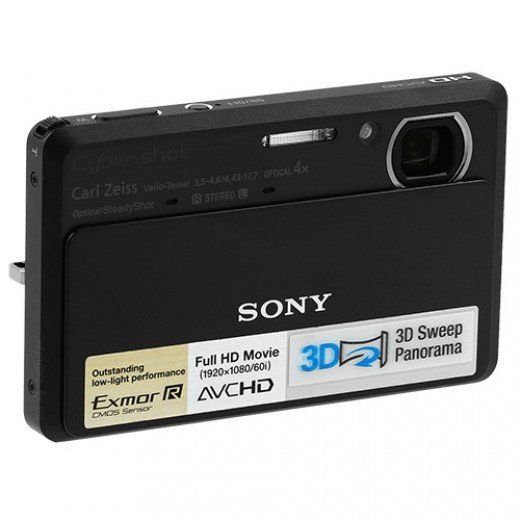
Sony Cyber-shot DSC-TX9 comes with a 25mm wide-angle lens and supports fast continuous shooting. Even so, the photos look a bit softer than expected, and zoom control can feel a little awkward. The TX9 offers 12.2-megapixel resolution and uses a 4x optical zoom lens. It also has a 3.5-inch touch screen.
Sony introduced the TX9 alongside the WX5. It was also meant to replace the earlier Sony Cybershot TX7 that had been announced before. Enhanced with sequential shooting, noise reduction, anti-shake and Full HD video recording. The lens and flash in the body fit the front sliding protection plate.
Rival Sony Cyber-shot TX9 is Nikon Coolpix S80 and Panasonic Lumix FX700. Machines have touch screen in turn are 3.5 inches and 3 inches. The image stabilization feature and many of the designs are intended to please the mobile audience who still require high image quality.
Sony TX Series DSC-TX9/H 12.2MP Digital Still Camera with “Exmor R” CMOS Sensor and 3D Sweep Panorama: Buy it now
Sony TX Series DSC-TX9/R 12.2MP Digital Still Camera with “Exmor R” CMOS Sensor and 3D Sweep Panorama: Buy it now
Sony Cyber-shot TX9: All Style, Some Substance
This thing is thin. 98 x 59 x 16mm, 160 grams — it basically disappears in a pocket. There’s no real grip because there’s nothing to grip onto: it’s a slab of metal with a touchscreen standing in for buttons. If you’re used to physical dials, give yourself a few days to adjust.
The metal body feels legitimately nice, not the plastic-dressed-as-premium thing a lot of compacts pull. But thin and metal isn’t the same as tough — drop it and you’ll notice more than you would with a chunkier camera. Treat it gently.
12.2 megapixels on a 1/2.3″ Exmor R sensor, run through Sony’s BIONZ processor. The whole point of the Exmor R design was better low-light shooting — less noise, cleaner files and BIONZ backs that up with faster processing and colors that look right without looking pumped up.
The lens is where you feel the size constraints. 4x zoom, 25-100mm equivalent, f/3.5 wide open down to f/4.6 at full zoom. Fine for everyday shooting, not trying to be anything more — this was never going to be a superzoom. Stabilization earns its keep at the long end and in dim rooms, where a camera this thin needs every bit of help it can get.
Skip the viewfinder — there isn’t one. You’re composing on the screen, full stop. Good thing the screen’s solid: 3.5 inches, 921,600 dots, bright enough that you won’t miss having a viewfinder most of the time.
Everything runs through touch — no buttons cluttering up that sleek shell. It’s responsive, the menus stay organized, and honestly whether you like this comes down to whether you’re someone who wants to feel a click under your finger or doesn’t care either way.
Autofocus is contrast-detection, single and continuous — perfectly adequate, nothing more. Burst mode is the actual surprise here: 10fps, fast enough that it handles moving subjects better than you’d guess from the rest of the spec sheet.
ISO goes 80-3200, and the Exmor R sensor keeps noise in check at the lower end — push higher and it starts to show, same story as every sensor this small. Sharpness stays consistent through the zoom range, colors come out accurate without tipping into oversaturation.
Video is where this camera actually impresses. Full HD, 1080p at 30fps, sharp and well-stabilized thanks to the same optical stabilization doing double duty on stills. This is the one part of the TX9 that still holds up reasonably well today.
Getting files out means a cable, every time — mini HDMI or USB, no wireless option at all. Even a few years later that would start to feel like a real gap.
It’s a genuinely good travel camera, small enough to carry anywhere, capable enough to handle most situations you’d point it at. Portraits work fine given the manual exposure control. Landscapes get a boost from the 25mm wide end. And for action, the burst rate actually helps more than the autofocus does — fine for kids running around a yard, not built for anything genuinely fast and unpredictable.
Against anything modern, the gaps are obvious: 20-60-plus megapixel sensors with backside illumination the TX9 never had access to, hybrid autofocus that tracks subjects properly, 4K as the baseline instead of the ceiling, wireless everything built in. Even build quality has moved on — a lot of new compacts manage better weather resistance without giving up the thin, pocketable shape the TX9 was known for.
It was a genuinely nice camera for 2010 — thin, well-made, with video that outperformed most of what else was around. It’s aged the way you’d expect: no wireless, modest low light, autofocus that won’t keep up with anything quick. Still owns one? It’s a perfectly fine everyday and travel camera. Shopping today? Almost anything new will beat it on paper — you’d just be giving up some of that pocket-sized elegance to get there.
Related Posts






Tech Reviewer & Product Analyst
Định Bia has spent over 10 years testing consumer electronics with a focus on smart technology. He work as a product advisor at Biareview where he helped customers find the right devices for their needs. He personally tests every product featured on this site using a consistent evaluation framework covering quality, durability, and value. All reviews are based on experience, not influenced by the manufacturer.