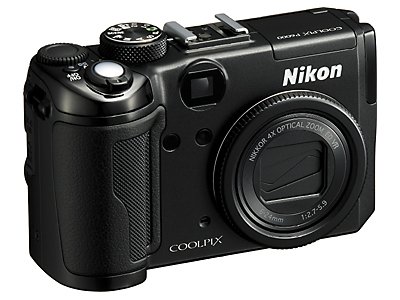
The Nikon P7000 is a real departure from the P6000 — different design, and a sensor change that looks backwards on paper: 10.1 megapixels versus the P6000’s 13.5. Nikon’s explanation was that fewer pixels on the same size sensor meant less noise and better overall image quality. Whether that tradeoff paid off is the kind of thing you’d have to shoot with both to really judge.
Zoom sits at 7.1x, roughly 28-200mm equivalent, f/2.8 at the wide end and f/5.6 once you’re zoomed all the way in. The EXPEED C2 processor runs the show, covering ISO 100-6,400, 720p video, and a burst rate of just 1.3fps — not fast, though boot time is nearly instant at 0.9 seconds.
Around back you get both an optical viewfinder and a 3-inch, 921,000-dot LCD, plus full manual controls, a removable hot shoe, and a built-in flash.
It shoots to SD cards (SDXC works too) in JPEG or Nikon’s own .NRW raw format, has HDMI out for viewing on a bigger screen, and runs on the EN-EL14 battery — good for about 350 shots per charge.
Nikon aimed this one squarely at the Canon PowerShot G12, trying to take a bite out of territory Canon’s G-series had held for years.
Nikon Coolpix P7000 10.1 MP Digital Camera with 7.1x Wide Zoom-Nikkor ED Lens and 3-Inch LCD: Buy it now
Advantage
– Large focus range.
– Optical anti-shake system.
– The right design allows for comfortable grip.
– 3 inch LCD screen, 921,000 pixels.
– Optical viewfinder.
– Low autofocus latency.
– RAW support.
– 720p movie recording with stereo sound.
– An external stereo mic jack.
– Can zoom when recording video.
– You can add a wide angle converter (21mm instead of the original 28mm, need adapter for mounting).
– Battery life is relatively long.
– Show Tone level on screen.
– Noise reduction (Low and Normal).
– Customize by user U1 to U3 on Mode dial.
– Active D-Lighting.
– Anti-distortion option.
– Reduces chromatic aberration.
– Built-in ND filter.
– Compatible with infrared remote.
– Show the horizon.
– Fn button allows to set functions or use.
– i-TTL compatible.
– AF Tracking.
– Customizable Menu Easy.
– RAW + JPEG capture.
– Shutter / ISO / WB bracketing.
– Picture control (similar to SLR).
– Macro shooting is very good (no flash).
Disadvantages
– Slow shutter speed.
– The machine does not report or operate while recording images to the card.
JPEG images are slightly darker in color, sometimes with a light pink appearance.
– The print quality from JPEG files is not really good.
– User interface is slow.
– Long transition between images.
– Correctness while AF is sliding.
– Distortion control can cause the LCD display to display incorrectly with the viewing angle.
– RAW files are not display when connected to a computer without the use of Nikon software.
The P7000 runs a 1/1.7″ CCD sensor at 10.1 megapixels — not the highest number around at the time, but Nikon leaned on image quality over pixel count here. The EXPEED C2 processor does the noise reduction work and pushes for images sharper and more color-accurate than your typical point-and-shoot.
Lens-wise, you’re looking at 7.1x zoom, 28-200mm equivalent, f/2.8 wide open down to f/5.6 at full reach. Optical stabilization helps at slower shutter speeds, which matters more than usual once you’re zoomed all the way in.
The optical viewfinder is really the headline feature. Most compacts had already ditched these by the time the P7000 came out, so just having one made it stand out — particularly outdoors, where a bright day can turn an LCD screen into a useless mirror. The screen itself is solid too: 3 inches, 921,000 dots, clear enough that framing and reviewing shots isn’t a struggle.
Controls are built for someone who actually wants to use them — mode dial, customizable buttons, a control wheel. Nothing here is hidden behind a single auto mode. The menus stay organized enough that basic settings don’t require a hunt.
Autofocus is contrast-detection with single, continuous, and manual options — nothing fast, nothing slow, just adequate. Burst mode caps around 1.2fps, which won’t turn heads but handles casual action fine. ISO goes 80-3200, expandable to 6400, with noise staying under control at the lower end and creeping in as you push higher — typical for a sensor this size. Sharpness holds steady across the zoom range, and colors come out accurate without looking punched up.
Video’s clearly an afterthought: 720p at 24fps. Reasonable for a compact back then, basic now, no Full HD or 4K to fall back on. If video matters at all, look elsewhere.
Getting files off the camera means mini HDMI, USB, or AV-out — no Wi-Fi, no Bluetooth, everything’s a physical connection. SD and SDXC cards work fine, saving as JPEG or Nikon’s own .NRW raw. The EN-EL14 battery is good for roughly 350 shots.
It’s a solid travel camera — a bit bulkier than an ultra-compact, but the manual controls make up the difference. Portraits benefit from that same manual control, letting you actually decide on depth of field instead of leaving it to guesswork. The 28mm wide end and decent dynamic range make it capable for landscapes too. Action and sports are where it falls short — the burst rate just isn’t built for fast, unpredictable movement, though slower action is fine.
The interface shows its age next to anything with a touchscreen, and there’s a real learning curve coming from a basic point-and-shoot — though that curve buys you actual creative control. The build holds up fine day to day, though parts and support get thinner as the camera gets older. The sensor and processing were sharp for their time and are simply outclassed now.
What the P7000 actually did was carve out space between point-and-shoot and DSLR — real manual control, a functioning viewfinder, image quality that held its own against bigger cameras. It doesn’t compete with anything current, and it was never going to. If you’ve got one and it still does what you need, keep using it. If you’re shopping for something new, there are better options now — that’s just what a decade and a half does to a camera.
Related Posts

Tech Reviewer & Product Analyst
Định Bia has spent over 10 years testing consumer electronics with a focus on smart technology. He work as a product advisor at Biareview where he helped customers find the right devices for their needs. He personally tests every product featured on this site using a consistent evaluation framework covering quality, durability, and value. All reviews are based on experience, not influenced by the manufacturer.