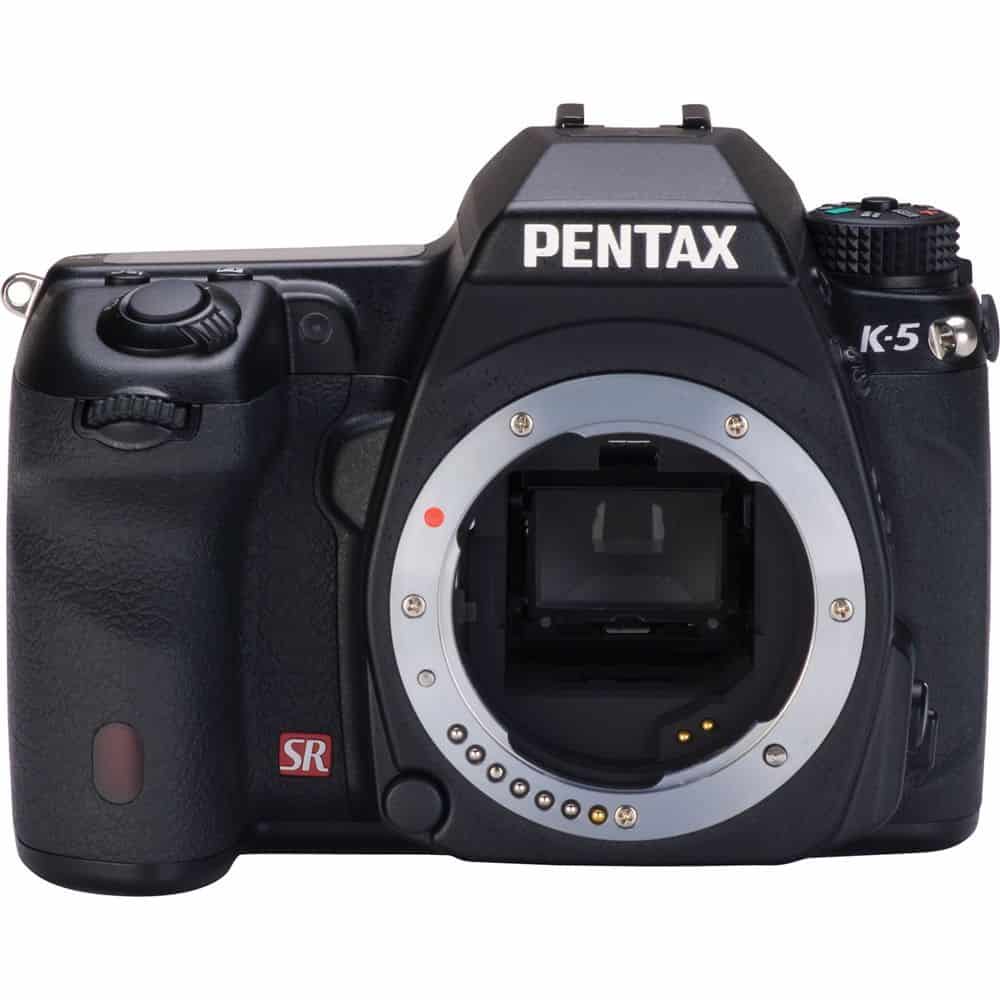
The Pentax K5 is a perfect continuation of the K7 model with 16.3 Megapixel APS-C sensor to be a highly customizable DSLR, although there are still some downsides.
The Pentax K-5’s semi-sub-frame camera is inherited from the predecessor Pentax K-7 and the most advanced 16.3 Megapixel image sensor (along with the Nikon D7000 and Sony A55).
The most prominent feature of the K-5 lies in the ISO range extending from 80-51.200, Full HD 1080p video recording mode at 25 frames per second, continuous shooting capability of 7 fps, 11 focus system Safox IX faster and wider coverage, improved High Dynamic Range mode and various digital filter effects.
K-5 inherits from the K-7 structure’s resistance dust, water and low temperature resistance, shutter opening up to 100,000 times at up to 1 / 8,000 second, 100% optical viewfinder magnified 0.92 times. A 77-area metering matrix, a 920,000-dot 3-inch LCD monitor, a built-in anti-shake and dustproof system, Live View with Face Detection, and auto-correction and chromatic aberration. Across the DA / DFA lens.
The K-5 shutter is designed for a 100,000-times life cycle of 1 / 8,000 second, which brings the machine closer to professional models. The standard 18-55mm kit is well designed and also inherits weathering properties that outperform the competition. The Pentax DA 18-55mm f/3.5-5.6 WR keeps things simple, some basic weather sealing to keep water and moisture out, plus a coating that fights off dust, water, and grease so fingerprints wipe right off. Yes, it’s slow. f/3.5-5.6 isn’t going to impress anyone chasing shallow depth of field or low-light performance. But matched with the K-5’s weather-sealed body, it just makes sense, you get a fully sealed setup without spending real money on it.
Pentax K-5 16.3 MP Digital SLR with 3-Inch LCD (Black Body Only): Buy it now
Pentax K-5 16.3 MP Digital SLR with 18-55mm Lens and 3-Inch LCD (Black): Buy it now
Pentax K-5 II 16.3 MP DSLR DA 18-55mm WR lens kit (Black) (OLD MODEL): Buy it now
Pentax K-5 IIs 16.3 MP DSLR Body Only (Black): Buy it now
Pentax K-5 II 16.3 MP DSLR Body Only (Black) (OLD MODEL): Buy it now
Pentax K-5: The Tank That Takes Great Photos
At 131 x 97 x 73mm and 750 grams loaded, the K-5 is small for a DSLR but doesn’t feel small in your hands. Magnesium alloy over high-strength plastic — this thing is built to survive a drop, not just look sturdy on a store shelf. The grip holds on even with cold or wet hands, and the buttons sit where your fingers expect them.
The screen surprised me for its age. 3 inches, 921,000 dots — sharp enough to actually judge focus from the preview instead of guessing and hoping. Colors hold up off-angle too. Sunlight still washes it out, but that’s an LCD problem, not a K-5 problem.
The sensor still holds up
16.3-megapixel APS-C CMOS. Better in low light than the CCD sensors before it, noticeably less noisy. That resolution gives you plenty of room for a large print or an aggressive crop. Colors are rich without tipping into fake-looking territory. Dynamic range was genuinely strong for the era — better shadow and highlight recovery than a lot of what else was around at the time.
Any K-mount lens you want
The K-5 works with Pentax’s whole K-mount catalog, new and third-party. Pair it with a decent lens and you get sharp results with barely any distortion. The optical viewfinder is a big part of the appeal here too — no lag, no digital artifacts, just what’s actually happening in front of the camera.
Autofocus is fine, not fast
11-point SAFOX IX+ phase-detection. Quick enough in good light, noticeably slower once you’re in low contrast or dim conditions. You’ve got single AF, continuous AF, and manual — enough options to cover most situations.
Burst mode runs 7fps, which is solid without being flashy. Shutter lag stays minimal, so you’re not fighting the camera to catch the moment.
Battery life is genuinely impressive: 800-1,000 shots per charge. That’s most people’s whole week on one charge, or a full aggressive shooting day without needing a backup.
What’s under the hood
PRIME II handles processing quickly and cleanly, with solid noise reduction at higher ISOs. The in-body Shake Reduction stabilizes at the sensor, meaning it works with literally any K-mount lens — including old manual glass with no stabilization of its own. That’s a real edge over cameras that only stabilize through the lens.
This camera can take a beating
Weather sealing is the big deal here. Take it out in rain or dust and it just keeps working — this isn’t a camera you have to baby indoors. Add the customizable buttons and dedicated dials, and you’ve got something built for people who’d rather shoot than dig through menus mid-shot.
Live View uses contrast-detection AF for awkward angles, and video caps at 1080p — competent for its time, basic now. No 4K, no fancy autofocus tracking during video.
Compared to what’s out now
Current sensors run 20 to 60-plus megapixels with backside illumination the K-5 simply didn’t have access to. Autofocus on new cameras uses hybrid systems with way more focus points and real face tracking. 4K is standard now. And there’s no wireless anything on the K-5 — no Wi-Fi, no Bluetooth, no cloud backup. You’re pulling the card, every time.
Where it still earns its keep: portraits benefit from the resolution and dynamic range, and the huge lens catalog means you can find a fast prime for whatever look you’re after. Landscape shooters get the dynamic range plus weather sealing that actually matters when you’re out in the rain. Sports and action are handled fine at 7fps, though truly unpredictable fast movement will show the autofocus system’s age. And for travel, it’s tough enough for the road without being the heaviest thing in your bag.
The honest trade-off: you get excellent image quality, a body that takes real abuse, deep customization, and stabilization that works with anything you attach — but you give up wireless features entirely, autofocus speed compared to modern hybrid systems, video quality, and screen resolution by today’s standards.
It’s still a dependable camera. If you own one, it’ll keep working for years. If you’re buying new and don’t specifically need the weather sealing or the K-mount ecosystem, something newer will beat it on paper — it just won’t feel as solid doing it.
Related Posts




Tech Reviewer & Product Analyst
Định Bia has spent over 10 years testing consumer electronics with a focus on smart technology. He work as a product advisor at Biareview where he helped customers find the right devices for their needs. He personally tests every product featured on this site using a consistent evaluation framework covering quality, durability, and value. All reviews are based on experience, not influenced by the manufacturer.