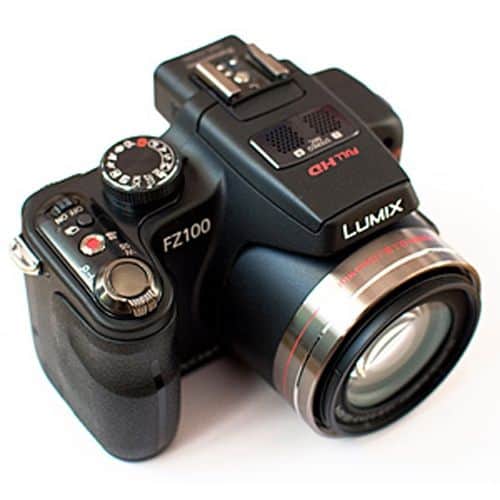
Panasonic put the Lumix FZ100 out in July 2010. Around the same time, it also listed the FZ45 and the FZ40. Those new models replaced the older FZ38 and FZ35.
The FZ100 has a 14-megapixel sensor. It also keeps the 24x zoom setup, the same kind that helped Panasonic’s superzoom cameras draw notice.
From far away, the lineup looks almost the same. The FZ45 and the FZ40 match the FZ100 in overall shape and build. Still, the details change once you go deeper. The FZ100 uses a MOS sensor. The FZ45 and FZ40 use a CCD sensor that is older.
This change affects what the cameras can do. The FZ100 can record 1080i video. It also does quick burst shooting. The FZ45 and FZ40 do not deliver the same level in those areas.
Other parts also differ. The FZ100 has a 3-inch screen with a 460,000-pixel count. It also has a hot shoe. The FZ45 and FZ40 do not include those items.
Panasonic seems to have split the product line on purpose. The FZ100 was meant to take on the Canon PowerShot SX30 IS. It tried to match that model in both features and price.
At the same time, the FZ45 and FZ40 were pushed as lower cost choices. Some features were removed. The price dropped, but buyers had to accept weaker video and slower burst performance.
Panasonic Lumix DMC-FZ100 14.1 MP Digital Camera with 24x Optical Image Stabilized Zoom and 3.0-Inch LCD – Black: Buy it now
Panasonic digital cameras Lumix black 14100000 pixels DMC-FZ100-K great 24 x optical zoom 25 mm wide angle high speed continuous shooting, free-angle 3.0-LCD full HD videos: Buy it now
At 382 grams and roughly 122 x 83 x 98mm, the FZ100 is small for a superzoom — but you’ll still feel it in your hand next to an actual compact. Mostly plastic, some metal underneath, and a rubberized grip that does its job: this thing doesn’t slip out of your hand on a sweaty hike.
The screen hasn’t aged well. 3 inches, 460,000 dots — fine a decade ago, soft and washed-out now, especially outdoors. You’ll end up cupping your hand over it more than you’d like.
The sensor is where the “advancement” talk actually holds up
14.1MP CMOS, a real step up from the CCD sensors Panasonic was using before this. Better low light, less noise. 14 megapixels sounds small today, but it printed a clean 13×19 back then, and it’s honestly still plenty for anyone not planning to crop aggressively. Colors are rich without tipping into cartoonish saturation. Dynamic range is fine in normal light and falls apart a bit in anything high-contrast — nothing surprising for a camera this old.
The lens is why you’d buy this
25-600mm equivalent, f/2.8-5.2, 24x zoom. That’s the whole pitch. Wide enough for landscapes, long enough to pull in a bird sitting across a lake. Sharpness holds up too, you’d have to go pixel-peeping to find where it’s cutting corners. And the stabilization matters most exactly where you’d expect: zoomed all the way in, where even a slight shake turns into a blurry mess.
Autofocus hasn’t aged as well as the lens
Contrast-detection AF — standard for 2010, slow by any current standard. Fine for anything sitting still, frustrating for a kid running across a yard. What actually holds up is the burst rate: 11 fps is quick even now for a camera in this class. Shutter lag stays minimal, though rapid-fire shooting does introduce a bit of hesitation.
Battery gets you 300-400 shots per charge. Enough for a casual day out, not enough if you’re shooting all day at a wedding or an event. Carry a spare.
Everything else
The Venus Engine HD processor does its job quietly in the background — decent noise reduction, steady processing. Scene modes cover portrait, landscape, night, sports, the usual suspects, plus some creative filters if you want to play around in-camera. Video caps at 1080p with basic auto exposure and focus — good enough for home movies, nowhere close to what a modern hybrid does.
Against anything current, it shows its age
Modern sensors run 20 to 60-plus megapixels with backside illumination and noise handling that wasn’t possible in 2010. Autofocus has moved to hybrid systems with dozens of points and real face tracking. 4K is standard now, not a premium feature. And there’s no Wi-Fi, no Bluetooth, no cloud backup of any kind, you’re pulling the card and moving files manually, which feels almost old-fashioned at this point.
Still, for everyday shooting, travel, family stuff, casual sports — it handles all of it fine. That zoom range alone means you’re not lugging three lenses around, and the controls are simple enough that anyone can pick it up and start taking usable photos in five minutes.
The real trade-off: you get an excellent zoom, a genuinely fast burst mode, and stabilization that works — in exchange for no wireless connectivity, a dated screen, sluggish autofocus, and a battery you’ll want to double up on. None of that makes it a bad camera. It just makes it a camera from 2010, doing 2010 things well. If you already own one, it’ll keep taking decent photos for years. If you’re shopping today, spend the money on something newer.
Related Posts


Tech Reviewer & Product Analyst
Định Bia has spent over 10 years testing consumer electronics with a focus on smart technology. He work as a product advisor at Biareview where he helped customers find the right devices for their needs. He personally tests every product featured on this site using a consistent evaluation framework covering quality, durability, and value. All reviews are based on experience, not influenced by the manufacturer.