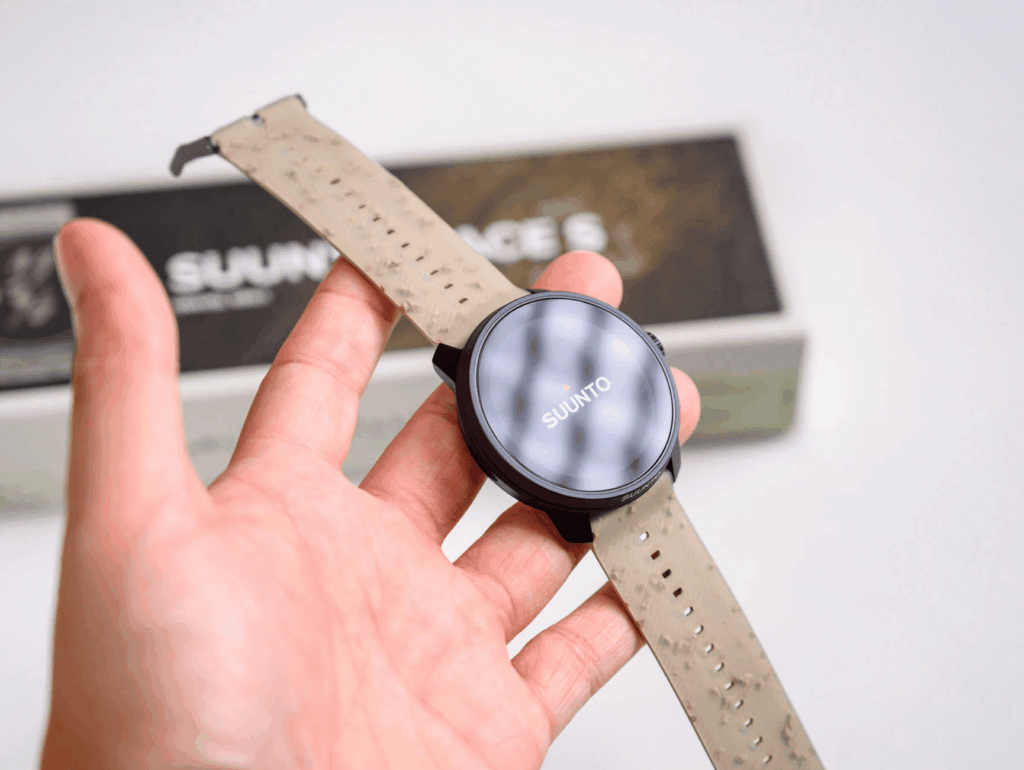
The Race S isn’t a new Suunto release anymore, but it’s one of the best-looking, best-built watches the company has made. Since the Race, Suunto has also reworked a lot of how it approaches products, and you don’t see numbered Suunto lines anymore. The Race S is a lighter, more compact version of the Race. The Race itself already has a second generation, but the Race S has nearly the best hardware Suunto offers right now for trail and road running.
I went back and forth between the Race S and quite a few other watches, but I ended up with this one. Once I opened the box and held it, I knew I’d made the right call.
When Suunto launched the Race, I tried it on, and then the Vertical too, but both were a bit more than I needed. They’re heavier, bigger and bulkier. Then the Race S came out and I didn’t pay attention to it, until now. There are two versions, folks: a steel one that weighs about 60 g (strap included) and a titanium one at about 53 g. The hardware is identical and only the case differs, yet the titanium costs almost $80 more. I didn’t think that was worth it, so I went with steel.
One thing that really draws me to Suunto watches is the design, especially the straps, which really stand out. Plenty of people say the design is ugly. That’s fine, looks are personal, so I won’t argue, hehe.
The packaging is distinctive too. It reminds me a bit of Apple Watch: open the outer paper box and there’s another box inside, along with Suunto’s signature line, “Adventure starts here!”
SUUNTO Race S GPS Sports Watch, 1.32″ AMOLED Touchscreen w/Crown All Black & SUUNTO Heart Rate Belt: Check Availability on Amazon
SUUNTO Race S GPS Sports Watch, 1.32″ AMOLED Touchscreen w/Crown Gravel Gray & SUUNTO 22 ATH6 Silicone Strap Powder Gray S+M: Check Availability on Amazon
SUUNTO Race S GPS Sports Watch, 1.32″ AMOLED Touchscreen w/Crown Powder Gray & SUUNTO 22 ATH8 Silicone Strap Wave Blue S+M: Check Availability on Amazon
SUUNTO Race S GPS Sports Watch, 1.32″ AMOLED Touchscreen w/Crown Powder Pink & SUUNTO 22 ATH6 Silicone Strap Powder Gray S+M: Check Availability on Amazon
SUUNTO Race S GPS Sports Watch, 1.32″ AMOLED Touchscreen w/Crown Powder Blue & SUUNTO Heart Rate Belt: Check Availability on Amazon
The Race S comes in lots of colors, and it suits anyone, men or women, since it isn’t too big. I chose gray. Between the orange, black and gray versions, the only real difference is the strap, and I think the gray looks best.
Look at the gray strap: it has a subtle recessed pattern, like the camouflage US soldiers wear in the Middle East or Africa, like grains of sand in a desert. It looks great.
The buckle has the Suunto logo engraved on it, and the keeper loop is built like the ones on the Apple Watch or Xiaomi Smart Band, not like on ordinary watches.
The strap is 22 mm, so swapping it is easy, and Shopee has plenty of options. If you want a lighter watch, you can go with a nylon strap. I’ve already ordered a Suunto nylon strap and will show it once it arrives.
Now the watch itself. It’s pure black, handsome and masculine. The case has a matte finish, and the logo sits where you’d expect it. The upper half of the body is stainless steel or titanium, depending on the version you pick, and the lower half is Suunto’s tough reinforced plastic.
Suunto used to be a Finnish brand. It changed owners a few years ago, but its heart is still in that Nordic country. The Race S, for example, is still designed in Finland and only “Made in China.”
Compared with the old Suunto 5, 7 and 9 lines, starting with the Race and especially the Race S, Suunto redesigned the optical heart rate (OHR) sensor with a 2.5D beveled shape so it sits closer to the skin during workouts. This minimizes gaps and cuts down on measurement errors while you exercise.
The Race S also uses nearly the best heart rate sensor system Suunto has right now, along with close to its best algorithm. There’s no successor to the Race S yet, so it can still be considered the latest generation. It also records HRV continuously during sleep and gives you a recovery chart after 14 days of baseline data.
For the display, the Race S has a 45 mm case and a 1.32-inch AMOLED screen at 466 x 466 pixels, so its pixel density is higher than the 49 mm Race’s (1.43-inch). Fonts, icons and the contour lines on maps look sharper and smoother. The screen reaches about 1,000 nits and uses Corning Gorilla Glass with beveled edges, which cuts down on glare in harsh sunlight.
The controls are the same as on Suunto’s recent watches. It has a touchscreen, but if you prefer physical buttons, you can use those just as well. One thing I only noticed after putting the Race S on: the Digital Crown is a bit small, which makes it harder to scroll. I don’t love that. Coros’s crown looks bigger and easier to use.
The Race S also can’t flip its display 180 degrees for wearing on the right wrist. If you wear it on the right, the crown ends up facing the inside of your arm and you have to use your thumb to operate it.
The strap is fairly thin, and even at a moderate notch it hugs my wrist. My wrist isn’t big, so watches from around 47 mm down suit me. I really like Garmin’s Fenix line, but it’s too big and doesn’t look right on me.
On the original Race, the steel version was cut down to 16 GB and only the titanium one had 32 GB. On the Race S, both steel and titanium come with the full 32 GB, which you can use to download free worldwide color offline topo maps over Wi-Fi. According to Suunto, the maps show trails, water, elevation contour lines and turn-by-turn navigation, all without a network connection or a phone.
On GPS, the Race S has a dual-band L1 + L5 GNSS chip, carried over unchanged from its pricey flagships. It picks up signals from multiple satellite systems at once (GPS, GLONASS, Galileo, QZSS and BeiDou) and keeps the tracklog accurate in cities with lots of tall buildings or on trails under dense tree cover. How accurate it really is, I’ll test later.
It also has a barometric altimeter that supports FusedAlti, a 3D digital compass and a blood oxygen sensor.
For battery, the Race S gets up to 30 hours of multi-band GPS tracking, enough for marathons or 50-70 km trail runs. With power-saving modes, it reaches 40 to 120 hours, and with normal wear the battery lasts 5-9 days.
After coming back to Suunto after a long break, the biggest improvement I see on the watch interface is solid Vietnamese support. The UX still isn’t very friendly, and there are some small UI/UX details where Suunto isn’t as polished as Garmin, or especially fashion smartwatches like the Apple Watch and Galaxy Watch. But Suunto is a training watch, and it focuses on other things.
Related Posts


