The JBL Brand presents a new and distinctive fresh breeze. JBL has established itself as a leading brand in soundbar production through its development of exceptional soundbar products which it has released since the beginning of its operations. The company as of 2023 plans to expand its product line through its introduction of nine different soundbar models which will cover all market price points and will be displayed at CES this year.
The launch of nine new models demonstrates JBL’s commitment to provide products which will meet all customer needs throughout the current year. The JBL Bar 300 stands as the most affordable soundbar in their product range according to their new name system. Biareview will provide more information about the Bar 2.0 All-in-One and Bar 2.1 Deep Bass MK2, which are both included in their new MK2 release, through forthcoming articles. The JBL Bar 300 shares certain similarities with the JBL Bar 5.0 MultiBeam through its technical specifications which both products possess.
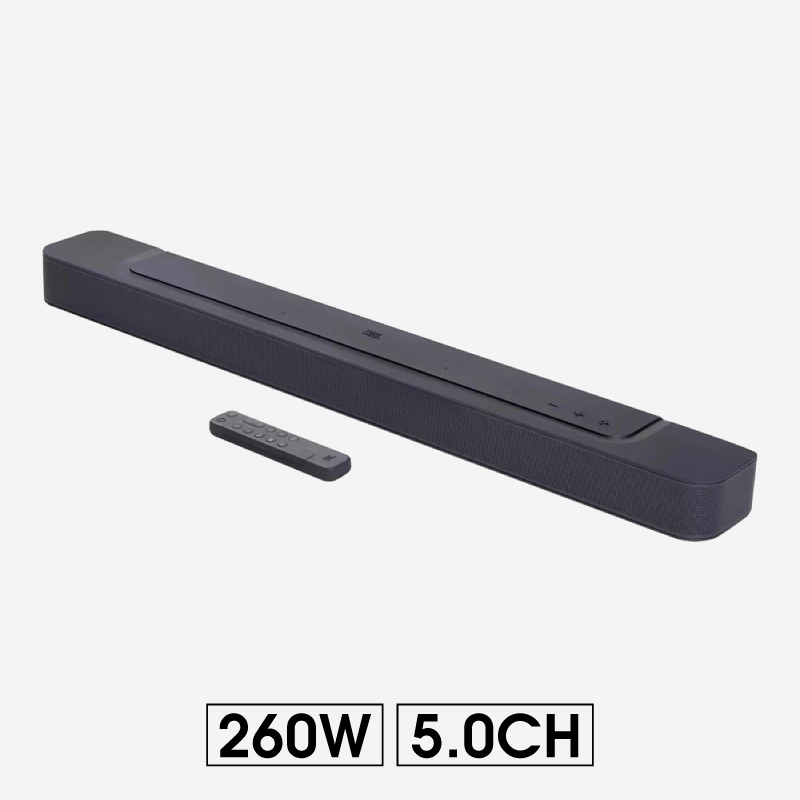
The review begins with a summary of the JBL Bar 300 technical specifications. The soundbar operates with five audio channels to produce sound at 260 watts. The system provides surround sound through its support of Dolby Atmos and MultiBeam while delivering multiple features that include Wi-Fi and Bluetooth connectivity. Biareview executed a basic assessment of the additional features, which included testing the sound calibration system, Chromecast, AirPlay, and voice control functionality, together with JBL One mobile app support.
The JBL Bar 300, together with its “sibling” Bar 2.0 All-in-One MK2, does not include a special subwoofer. The sound quality difference between these two products creates a need for us to investigate it.
The new design presents a compact and stylish appearance. All JBL soundbar products released in 2023 have received design transformations, which extend beyond the Bar 300. Most soundbar companies need new ways to improve their products because they currently show no interest in developing fresh designs which will provide customers with new experiences.
The JBL Bar 300 has dimensions of 820 x 56 x 103.5 mm and a weight of 2.5 kg which makes it simple to transport. Biareview states that during installation the installation space must remain unblocked on both sides of the speaker. This space requirement allows for upward sound projection through the tweeters and the use of MultiBeam technology.
The speaker requires correct positioning because its length requires proper speaker placement to avoid blocking the remote control infrared sensor which works with front placement.
The speaker body uses dark gray plastic material which has a matte surface that prevents fingerprint marks and matches various design styles. The front grille includes perforations which shield the internal speakers while displaying the front drivers and screen.
The top of the device holds physical control buttons with an LED indicator on the left side that shows the current operating state. The built-in microphone next to it serves sound calibration purposes only because Biareview has not yet tested its virtual assistant capabilities. The speaker’s back panel contains all its connection ports. JBL failed to supply wall mounting brackets which leaves users without mounting options.
The JBL Bar 300 displays an attractive yet functional design which matches any environment through its understated appearance.
JBL BAR 300 MK2 5.0 Channel Soundbar with AudioQuest Sky 3m HDMI Cable:
The Internal Hardware Components
Biareview experienced initial confusion while examining the Bar 300 drivers because their actual configuration turned out to be a 5.0 channel system. The reason for this confusion stemmed from the lack of information which showed which driver paired with which channel. The JBL system used three front-facing speakers together with two side-facing speakers.
The soundbar system contains five audio channels which can produce up to 260 watts of sound power according to its technical specifications. Biareview discovered that the site did not disclose its channel-specific output power details. The Biareview report confirms that the system features four racetrack drivers which measure 46 x 90 millimeters and produce sound through two 0.75-inch (20 millimeter) tweeters that face forward and sideward. Biareview determines that the center channel receives audio from the middle two racetrack drivers while the outer racetrack drivers direct sound to the right and left channels and the tweeters operate on the last two channels.
JBL has selected racetrack drivers as the main driver technology for its soundbar products since the last two years. The six drivers create an uncommon setup, yet they are designed to function with JBL’s MultiBeam technology. The sound system provides sufficient audio depth because the soundbar lacks rear speakers. We will evaluate how the two parts operate together to determine whether they fulfill the actual performance claim made by JBL.
The new JBL model now features a built-in bass port which delivers additional bass support. Port systems of that type create extensive amounts of sound. The design exhibits minimal changes yet “it proves superior to lacking anything at all.”
Connectivity and Additional Control Options
The product’s port layout is on the back, from left to right: power input, USB Type-A, Ethernet port for wired connection to a local network, two HDMI ports (one input and one output), and a digital optical audio input (Optical In).
The HDMI ports can transmit 4K HDR10 and Dolby Vision signals while both ports which support HDCP 2.3. The output supports eARC functionality which allows Dolby Atmos playback through Dolby Digital Plus and Dolby TrueHD audio formats.
The equipment needs to use the optical port because its users possess older technology, while the USB port only supports MP3 playback.
Biareview found the HDMI port to provide only limited functionality which became a source of disappointment for them. The soundbar’s eARC function needs to be used when connecting multiple devices because your TV will act as your primary connection point.
The product provides support for 802.11 a/b/g/n/ac/ax WiFi (2.4GHz/5GHz) and Bluetooth v5.0. JBL finally listened and upgraded the Bluetooth module on this product. The upgrade enables better connection to current devices through the new system.
JBL provides a remote control which improves user control and customization options through its new design. The remote control design appears basic because it contains large round buttons which maintain good distance from each other, but its actual button arrangement differs from this initial impression.
The integrated buttons maintain their traditional design, which has remained unchanged throughout. The device contains three buttons, thus there is limited information to provide about it. The buttons provide basic functions because all buttons include a power button together with volume control functions.
Biareview found a tiny opening to the left of the controls which concealed the microphone used for built-in sound calibration.
The soundbar supports HDMI-CEC which allows users to control both devices with their TV remote when their TV also supports this feature. This way, you can use fewer remotes in your entertainment area.
JBL was one of the few brands that didn’t offer a dedicated app for their soundbars. The new products from 2023 bring a long-awaited update which finally delivers this feature. The JBL One app provides complete soundbar control through its compact mobile application. The current version of the app works exclusively with the 2023 Bar series which will only change in future updates.
The JBL One application provides users with a simple and attractive interface which allows them to manage their device while they establish Wi-Fi connections and adjust EQ settings. Users have the ability to customize soundbar settings while they listen to their preferred music through the soundbar’s integrated music platforms.
The Bar 300 works with Amazon Alexa and Google Assistant but these voice assistants need external devices to function. The device includes a built-in microphone which serves to capture audio for sound calibration purposes only.
How do the actual sound technologies function?
The soundbar supports Dolby Atmos along with MultiBeam surround sound technology. The device creates overhead sounds through virtual sound because it lacks an active Atmos driver which results in simulated overhead sound. The system will produce inaccurate results since it uses virtual sound technology to generate overhead sound. Soundbars which use 3D virtual sound technology provide inferior performance when compared to soundbars which employ active sound channels.
The Biareview team discovered that Bar 300 uses MultiBeam technology as their primary sound system. Soundbars face their biggest challenge because they lack dedicated rear speakers which are essential for delivering complete surround sound capabilities. JBL developed its MultiBeam technology which the company used after testing various techniques and technologies on the product.
The system utilizes special tweeters which project sound from both sides to create an extensive sound experience that doesn’t require extra speakers.
The JBL Bar 300 preserves JBL’s core values of creating user-friendly soundbars which deliver functional performance. Users who want an uncomplicated daily experience will find it easier to use the system because it has fewer functions. The device includes a limited number of sound adjustment options.
The first control element enables users to select from five bass levels which determine the strength of bass sound. Users have the ability to enable or disable Dolby Atmos technology based on their viewing preferences. The soundbar produces a superior Atmos sound experience through this feature which users should activate for their movie watching.
The system features a Smart mode which enables users to experience TV shows with their full sound effects. TV shows such as news programs and weather broadcasts require you to disable Smart mode and switch to Standard mode so that you can decrease sound effects. Smart mode uses EQ and JBL Surround Sound settings to produce enhanced audio effects while Standard mode uses Preset EQ to deliver basic audio effects.
PureVoice serves as the final sound feature which the system provides. The soundbar uses PureVoice dialogue enhancement technology to improve vocal clarity which enables users to understand speech more easily.
The technology applies digital signal processing (DSP) methods to identify human speech present in TV shows or movies and extract it for speech content enhancement and analysis purposes. The system automatically increases dialogue volume to deliver crystal-clear speech without interfering with other audio elements. The system handles dialogue enhancement automatically because users do not need to use their remote control to activate the feature. Users can choose to enable or disable PureVoice according to their personal preferences.
The sound settings show everything that exists as sound options. The device lacks additional sound modes beyond the existing ones. The solution works fine for users who want to avoid constant sound mode adjustments. The soundbar provides limited sound options which make it unsuitable for users who want to have multiple sound settings available.
The Bar 300 installation process requires minimal effort. The initial process requires basic setup work. Biareview chose to utilize the device’s pass-through capabilities, so we connected the player to the soundbar itself and tested it with our TV.
You must connect the device to your local network through your LAN network which you can accomplish with the JBL One application. The complete procedure operates smoothly and quickly because it needs only a few seconds or a maximum of one minute depending on how well the device recognizes and establishes connections.
The automatic calibration system needs to run. The process requires minimal time yet provides sound output enhancements. You need to adjust the bass while choosing between smart mode and Dolby Atmos according to your content selection for viewing.
What is the true quality of sound reproduction?
Biareview conducted an evaluation of sound quality through their testing process which involved watching a movie (4K movie trailer) on YouTube and playing digital music on a phone via the JBL One app.
The soundstage extended beyond the device’s physical boundaries because we tested both size and breadth of sound. The speaker provided clear and extensive sound with enough power to fill a 40 m² space at volume level 20. The activation of Dolby Atmos produced a more “powerful” sound experience, yet the system sacrificed audio details.
The soundbar fails to deliver its second important feature because it does not provide its users with surround sound audio. The front speakers of soundbars create an impression that all sound elements exist between two points while their rear space remains unoccupied.
The speaker produces bass sounds that reach only standard listening levels. The outcome provides excellent enjoyment during violent battle sequences which include numerous explosions although the bass fails to deliver the expected explosive “BOOM” sound. The sound experiences compression when users raise the volume to maximum levels because all audio elements contain specific limits.
The JBL Bar 300 delivers adequate performance for its size and functions but Biareview did not find any unexpected results. Biareview showed no expectation for the system to function better than its existing performance because the system has obvious operational restrictions. A significant enhancement will occur for your audio output if you purchase this product because your television sound system delivers extremely poor performance at this price point.
Conclusion
The JBL Bar 300 serves as an ideal soundbar solution for users who require audio equipment for their small living spaces according to Biareview assessment.
Related Posts



Tech Reviewer & Product Analyst
Định Bia has spent over 10 years testing consumer electronics with a focus on smart technology. He work as a product advisor at Biareview where he helped customers find the right devices for their needs. He personally tests every product featured on this site using a consistent evaluation framework covering quality, durability, and value. All reviews are based on experience, not influenced by the manufacturer.