The Mac mini M6 is fast, and with a compatibility layer it runs plenty of Windows PC games.
Macs were never gaming machines. macOS is closed, sure, but the hardware is also unusual, and the big AAA studios make games for Windows first and mostly ignore everything else. Apple’s M6 generation changes that a bit. The new Mac mini plays Windows games a lot better than I thought it would. Below: design, specs, performance, then the games.
Table of Contents
Design
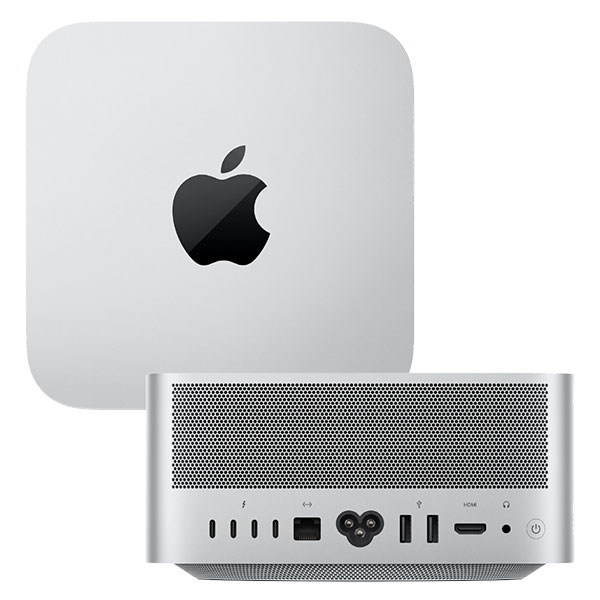
Apple kept the same look. It’s a small, plain square, about 127 x 127 x 50 mm and 670 grams, with a recycled aluminum shell, rounded corners and a glossy Apple logo on top.
| Location | Ports | Standard and speed |
| Front | 2 x USB-C 1 x headphone jack | USB 3 (up to 10Gbps) 3.5mm jack supports high-impedance headphones |
| Back | 3 x Thunderbolt 4 1 x HDMI 1 x Ethernet 1 x AC power | Thunderbolt 4 (40Gbps) / DisplayPort 1.4 4K/8K output 2.5GbE (10GbE optional) Built-in power supply, no external brick |
I like the ports. For a box this small, two USB-C and a headphone jack on the front is generous. Flash drive, memory card, gaming headset: you plug them in without feeling around the back.
The fast ports are at the rear, and the mini can drive three external displays at once. That includes 8K, or 4K at 165Hz or 240Hz. It pulls air in from the bottom and blows it out the back. Day to day it’s close to silent.
Specs
The chip is the Apple M6, made on a 2nm process.
| Component | Spec | Details |
| CPU | 12 cores | 2 Super cores (up to 4.8 GHz) + 4 Performance cores (4.5 GHz) + 6 Efficiency cores (2.9 GHz) |
| GPU | 12 cores | AI accelerators built into the GPU cores; new-generation hardware ray tracing |
| Unified memory | 16GB, 24GB or 32GB LPDDR5X | 153GB/s to 170GB/s bandwidth |
| SSD | 256GB / 512GB / 1TB / 2TB | |
| Wireless | Wi-Fi 7 and Bluetooth 6.0 | Apple N1 networking chip |
| Dimensions | About 127 x 127 x 50 mm | |
| Weight | 670 grams |
Before you order: the RAM and SSD are soldered on, and there’s no upgrading later. If you want to game on it for a long time, get 24GB or 32GB of RAM and 512GB of storage or more.
Performance
It’s still quiet and still barely uses any power. What changed most is graphics. Better ray tracing hardware and new Neural Accelerators push it beyond what the base Apple Silicon chips could do, and it’s much closer to the Pro and Max chips of earlier generations.
Benchmark numbers:
- Geekbench 6 / 7: about 4,000 to 4,600 single-core, 20,000 to 22,700 multi-core. That’s 24% to 48% faster than the M4.
- Cinebench R23: around 2,697 single-core, over 20,200 multi-core.
- V-Ray: the M6’s 12-core GPU scored 1,396 vpath. The M4 Max with its 40-core GPU scored 1,899, so the M6 gets about 74% of that.
Rendering 4K or 8K video in Final Cut Pro, working through batches of RAW photos in Lightroom, running local AI models: everything responds instantly. It idles at about 2.09W, and at full load it still draws far less than a desktop Windows PC with a discrete graphics card.
Gaming
Games made for macOS
Resident Evil Village, No Man’s Sky, World of Warcraft and DOTA 2 all run at max settings at 1080p or 1440p. You don’t have to configure anything.
Frame rates sit above 75 FPS without trouble. MetalFX Upscaling together with Frame Generation keeps the image sharp and doesn’t cost performance.
Windows games
macOS can’t open Windows .exe files, so you need a translation layer: CrossOver, or Apple’s Game Porting Toolkit (GPTK). Both turn DirectX 11/12 calls into Apple’s Metal API on the fly.
I tested a few Windows-only blockbusters through CrossOver:
| Game | Resolution | Graphics settings | FPS | Notes |
| Cyberpunk 2077 | 1080p | High textures, no ray tracing | 37 to 60 FPS (average) | Depends on whether MetalFX is on |
| Resident Evil Requiem | 1440p (upscaled from 720p) | Running through CrossOver | 50 to 55 FPS (heavy scenes), 65 to 75 FPS (light scenes) | Changes with how demanding the scene is |
| Baldur’s Gate 3 | 1080p | Medium to High | 42 to 55 FPS (stable) | |
| Elden Ring | 1080p | Medium to High | 42 to 55 FPS (stable) | |
| 007 First Light | 1440p | Medium | 30 FPS (locked) | Runs smoothly and still looks good |
| Ghost of Tsushima | 1440p | High | 55 FPS | FSR Balanced |
What doesn’t work
Biareview.com has to be straight about this: not every Windows game runs on a Mac. Three things get in the way.
- Kernel-level anti-cheat. VALORANT, League of Legends, Call of Duty and similar online shooters and MOBAs use anti-cheat that can’t run in an emulated setup on macOS. The games just won’t start.
- The 16GB model. Through CrossOver, 16GB fills up, and the system falls back on the SSD as virtual memory. You get small stutters in some scene changes.
- Compatibility bugs. Some games aren’t fully compatible, and a few scenes show wrong colors or flickering light.
I wouldn’t buy a Mac mini M6 only to play games, especially esports or online titles with strict anti-cheat. For the same money, a Windows PC you build yourself with a discrete graphics card plays a lot more games at much higher frame rates.
(CTO) Apple Mac mini: M6 12C CPU – 12C GPU, 32GB, 1TB, 2.5G – Z1UA0004C: Check Availability on Amazon
(CTO) Apple Mac mini: M6 12C CPU – 12C GPU, 16GB, 1TB, 2.5G – Z1UA0003X: Check Availability on Amazon
Apple 2026 Mac mini desktop computer M6 chip with AppleCare+ (3 years): Check Availability on Amazon
Apple 2026 Mac mini desktop computer M6 chip with AppleCare+ (3 years): Check Availability on Amazon
Related Posts