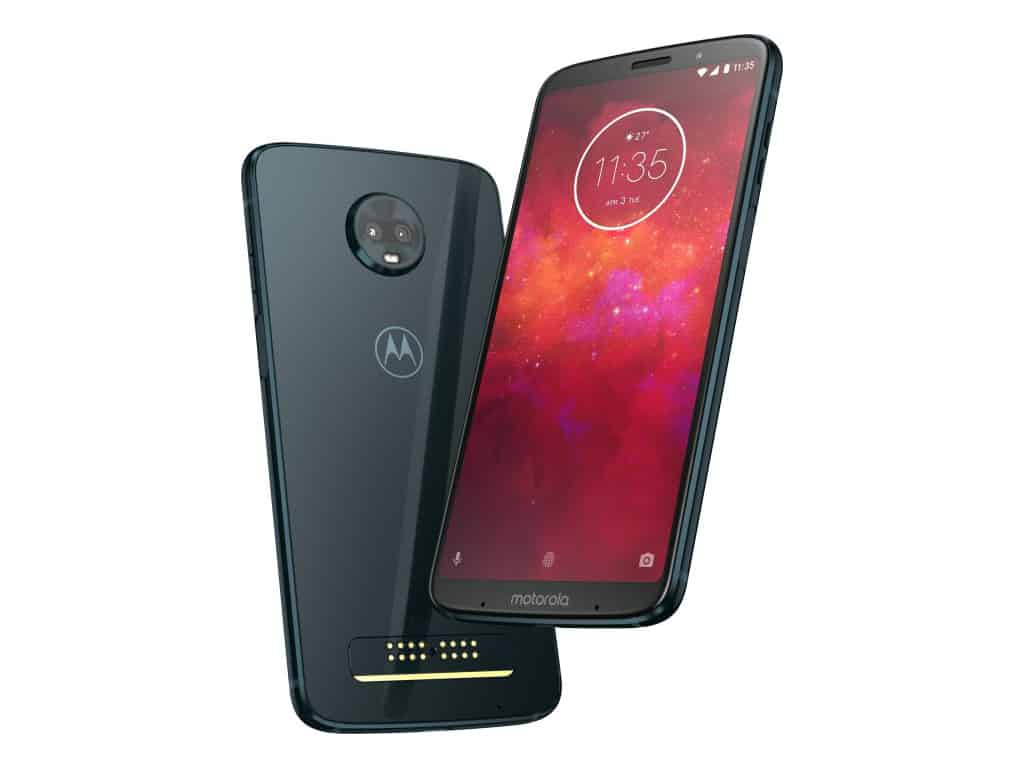
- Design
The design of the Moto Z3 resembles the recently released Moto Z3 Play. There was a clear design difference between the Play and non-Play versions of the Z series, but no longer exists. Aside from the Verizon label on the back of the Moto Z3 and the blue Z3 Play, you wouldn’t be able to tell them apart from the looks alone. Z3 has the same design as the Z3 Play, the same dimensions and no headphone jack.
The Z3 has a beautiful design, a comfortable grip and the thinness of the phone is quite ideal. The fingerprint sensor is mounted on the side – it’s the perfect spot for your thumb if you use the smartphone with your right hand and unlock it. For left-handed users, the sensor with them will not be easy to use.
- The display screen
The Moto Z3 has a 6-inch AMOLED display with 18: 9 aspect ratio similar to Z3 Play, super thin bezels, vivid colors and sharp FHD + resolution. The widescreen display makes gaming and movies great. What’s more, the screen doesn’t glare when viewed in direct sunlight, and the Moto Z3 adjusts the temperature and color saturation of the screen.
- Performance
The Moto Z3 is some sort of big upgrade in hardware, compared to the Z3 Play, like it’s not even on the same level. It comes with a Snapdragon 835 processor , yes it’s not the brand new chipset but it doesn’t ruin the user experience. In other words the Snapdragon 835 is still a solid performance core. The handset also has 4GB RAM. The Moto Z3 runs smoothly, like it just keeps going, and it smoothly handles any task you throw at it. It handles normal everyday tasks like reading emails and surfing the web, social media, and ‘weighing’ all heavy games with high-set graphics.
Battery life on the Z3 was not impressive. With 3000mAh capacity, if you want to use it for 1 day, you can only play some light games, watch YouTube, read emails and surf Facebook.
- Hardware
The main reason people should really buy a Moto Z smartphone is mostly the add ons that roll in with Moto Mods. The newest member in the Moto Mod lineup is the Mod 5G Moto , which is supposed to let the phone hit 5G speeds, so the Z3 ends up being a pretty remarkable handset.
Camera
The Moto Z3 has a 12-megapixel rear lens. This primary camera uses an f / 2.0 aperture plus laser autofocus. There’s also an 8-megapixel front camera for selfies , and yeah it’s basically in the same family spec wise as the Z3 Play. You get things like Cinemagraphs for taking animated photos, and there’s Google Lens integration too.
All in all, the camera does well when there’s plenty of light. Shots come out sharp, with strong detail and nice color. Still, in darker rooms the weakness shows up clearly, which isn’t that shocking since there’s no OIS mode.
Software
The Moto Z3 comes with Android 8.1 Oreo. The navigation gestures are the same idea as the iPhone X or Android Pie , for the default navigation keys. If you rotate your wrist , the display lights up.
That said, besides the applications Verizon already has baked in, there are a bunch of third party apps like Slotomania, Final Fantasy XV, Bank of America, eBay, WeatherBug, and FanDom. You can delete those apps if you want to free up some memory.
Camera Quality
The secondary monochrome sensor on the Motorola Moto Z3 basically exists to help with depth sense for portrait mode pics, and also to pull out a bit more nuance in black and white photography. This dual camera arrangement is paired with a dual tone LED flash, phase detection autofocus (PDAF), and the option to record 4K video at 30 frames per second , which sounds straightforward but it is pretty useful.
Daylight performance
When you’re shooting in daylight, the Moto Z3 camera gives pretty dependable outcomes , you get solid color accuracy and decent sharpness. The 12MP main sensor turns out images with a fair amount of fine detail, and the colors stay natural, not overly loud or too saturated. The dynamic range is decent , but it still feels like it can’t fully keep up with what you’d see on higher end phones. There is HDR too and it tries to help by lifting shadow areas while calming down bright highlights, but sometimes the processing feels a little too forceful, so the scene can look slightly staged or artificial.
As for the monochrome sensor, it’s not as commonly relied on as the primary one, but it gives black and white shots a more particular signature. It tends to catch subtle textures more clearly than a typical color sensor would, so the final images can look genuinely striking. And yes, it also supports portrait shots by giving extra depth information, which then helps produce a more believable background blur , meaning the bokeh looks more measured and less random.
Low-Light Performance
With low light photography, the Moto Z3 sort of struggles a bit more than you’d hope. The f/2.0 aperture is decent, sure, but it isnt really as wide as the f/1.8 or wider options you get on some competitors. Because of that, images shot in dim areas usually end up with more noise, and finer details can look smudged ,especially when conditions are really dark. Its night mode, which is there to help in low-light situations, does improve things a little by brightening the scene, but it also tends to bring in extra noise and it can erase a bit of detail along the way.
Portrait Mode
Portrait mode on the Moto Z3 is helped by the secondary monochrome sensor , which makes it easier to separate the main subject from the background. The edge detection is pretty accurate, and the blur effect looks nice, without being overly aggressive or harsh. Still, it does have trouble when the scene is more complex, like when the background is busy ,or when the subject’s hair blends into similar tones around them. When that happens, you might see little artifacts near the borders, and yeah that can spoil the final look more than you want.
Front Camera
The front camera on the Moto Z3 uses an 8MP sensor with an f/2.0 aperture. In brighter conditions, it performs well , capturing selfies with pretty accurate skin tones and enough detail to keep things looking natural. It also includes portrait mode, and this is done through software-based depth estimation. Overall the results are decent—background separation is usually good but , as with the rear camera, it can stumble with complicated backgrounds where there’s lots going on behind the subject.
In low light, the front camera sort of tapers off , noise starts looking more noticeable, and the fine textures get a bit softer. There’s no dedicated front-facing flash, so the camera kind of leans on the screen to create a flash like glow in dim conditions. This helps , but it’s still not as convincing as a real, dedicated LED flash.
Video Recording
The Moto Z3 can shoot 4K video at 30 frames per second. It can also do 1080p video at 60, or 30 frames per second too, depends on the setup. In general the video quality is pretty solid and looks natural, the colors are calm and the dynamic range is decent when the scene is bright. Still, because it lacks optical image stabilization (OIS) , hand held clips may look unsteady, especially in darker settings or if you’re recording while walking. Electronic image stabilization (EIS) is included and it does help, but it doesn’t deliver the same kind of steady smoothness you get from OIS.
The camera app includes a bunch of modes and useful tools, like slow-motion, time-lapse, and manual controls for people who want more control. The layout is straightforward , it’s easy to browse, and the key options are reachable quickly without too much fuss.
All things considered , the Motorola Moto Z3 camera experience is pretty solid for a mid range phone. In daylight shooting it looks good, and portrait style results are mostly decent too. But when it comes to low light performance and video stabilization, it doesn’t quite get to the same level that more premium devices usually manage.
Battery Life and Charging
The Motorola Moto Z3 includes a 3000mAh battery, and honestly it feels a bit on the smaller side especially for a phone with a 6.01-inch screen. The capacity seems like a side effect of how slim the whole device is, so yes it stays light and pleasant to hold, but there’s a trade off, it just doesn’t chase the very best battery longevity out there.
In day to day use, the Moto Z3 battery is pretty fine for average, not-overly-intense users. Most days, it should get you through a workday with the usual stuff like web surfing, social apps, texting, and some video watching. Still, if you are a heavy user , meaning lots of gaming, frequent video recording, or extended GPS time then you may be grabbing the charger late afternoon, maybe early evening too.
Charging-wise, it brings Motorola’s TurboPower fast charging. With the included 15W charger, you can get a battery jump from 0 to around 50% in roughly 30 minutes. That’s a useful “quick fix” if you suddenly need power mid day. But it’s not as fast as certain rival phones, some of which support 30W or even higher charging speeds.
Another thing , because the Moto Z3 is modular, you can also lean on Moto Mods to stretch endurance. Motorola sells battery pack Mods that snap on the back, they add something like an extra 2000-3000mAh. With those attached, the phone can effectively run much longer, often turning into a full day, and sometimes even into about two days without recharging. The catch is that these battery Mods do add noticeable bulk and extra weight, so if you care about a sleek lightweight look and feel, that extra layer of “mass” might not be for you.
The Moto Z3 also does wireless charging, but only if you slap on a Moto Mod. So, the handset itself… doesn’t really include the required wireless charging hardware, and that’s probably a deliberate design call to keep the body looking as s lim as it can be. Sure, that wireless charging Mod is handy if you already keep wireless chargers around at home or in the office, but it still costs extra, which is not always great.
Overall, the battery life on the Motorola Moto Z3 is sort of OK for casual or moderate users, but if you’re the type who burns through battery a lot, you might feel it runs short. Fast charging helps, and being able to stretch the battery life using Moto Mods is kind of a rare benefit, even if you do pay for it with extra thickness and cost, kinda like a trade in plain sight.
Connectivity and Network Performance
For connectivity, the Motorola Moto Z3 includes the usual lineup you’d expect from 2018. You get 4G LTE, Wi-Fi 802.11 a/b/g/n/ac, Bluetooth 5.0, NFC and GPS. In day to day use, reception and call quality tend to be solid, with a solid signal in most places, and the audio during calls stays pretty clear.
A highlight though is that the Moto Z3 can work with the 5G Moto Mod, which showed up in 2019. With that Mod, the Moto Z3 can connect to Verizon’s 5G network, so it ends up among the earlier phones offering 5G, though it’s tied to an accessory not the internal setup. The 5G Mod is rather bulky, and yeah it adds noticeable weight, but for areas with 5G coverage it does unlock quicker data speeds, which is the main reason people tolerate the added bulk.
It’s worth mentioning that 5G networks were still kinda in their early phase back then, the deployment was limited, mostly to a handful of dense city zones. So yeah, the 5G Moto Mod felt more like a future minded option, instead of a straight up requirement for most people in 2019. Also, the price on that 5G Mod was relatively steep, so it turned into more of an investment play for the early adopters , not a casual add on.
On the Moto Z3 Wi‑Fi performance stays pretty solid, connections are steady , and the reach is decent, not amazing but reliable. The handset supports dual band Wi‑Fi, so it can join both 2.4GHz and 5GHz networks. That’s useful, specially if someone wants to lean into the faster 5GHz side for things like streaming, or online gaming.
Bluetooth 5.0 meanwhile adds better range, along with speedier data transfer compared to older Bluetooth versions. It also supports pairing with more than one device at a time , which is pretty convenient when you move between different accessories like headphones, speakers, and smart watches.
NFC on the Motorola Moto Z3 lets you do contactless payments through services like Google Pay , and it also helps with pairing up other NFC-enabled devices. It’s also one of those handy small things that feels kinda useful if you’ve already leaned into mobile payments or you’re running a bit of smart home automation.
Overall, the connectivity and network performance on the Moto Z3 feel solid, and then you get the extra “bonus” of 5G compatibility thanks to the Moto Mod. But , the 5G Mod itself comes with a pretty noticeable price tag, plus it adds some bulk, so it might only make sense for a smaller kind of buyer.
Value Proposition
When you’re thinking about the value proposition of the Motorola Moto Z3 , you really want to look at the price , what you actually get , and how it stacks up against other phones in the same rough tier. When it launched , the Moto Z3 was kind of positioned as a mid range device, so it was usually cheaper than the flagship kinds of things you’d see from Samsung and Apple.
One big reason people notice the Moto Z3 is the modular design, which is still pretty unusual compared to most other smartphones. The whole idea that you can modify the phone’s capabilities with Moto Mods is a unique selling angle, especially for users who like the concept of extending a phone’s usefulness over time. Still, the Moto Mods don’t come free, and those add-ons can start to become expensive, and the extra thickness may not be the vibe for everyone.
When it comes to the hardware, the Moto Z3 feels pretty strong, you get the Snapdragon 835 chipset, a nice display, and a camera that’s honestly decent for the price you’re paying. That said, it runs into some pretty stiff competition from a bunch of other mid range phones, the ones with newer processors, more RAM, larger batteries and sometimes more sophisticated camera setups. For instance, around the same period, handsets like the OnePlus 6 and the Samsung Galaxy A8 (2018) basically looked like more tempting picks, they brought newer features and they were often priced similarly, or maybe just a bit higher.
The Moto Z3’s main selling point is the kind of flexibility it has, mostly because of the Moto Mods. If you’re the sort of person who really likes the idea of upgrading your phone bit by bit, like swapping in a better camera add-on, boosting endurance with an extra battery module, or even getting 5G support, the Moto Z3 gives you a customization style that not many other brands manage. But, there’s a catch, and it’s a common one. To actually get the best use out of the phone, you may need to buy extra Mods, and then the whole thing can end up costing more than what you first expected.
Also, you should think about how long the Moto Z3 will stay “worth it” in a modular sense. Motorola has talked about continuing support for the Moto Mod ecosystem , but whether new Mods keep showing up over time is still kind of uncertain. Especially once newer phone models flood the market. That uncertainty can affect how valuable it feels to buy into the system, if the modular selection doesn’t keep growing, or if certain Mods start feeling irrelevant when newer devices arrive.
Durability and Build Quality
The Motorola Moto Z3 has a look that’s sort of sleek and very modern, with a glass front and back, plus an aluminum frame. In the hand it feels solid, premium too, and the weight comes across as nicely balanced even if the phone is kind of thin. Overall the build quality is pretty great, with tight tolerances and nothing that really looks loose or like it has weak points, no obvious gaps, not even under closer attention.
That said, the glass back, while stylish , is kinda going to show smears, fingerprints, and the usual smudgy marks, unless you keep wiping it. So yeah it can start to look less sharp over time, or at least not as clean unless you’re regularly cleaning it. Also, since it’s a glass-backed model, it can crack or even shatter if it hits the ground. For that reason, a case is pretty much the simple, sensible move if you want to safeguard the device.
Another part of the overall durability that really stands out is that water-repellent kind of coating. The Moto Z3 isn’t fully waterproof, and it also doesn’t have an official IP rating, so yea its not “protected for everything”, but that nano-coating does help a bit with minor mishaps. Think of it as some extra safeguard railings for accidental splashes, light rain, or even smaller spills. It gives people a touch more reassurance, but you should still stay away from heavy moisture situations, and don’t treat it like it’s invincible.
Also worth thinking about for durability is the Moto Mods system, because yeah, the whole setup is sort of central to how the phone feels over time. The magnetic connectors on the back of the phone are well engineered, built to handle repeated snapping on and off of Mods. Still, if someone is swapping Mods pretty often, like daily or every couple hours, they might eventually see a bit of fraying or surface wear on those connector points, or on the Mods themselves. That wear and tear could then play into long term reliability, even if everything starts off solid.
Audio and Multimedia
For audio, the Motorola Moto Z3 gives you a decent multimedia experience, though it is held back by the single bottom firing speaker. This speaker is able to deliver pretty clean sound, and the midrange and treble are pretty nice. But it doesn’t really bring the kind of depth plus bass you might expect if there was a stereo speaker setup. When you push the volume higher, the audio can turn thin or a little sharp, and distortion shows up more easily, especially during music or videos where the low end is heavy.
Then, there is the headphone situation. Having no 3.5 mm headphone jack is gonna be annoying, especially for folks who still use wired headphones. At the same time, this phone does come with a USB-C to 3.5 mm adapter in the box , so you can still hook up wired audio if you want it. Motorola probably ditched the jack so the Moto Z3 could stay slim, but honestly, it feels like a give and take situation, and that might not land well with everyone. Still, some people will notice it pretty quickly, and that won’t be a surprise.
If you’re the type that likes wireless audio , the Moto Z3 has Bluetooth 5.0 on board, and that usually means cleaner sound and better pairing with earbuds , headphones and even little speakers. In day to day use the Bluetooth actaully holds up well, decent reach, fairly steady links, so for people who have already moved away from wired audio it feels like a sensible choice.
And yeah, the display like mentioned earlier is pretty handy for videos and gaming . You get bold colors plus deep blacks, and the 18:9 layout works nicely with most modern video formats. The Full HD+ resolution keeps things crisp, so footage and images don’t look fuzzy. On top of that the AMOLED panel brings strong contrast, which makes movies and TV shows feel more immersive on the phone, not just “watchable”.
Conclusion
The Motorola Moto Z3 is one of those devices that feels a bit distinctive because it mixes reliable mid-range power, a fairly clean Android vibe, and that modular flexibility people associate with Moto Mods. The overall design looks sleek , modern, and polished, and you also get a good screen along with a camera that’s decent, especially when lighting is good. Battery performance is fine for average or moderate usage, and the ability to stretch it with a battery Moto Mod gives it extra flexibility depending on the day.
However , the Moto Z3 is still not without its compromises. The missing 3.5mm headphone jack , the lack of optical image stabilization and yes, a smaller battery capacity are basically the deal makers that helped it stay so slim. Also, the phone kind of leans on Moto Mods for things like 5G connectivity and wireless charging, so if you want the full flow you end up needing extra accessories , and those can quietly pile up in price.
In terms of value , the Moto Z3 really hits hardest for people who like modularity, and who see 5G as part of a futureproof plan. But if you care most about camera quality, longer battery endurance, or you want 5G right away with no additional gear, then other phones out there may feel more worthwhile.
To wrap it up, the Motorola Moto Z3 is a good fit for users who enjoy its distinctive modular setup and are prepared to buy Moto Mods to improve the experience. It strikes a decent compromise between performance, design, and software smoothness, though it also runs into stiff competition from other mid range and flagship models that bring more “ready to use” features. So overall, the Moto Z3 is probably better for those who are curious about tweaking things through modules and personalization, not for anyone hunting the absolute newest smartphone tech in one self contained device.
Motorola Moto Z3 MOTXT192917 Verizon Locked Edition 5G Capable – Ceramic Black (Renewed): Buy it now
Motorola Moto Z3 MOTXT192917 GSM/CDMA LTE Unlocked Droid Edition 5G Capable – Ceramic Black: Buy it now
Related Posts



Tech Reviewer & Product Analyst
Định Bia has spent over 10 years testing consumer electronics with a focus on smart technology. He work as a product advisor at Biareview where he helped customers find the right devices for their needs. He personally tests every product featured on this site using a consistent evaluation framework covering quality, durability, and value. All reviews are based on experience, not influenced by the manufacturer.