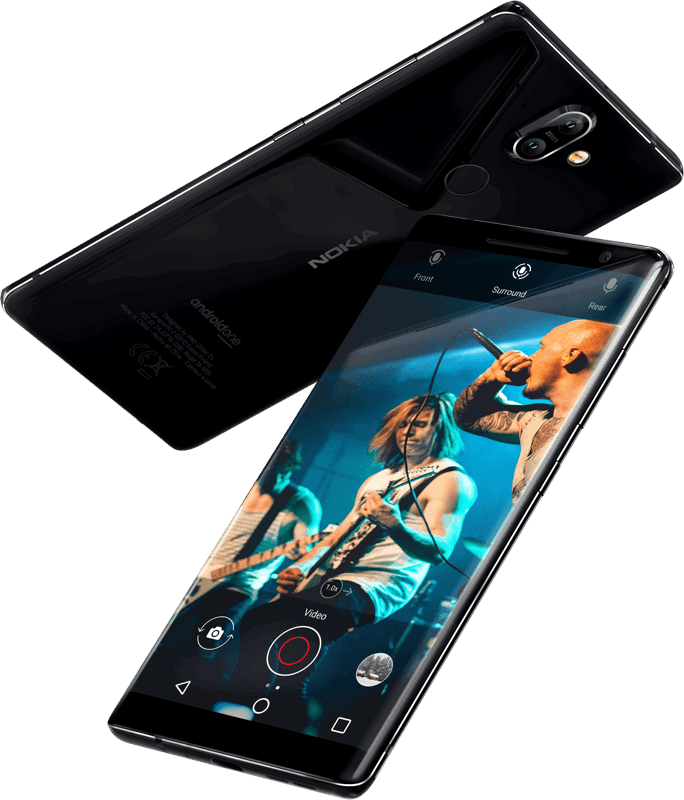
Nokia 8 Sirocco was officially unveiled at the MWC 2018 event, with dramatic changes in design and features such as curved screen, fingerprint sensor, or Nokia Camera holographic photography application. Right now, let’s have a look at the latest Nokia !
This is an upgrade from the predecessor Nokia 8 introduced before 2017, however Nokia has brought a lot of interesting surprises around the name Sirocco.
Design and Build Quality
One of the most striking things about the Nokia 8 Sirocco is honestly how it looks and feels. Nokia went out of their way, like, all out, to make sure the Sirocco actually stood out in that crowded market. The device is crafted from a single block of stainless steel, so it’s both sturdy and it gives this premium kind of vibe that can stand up to some of the best options out there. And the stainless steel part really matters , because it’s different from the more typical aluminum or glass bodies that you see on plenty of smartphones. That contrast creates a distinct kind of hand feel, almost a little luxurious.
On the front and the back, you get Corning Gorilla Glass 5, and it curves right into the stainless steel frame along the sides. So the whole thing ends up looking smooth and pretty, like there isn’t really a hard break between materials. Those curved panels do more than just look good though— they also help the phone seem slimmer, and they make it feel more ergonomic in daily use, even with its heavier weight of 177 grams. Also, the curved edges bring to mind the Samsung Galaxy S series, which a lot of people treat as a kind of signature feature for premium styling.
The phone is also, weirdly enough, incredibly slim, coming in at just 7.5mm at its thickest point . That svelte kind of profile makes it pretty easy to tuck into a pocket or even a purse, and it feels really good in the hand because of the smooth rounded edges. But of course , the slim design does carry a little trade off—there’s no 3.5mm headphone jack. This was already fading out on flagship phones around that time, but a lot of people still really missed it. Nokia does include a USB-C to 3.5mm adapter in the box, so if you use wired headphones you can still work around it, with no drama.
On the back, the look stays minimalist. There’s a centrally placed dual-camera module, and you’ll spot a Zeiss logo on it, plus a dual-tone flash. Under the camera sits a circular fingerprint sensor, which feels pretty neat and uncluttered. Right below that, the Nokia logo is put on pretty clearly, so the overall vibe stays clean, polished, and kind of sophisticated. The fingerprint sensor itself is responsive and accurate, but honestly some users might think the placement is a bit high , so you might need a small stretch to reach it comfortably.
All things considered, the design and build quality on the Nokia 8 Sirocco are top-notch. It feels premium in pretty much every way, from the materials used to the small attention to detail in how it’s constructed. Still though , it isn’t perfect. The curved glass is nice to look at, yet it also makes the phone more likely to slip and get dropped by accident. And because the whole thing is glass all around, it can feel a little slippery in practice. A case is highly recommended, both for protection and for grip that actually holds up.
- Curve and glass
The Nokia 8800 Sirocco comes with a screen that spans over 95% of the screen space on the front and back of the phone.
However, Nokia still makes a difference when it comes to keeping the 16: 9 aspect ratio instead of the 18: 9 screen. This number has helped Nokia 8 Sirocco become square, stronger when holding on.
The sensation of the first time was quite strange and embarrassing because of the 16: 9 ratio on the screen overflowing. Do not worry too much as you will soon get used to the old but new rates on the Nokia 8 Sirocco.
The 5.5-inch pOLED screen has a 2K resolution, wrapped around both the front and back of the Corning® Gorilla® Glass 5th generation tempered glass to minimize scratches and breakages in basic collisions.
POLED sounds weird but actually this is the OLED screen that works on plastic backing materials. The performance and display quality of the Nokia 8 Sirocco is judged similar to the AMOLED on the curved screen Galaxy line.
Fingerprint sensors are also “moved gently” to the back just below the camera clusters to increase the display area and display the true meaning of a curved, seamless screen.
- Powerful camera upgrade
Instead of using the 13MP f / 2.0 camera module as its predecessor, the Nokia 8 Sirocco has been significantly upgraded with a dual camera cluster that combines 12 MP wide angle, f / 1.7 aperture and 13 MP telephoto angle f / 2.6. This improves the experience and quality of shooting in a variety of lighting conditions, especially in low light conditions.
Lenses that are made by the well known maker ZEISS can help you get the highest quality and strong fidelity in every single picture. In particular, the Nokia 8 Sirocco comes with Pro Camera mode, where you can tweak a bunch of shooting parameters like shutter speed , ISO, manual focus, and white balance.
The front of the camera is no different than the previous predecessor with 5MP camera (wide angle of 84 degrees) which enhances selfie capability and group video calling.
- Configure the flagship and Android One
Nokia 8 Sirocco is the next product of Google’s Android One project, with commitments to support the longest and fastest update of security patches, future operating systems.
In addition, the machine is also equipped with a powerful configuration: Snapdragon processor “last year” 835, 6GB RAM with a very good battery 3,260 mAh. With the rear-facing glass, the Nokia 8 Sirocco is also equipped with wireless charging capabilities.
The next change comes from doing away with the 3.5mm audio jack and just folding it straight into the USB-C port, so basically you would have to use the included audio transmitter when you want to connect audio to your headphones. Like, no 3.5mm system anymore.
Performance
Under the hood, the Nokia 8 Sirocco is powered by the Qualcomm Snapdragon 835 processor, which back then was kind of a high-end, top tier type of chipset yeah. The Snapdragon 835 has an octa-core layout that can push up to 2.45 GHz, and it’s paired with the Adreno 540 GPU, so overall it feels pretty speedy. Then, you also get 6GB of RAM , and 128GB of internal memory, so overall performance should stay steady. Unfortunately that storage cannot be expanded, since there’s no microSD card slot, period.
Performance wise, the Nokia 8 Sirocco handles everyday stuff pretty confidently. Browsing the web, jumping between social media apps, or multitasking between multiple apps feels fluid, no real lag that you’d notice. The 6GB of RAM is kind of the quiet hero here, it keeps apps resident in memory longer, so switching tasks usually doesn’t force a reload.
Gaming performance is pretty solid as well, mostly thanks to that strong Adreno 540 graphics unit. The handset can do most modern games on high settings without too much hassle. Titles like Asphalt 9, PUBG Mobile and Fortnite feel smooth, with decent frame rates and nothing that really feels like a big, sudden drop. However the device does tend to get warm on longer sessions , mainly near the top, right where the processor sits. This kind of behavior isn’t that unusual on phones with a metal frame , metal conduct heat more quickly than plastic or glass, so the warmth shows up faster.
Back then, the Snapdragon 835 was considered a flagship processor in 2017, but by the time the Nokia 8 Sirocco showed up in 2018, it had already been replaced, sort of, by the Snapdragon 845. So yeah, the Sirocco was a little behind the curve, if you look at pure processing muscle versus other top-tier phones launched around the same period. Still, for most people using it day to day, that gap ends up being pretty tiny, basically negligible, and the Snapdragon 835 remains plenty capable for the usual stuff, photos, browsing, messaging and all that.
Where the Nokia 8 Sirocco really stands out is the software side of things. It runs Android in a close to stock state, and that’s tied into the Android One program. In practice, this gives you a clean, bloatware-free layout, software updates that arrive in a more timely way and an emphasis on security. Also, because the manufacturer doesn’t pile on extra theme changes or deep custom features, the phone feels smooth overall, with fewer random background tasks, and no heavy skins, that tend to make everything feel a bit slower, after a while.
Overall, the Nokia 8 Sirocco performance comes off as solid, especially if you care about the clean software feel, and the hardware that doesn’t really feel flimsy. It might not be the most muscle-heavy flagship on the market, sure, but for most people it’s more than enough, and that near-stock Android experience kind of does the selling for it, in a very straightforward way.
Software and User Interface
One of the more noticeable things about the Nokia 8 Sirocco is its software experience, it’s pretty much the main personality. Since it’s tied to the Android One program, you get a near-stock Android, so the user interface stays clean, and it avoids that extra clutter, or whatever you want to call the usual bloatware. There’s also less heavy customization, no big skin overlays pushing things around, which is a big plus if you just want a pure Android experience, without extra “helpful” add-ons that other companies tend to cram in.
When it first launched, the Nokia 8 Sirocco shipped with Android 8.0 Oreo, and then later it moved to newer versions, including Android 9 Pie and Android 10. The whole “timely updates” idea is basically the point of Android One, and Nokia has mostly stuck the landing here, with frequent security patches as well as the bigger OS upgrades.
The user interface on the Nokia 8 Sirocco feels pretty simple and intuitive, with a layout that will seem familiar to just about anyone who has already used a Google Pixel, or some other Android One device. The home screen looks clean enough, with a Google Search bar down there at the bottom and a row of apps you use a lot sitting above it. If you swipe up from the bottom, you get the app drawer, and that’s where all installed apps appear, listed alphabetically.
The Settings menu is also well organized, and it’s easy to move around in, because the big options are grouped into sensible categories. Since there’s no real bloatware, there are fewer pre-loaded apps to sort of mess up the app drawer, so people end up with more say in what apps they actually want to install and use.
One of the nice parts of the stock Android experience is that it often runs more efficiently, and it’s usually less taxing on resources, compared to heavily modified skins like Samsung One UI or Xiaomi’s MIUI. That helps, because there are fewer background processes eating up CPU time and battery. With this kind of streamlined software experience, the Nokia 8 Sirocco can get more value from its hardware, and users should see a responsive, quick, no-lag feel across a bunch of everyday tasks, more or less.
Nokia 8 Sirocco TA-1005 128GB Black GSM ONLY (FACTORY UNLOCKED) 5.5″ 6GB RAM ( LTE BANDS 1,2,3,4,5,8,20,28,34,38,39,40,41) – International version: Buy it now
Nokia 8 Sirocco TA-1005 Single Sim – 128GB/6GB – Android One – Factory Unlocked GSM – International Version – No Warranty in the US – Black: Buy it now
Related Posts





Tech Reviewer & Product Analyst
Định Bia has spent over 10 years testing consumer electronics with a focus on smart technology. He work as a product advisor at Biareview where he helped customers find the right devices for their needs. He personally tests every product featured on this site using a consistent evaluation framework covering quality, durability, and value. All reviews are based on experience, not influenced by the manufacturer.