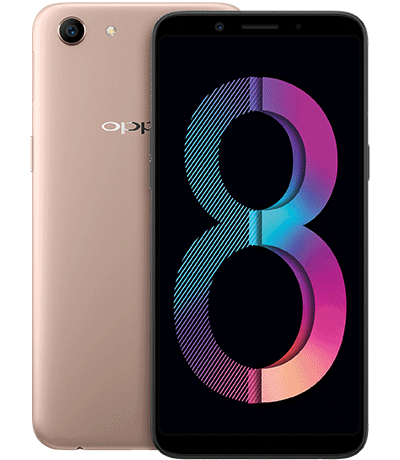
The OPPO A83 is a low-cost device, but comes with a 18: 9 aspect ratio display, good configuration and excellent selfie camera.
Pros
Sleek, compact design.
Monitor 18: 9 trends.
Good configuration with Helio P23.
Selfie quality camera.
The battery life is comfortable enough.
Cons
Plastic shell design.
Fingerprint remover.
Design and Build Quality
The OPPO A83 has a design that looks modern enough, and also feels pretty ergonomic in the hand. It measures 150.5 x 73.1 x 7.7 mm , and it comes in at around 143 grams, so it stays fairly slim and light, which makes it easier to manage with just one hand. The body is made from a quality plastic, but it’s finished in a way that mimics metal , so you get that “premium” sort of feel even though the pricing is clearly on a budget side.
Up front, you’re greeted by a 5.7-inch display, with narrow bezels running along the sides and slightly more noticeable ones at the top and the bottom. There’s no physical home button, so the whole face looks cleaner and more minimal. The power button sits on the right side, while the volume rockers are placed on the left, both are easy to reach and they respond in a satisfying way, no real lag when pressing.
Flip it over and the back is pretty straightforward. There’s one camera lens along with an LED flash, arranged vertically in the top left corner area. The rear panel is smooth, with a gentle curve that helps your grip, and the OPPO logo is centered, sitting roughly around the middle. One thing though, it does not have a fingerprint sensor, it instead leans on facial recognition for biometric security , which is a different approach than many similar phones.
All in all, the OPPO A83 looks simple, but in a neat way. The build quality feels solid, and it quietly contradicts the affordable tag. The materials they chose, plus those small construction touches, add up to a device that feels a bit more expensive than you’d expect.
Configuration is no longer really the point of failure, the interface sort of looks like F5, and yeah that is what I noticed.
From the early days of the F-series, OPPO was sort of “stuck” with the slogan Low-cost machine. Through the generations, by the time it hit the end of 2017 OPPO seemed to refresh itself with “Refesh” along with a bunch of shiny F5 like it was the only plan.
And this time, the A83, priced under $200, comes with a Helio P23 chip paired with 3 GB of RAM, plus 32 GB of ROM. It’s not exactly a rocket or a sort of superpower chip, but compared with the usual baseline out there, it is a big deal. Especially when you compare the A83 with older F1s, or F3 era devices, or even with a lot of “real” phones that stay under $200.
The Oppo A83 also does not just stop at basic level anymore, it can basically handle light gaming and popular titles like Mobile, Asphalt 8, Morden Compat, and stuff in that vibe.
The OPPO A83 is still on Android 7.1.1, and the ColorOS 3.2 interface has plenty of playful tweaks. You get things like theme switching, Speed Up Game, split screen, duplicate app accounts, and more… plus it feels a bit like OPPO F5 or F5 Youth.
Screen size 18:9 under the cheap segment
Overflow, super thin, or Full view, are kind of phrases that you saw again and again across mid 2017, then later they became the normal “template” for smartphones. Asus with the Zenfone Max Plus, and OPPO too, they basically give users an 18:9 display even when the price is less than $200.
The 5.7-inch panel with IPS brings decent viewing angles and the colors look a bit brighter.
Outdoor brightness is fine , but at night the brightness ramp can feel a little too soft, so it causes some eye strain if you binge-screen too long.
If you compare it with other 18:9 devices in the same bracket, Vivo V7 and Mobiistar Prime X Max 2018 are mostly just HD+, so honestly I don’t see that as a major minus point.
Performance
So under the hood , the OPPO A83 runs on the MediaTek MT6763T Helio P23 octa-core processor. It has a clock speed of up to 2.5 GHz which is pretty solid for the price. Depending on which version you get, you’ll see either 2GB or 3GB of RAM, and for storage there’s 16GB or 32GB inside. Now the interesting part is that the storage can be stretched further too, with a microSD card slot that supports as much as 256GB.
For everyday use , the OPPO A83 feels fine when you’re just doing the usual stuff. Web browsing, social media scrolling, and messaging all go through without much friction. The Helio P23 is a dependable mid-range chip, meaning most applications stay responsive and generally “smooth.” With the 3GB RAM model, switching between apps usually feels steady, and multitasking doesn’t feel too punishing. Still, if you pick the 2GB RAM variant, you might notice it getting a bit more crowded, especially with heavier apps running at the same time, and that can cause random hesitations.
About gaming performance, it’s… OK, but in a casual sort of way. Games like “Subway Surfers” and “Temple Run” typically run well, no big drama. When you move to graphically heavy games such as “PUBG Mobile” or “Asphalt 8,” they can be played, but mainly if you lower the settings. The Mali-G71 MP2 GPU handles rendering in a decent manner, but it’s really not built for serious, high-end gaming, so yeah, it’s best to keep your expectations realistic and not chase ultra visuals.
One of the standout features on the OPPO A83 is its facial recognition tech, which is kind of shockingly fast and also accurate for a budget phone. The face unlock part basically leans on the front-facing camera to map the user’s face and it can unlock the handset in under a second, which sounds simple but it really does feel quick. Sure, it might not be as tight as a fingerprint sensor, or the more advanced facial recognition you get on higher-end models , but in day to day use it holds up well across most lighting setups. And yeah, it brings that extra bit of convenience to the overall vibe of using the device.
All in all, the OPPO A83 lands as a pretty satisfying option for its price bracket. It’s not exactly a beast, but it still gives enough grunt for normal tasks and casual gaming. If you’re the type who cares about performance , you might want to look at the 3GB RAM version for a touch smoother feel in regular use.
Software
The OPPO A83 runs on ColorOS 3.2, which sits on top of Android 7.1 Nougat. ColorOS is OPPO’s own skin, it modifies the standard Android experience pretty heavily , so the interface feels different and you also get extra goodies. Some people probably will enjoy all the extra themes and added extras, but others may feel the software is a bit too much, or just not as close to clean Android as they expected.
On ColorOS the user interface looks pretty colorful and, honestly kinda charming, with rounded icons plus a layout that feels clean and light. The notification shade and quick settings panel seem to be tuned to fit the same vibe as the rest of the OS, so nothing feels too out of place. Also there’s no app drawer by default, so basically every installed app ends up sitting on the home screens, kind of like iOS but not exactly the same. If someone really wants an app drawer though, they can usually turn it on from the settings, which is nice.
ColorOS 3.2 ships with a bunch of pre installed apps and extras. For example, there’s a theme store so users can customize the overall feel of their device using themes, wallpapers, and different icon packs, it’s all part of that personalization idea. There are also handy functions such as split screen multitasking , which lets you run two apps next to each other, and a built in screen recorder that’s good for capturing what’s happening on screen.
A big deal with ColorOS is how it handles optimization for battery life and performance. The system offers multiple power saving modes that can extend battery by putting background processes on a leash, and by dialing down screen brightness. On top of that, the OS is designed to allocate resources in a more intelligent way, so you can still get smooth performance even if the device is on the lower end.
However, there are some downsides to ColorOS, and yeah it’s not exactly a perfect fit for everyone. The heavy customization can create a bit of a learning curve for users who are used to stock Android or other Android skins that feel more straightforward. Also, the software might feel somewhat bloated, mostly because of several OPPO-branded apps, plus other third party apps that are already on the device. Even if some of those apps can be uninstalled, others can’t be removed, and that’s the kind of thing that can get annoying fast for certain people.
Then there’s the update situation. The OPPO A83 launched with Android 7.1 Nougat, which was already kind of outdated at the time. OPPO’s software update record is a mixed bag , so some users might not get timely upgrades to newer Android versions. If you care a lot about the latest software, and especially security patches, that could end up being a real drawback.
So, in short, ColorOS 3.2 on the OPPO A83 delivers a feature-rich, good looking user experience, but it might not match everyone’s taste. It’s tuned for efficiency and battery life, however the heavy personalization , along with the possible shortage of updates , could be deal breakers for a portion of users.
Camera
The OPPO A83 has one 13 megapixel rear camera with an f/2.2 aperture, plus an LED flash, so yeah it’s fairly straightforward. Up front there’s an 8 megapixel camera with f/2.2 aperture too, and it’s made for selfies as well as facial recognition stuff. Even if the camera setup feels kinda basic, OPPO still slipped in a handful of features and small tweaks to make photos feel a little better overall.
When the lighting is good , the rear camera of the OPPO A83 does pretty well. You get solid detail, pleasing color accuracy, and a decent dynamic range, nothing too dramatic but it works. The camera app includes a set of modes like HDR, Panorama and Expert, and that last one is where you can mess around manually, like ISO and white balance, and also shutter speed. The HDR option is especially helpful when the scene has strong contrast, still sometimes the output looks a bit strange, like overly processed, you know.
In low light, though, the OPPO A83 camera starts showing where it cuts corners. In darker rooms or night settings the phone has trouble getting sharp shots , and noise starts to stand out more. Since there’s no optical image stabilization, OIS, you basically have to hold the device steady or expect blur. The LED flash can rescue things in very dark moments, but it also tends to throw harsh light around, and faces can end up with unnatural skin tones.
The front-facing 8-megapixel camera feels pretty solid for selfies and video calls. It takes shots with nice detail, and the skin tones look fairly natural, but yeah it can have trouble when the lighting gets dim , pretty much like what you’ll see with the rear camera too. OPPO also sneaks in its AI Beauty Recognition technology, it basically uses artificial intelligence to level up selfies by smoothing skin, brightening eyes, and doing a few other small, tasteful tweaks. This beauty mode is a hit with people who like their photos more polished, however you can switch it off if you want something more plain and real.
As for the camera app on the OPPO A83, it’s easy enough to use and it comes with a bunch of options that support better photography. You get filters, stickers, and different modes depending on what you’re shooting. The Expert mode stands out if you want more say over how things look, because it lets you adjust exposure, ISO, and white balance, so you can land on the result you’re after. There’s also a “Portrait” mode, and it leans on software tricks to imitate a shallow depth of field, so the background gets blurred and the subject pops. Still, since the OPPO A83 doesn’t include a dedicated depth sensor or a dual-camera setup, the bokeh vibe from Portrait can occasionally look a bit artificial, and the app may struggle a little with recognizing the subject’s edges correctly.
Video recording on the OPPO A83 is pretty normal for a budget device, more or less. It can do up to 1080p resolution, at 30 frames per second, (fps) which is the typical setup. In everyday light the footage looks decent, colors come out quite accurate and the finer details are there too. But once the lighting drops , things get rough, noise shows up sooner and you can feel the loss of detail, kinda noticeably. Also there is no optical image stabilization, so if your hand isn’t very steady the video can turn shaky, even a little movement becomes obvious. Because of that, you might end up leaning on a tripod or at least a stable surface, to keep things smooth.
Taken as a whole, the camera work on the OPPO A83 is good enough for casual photos, and for social media stuff. It won’t really compete with higher-end phones, especially when it comes to darker scenes. Still, it gives you the basics in a straightforward way, and the overall quality is solid if you mostly take pictures and record in brighter environments, while wanting something simple, easy to use, and not too complicated.
Connectivity and Audio
The OPPO A83 comes with a bundle of connectivity options that you’d kind of expect from a smartphone in this price range. There’s dual SIM, dual standby, so you can run two SIM cards at the same time which is nice for people trying to keep work and personal separated, or for anyone who travels a lot and wants access to different networks.
On the mobile side it includes 4G LTE, so you get quicker data for stuff like browsing, streaming, and downloading. For the “around the house” connections it also offers Wi-Fi 802.11 b/g/n, Bluetooth 4.2, and GPS, plus the classic 3.5mm headphone jack. That jack is still a welcome thing for users who like wired headphones, or who just don’t want to rely on adapters.
One thing it doesn’t have is NFC. So, no contactless payments, which could feel annoying for those who are used to Google Pay or similar tap-to-pay services.
As for audio, the OPPO A83 delivers decent sound but it isn’t really anything standout. The single bottom-firing speaker can get plenty clear at normal listening levels, and it works fine for casual videos , music, or hands-free calls. Still, the overall sound feels a bit flat, with limited bass and less “weight” in the low end. That’s pretty normal on a budget phone. If you crank the volume up too far, you may notice some distortion, so headphones, or at least something better than the built-in speaker, can make the experience more enjoyable.
The 3.5mm headphone jack being included on the OPPO A83 is kind of a win, because it means you can plug in your own wired headphones or earbuds , and you dont really need extra adapters or anything like that. On top of that it also has Bluetooth audio support, so you can pair wireless headphones , or even speakers if that fits what you want, for a less fussy listening setup overall.
As for call quality the OPPO A83 does pretty well, voice sounds clear enough and the connection stays stable while you’re on a call. There is also noise-cancellation tech, which helps cut down the usual background hum , so the other person on the line hears you more cleanly. And the dual SIM side works smoothly too, you can move between SIM cards without hassle, no weird delays or interruptions.
Compact design with hands
In the ultra-slim bezel language, the 18: 9 aspect ratio makes the OPPO A83 extremely compact and easy to operate with one hand. I sometimes mistakenly think that the machine is only about the size of the traditional 5.2-inch screen.
Talking about a bit of material, the A83 still uses a plastic plastic frame with soft curved angles. If the OPPO F5 is the most advanced device in the series and still has a plastic case.
The minus for me is probably the removal of fingerprint sensor, 2018 and a smartphone lacking fingerprint security is quite short of breath. Of course with popular smartphones, many of you will not care much about this factor.
In return, the speed of face recognition and unlocking extremely fast, looks like OPPO has removed the transition effects. The 7/10 test is very good, but I still do not trust the security of the face of the Android.
Still king of cheap segment selfie
When it comes down to price range under $200, OPPO will not forget to feature Beauty A.I for A83 selfie 8 MP camera.
I personally do not know what A.I do, but generally OPPO has reached a certain rank in the algorithm do “miraculous” user face.
The 13 MP main camera of the OPPO A83 delivers better quality than expected with automatic HDR mode, which improves the narrow range dynamic range of low-cost cameras.
Overall, you can not expect superior quality from low-end machines, the A83 gives you enough photos and better expectations at home and in complex lighting conditions. If the light is too low, it should be kept firm, otherwise the picture will be very easy to shake.
Battery life is enough for a day
Equipped with a 3.180 mAh battery, and with a HD resolution screen, I personally expect a comfortable working day.
On average, with a day off from charging at 8am, using 4G seamlessly with Chrome browsing, Facebook, Messenger, online music, Soundcloud, photography, … more 6 hours is 20% battery life.
Oppo A83 CPH1729 (Black) 3GB RAM, 32GB Internal Memory- Unlocked International Model, No Warranty (Free Universal Charger): Buy it now
OPPO A83 (Champagne, 4GB RAM, 64GB) with offers – Unlocked International Model, No Warranty: Buy it now
Oppo A83 CPH1729 (Champagne) – Unlocked International Model, No Warranty: Buy it now
Related Posts






Tech Reviewer & Product Analyst
Định Bia has spent over 10 years testing consumer electronics with a focus on smart technology. He work as a product advisor at Biareview where he helped customers find the right devices for their needs. He personally tests every product featured on this site using a consistent evaluation framework covering quality, durability, and value. All reviews are based on experience, not influenced by the manufacturer.