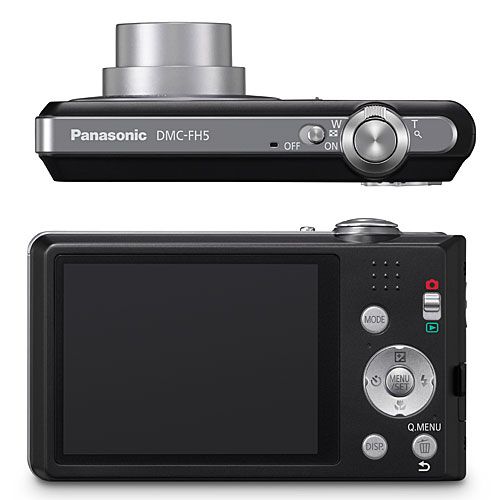
With just a few minor changes, FH5 has not yet emerged, not just against rivals in other companies but even with its predecessor.
Panasonic put out the FH5 and the FH2 together, and honestly they’re nearly the same camera. Same body, same features, same everything — except the FH5 got a 16-megapixel sensor where the FH2 stuck with 14. Depending on the market, these two versions are code-named FS18 and FS16 respectively.
The Lumix FH5 is an upgrade from the Panasonic Lumix DMC-FH3 that came out some year ago with some changes such as a 14 mega pixel increase to 16 megapixels, Leica stills, but the optical zoom drops from 5x to 4x, Holds 28mm, but the focal length is reduced to 112mm instead of 140mm. In return, the body is made thinner, only 19mm. The Lumix FH5 has a 2.7-inch LCD screen and 720p HD video recording at 24 frames per second.
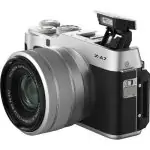
Panasonic Lumix DMC-FH5 16.1 MP Digital Camera with 4x Optical Image Stabilized Zoom with 2.7-Inch LCD (Black): Buy it now
Panasonic Lumix DMC-FH5 16.1 MP Digital Camera with 4x Optical Image Stabilized Zoom with 2.7-Inch LCD (Silver): Buy it now
98 x 57 x 22mm, 130 grams with the battery in. It just disappears into a pocket — that’s really all this camera was trying to do.
Plastic build, which is normal at this price and not worth holding against it. Matte finish, resists fingerprints okay, controls sit right where your hand expects them. Nothing fancy here, but nothing’s broken either.
The layout is simple enough that a beginner picks it up in five minutes — mode dial on top, buttons under your thumb. Grip is modest, and if you’ve got bigger hands you’ll feel it. Fine for most people though.
16.1-megapixel CCD sensor — decent resolution for the class, good color, manageable noise at moderate ISO. A CCD this size was never going to touch CMOS in low light, and it doesn’t pretend to. Sharpness holds up fine across the frame — corners go a bit soft wide open, but you’d have to be looking for it. Colors look right, white balance doesn’t get thrown off by mixed lighting, and the default contrast is close enough to good that there’s not much reason to touch it in editing. Nothing surprising — which, for a camera like this, is kind of the point.
Low light is where it struggles. ISO 80-1600, fine at the bottom, noticeably noisy by 1600. The f/2.5 aperture helps some, but there’s only so much a small sensor and a modest lens can do together. In good light this camera is happy. In a dim room, you’ll hit the ceiling fast.
Autofocus is contrast-detection — accurate, not fast, and it’ll struggle with anything moving quickly or with the lights turned down. Shutter lag stays low though, so everyday snapshots come out when you expect them to. There’s a burst mode too, handy for grabbing a few frames and picking the best.
Battery runs 250-300 shots per charge, which covers a normal day out. Anything longer, bring a spare.
The screen is 2.7 inches at 230,000 dots — low-res even by the standards of its own era, and you’ll notice it trying to judge focus critically. It’s usable in most light, struggles outdoors in direct sun like basically every small screen does. You get full auto, the standard scene presets portrait, landscape, sports, night and just enough manual control over exposure and white balance to tweak things if you want. That’s about the ceiling for this camera.
Video caps at 720p, 30fps, no stabilization, no manual focus while recording. Fine for casual clips, not much more. Connectivity is USB and AV-out only — no wireless of any kind. Storage runs on SD, SDHC, or SDXC, with an easy-to-reach card slot.
Compared to what’s out now, the gaps show fast. Canon’s PowerShot Elph 190 IS gets you a 10x zoom, f/2.8, built-in stabilization, and Wi-Fi plus Bluetooth. Sony’s WX220 goes further still — a CMOS sensor that actually handles dim light, 18.2 megapixels, a 10x zoom with real stabilization, and Wi-Fi of its own. Nikon’s Coolpix S7000 pushes to 20x zoom and shoots proper 1080p video. And Fujifilm’s XP130 skips the spec race entirely — it’s rugged and waterproof, a genuinely different kind of camera for people who want to take it somewhere the FH5 couldn’t survive five minutes.
None of that erases what the FH5 does well. It’s small, it’s simple, it’s cheap, and the images are good enough for everyday shots and posting online. That’s the deal, and it holds up its end. What you’re giving up is real low-light ability, any wireless connection, a sharp screen, and meaningful manual control — and depending what you need, that trade might be perfectly fine.
Related Posts



Tech Reviewer & Product Analyst
Định Bia has spent over 10 years testing consumer electronics with a focus on smart technology. He work as a product advisor at Biareview where he helped customers find the right devices for their needs. He personally tests every product featured on this site using a consistent evaluation framework covering quality, durability, and value. All reviews are based on experience, not influenced by the manufacturer.