At the launch event Roborock put forward some very impressive numbers for the G30S Ultra. With expensive home-care appliances, however, the numbers are only a starting point. What buyers really need to know is whether the machine solves the familiar everyday problems: the space underneath furniture, hair that wraps around the roller, food and grease stains that are hard to wipe away, and the smell that develops after long use.
Specifications
The spec sheet is strong: 41,000 Pa of suction, 75°C hot water for mopping, 100°C water for washing the roller, a body height of 89.8 mm, and the ability to climb a double step of 4.5 cm and 4.3 cm.
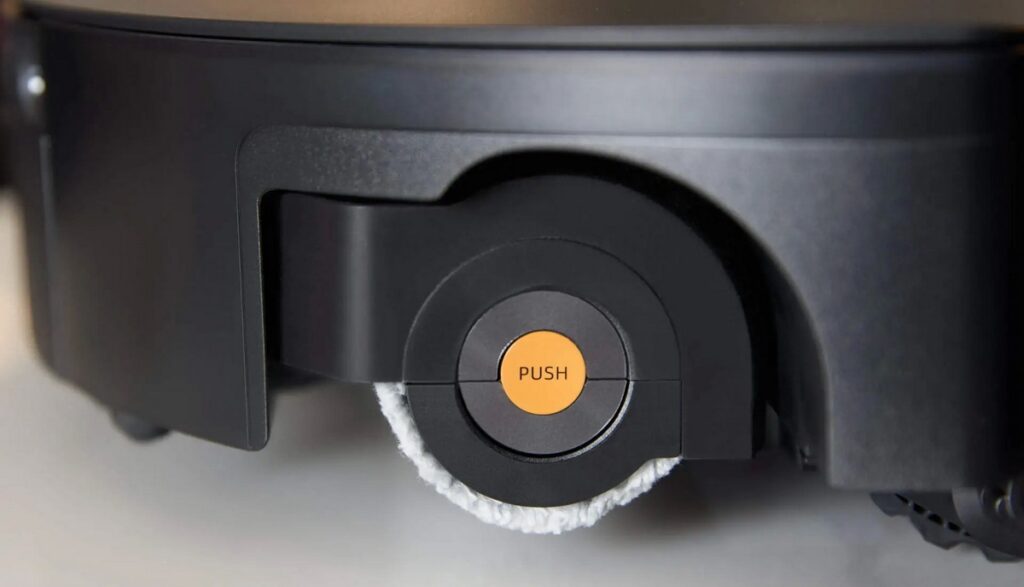
The biggest change in the G30S Ultra is the move from a flat mop pad to a roller with a pressurised hot-water mopping system. Roborock argues that traditional flat pads have an inherent limitation: when they meet sauce, milk or a sticky spill, the pad soaks up the dirt and then drags it along, smearing the stain across the floor.
With the G30S Ultra, the company says the roller design fixes this. The roller has 16 spray holes that continuously feed it with 75°C water, spins at 240 rpm and presses down on the floor with 15 N of force. Behind the roller sits a floating squeegee blade that scrapes off the dirty water and returns it to the waste-water tank. This spray–scrub–squeegee–recover cycle cleans the roller immediately after each pass, so dirt is not carried over to the next patch of floor.
In hands-on testing, tomato sauce smeared on the floor came up almost completely in a single pass. The 270 mm roller is wide enough to cover the area behind the wheels as well, so the floor shows few wheel tracks during wet cleaning. With the water level set to medium in the app, the damp trail left behind was very faint and dried quickly.
Noteworthy features
The 8.98 cm body is remarkably slim, and that matters because a roller takes up a lot of internal space and normally makes this type of robot thicker. That extra thickness is why furniture with a 9–10 cm clearance underneath is so often skipped and ends up collecting dust over time.
The G30S Ultra uses a retractable LDS turret. When it meets a low-clearance space, the laser sensor on top drops down so that the overall height falls to just 89.8 mm. Roborock claims this makes it the slimmest roller-type robot currently available, although it is still thicker than the G30S Pro (79.8 mm, which uses a flat mop pad).
Roborock also lists a number of other features in the G30S Ultra that are worth noting:
- The roller can extend outward to mop right up against walls and furniture legs, leaving a gap of under 10 mm.
- On short- and medium-pile carpet, the roller lifts by 15 mm and the roller cover drops to reduce direct contact with the carpet and limit water soaking in.
- The Reactive AI system recognises more than 300 household objects — slippers, cables, bathroom scales and so on — with a reaction time as fast as 0.2 seconds so it can steer around them.
- An integrated RRMind GPT model lets you ask about cleaning statistics or diagnose faults by voice, and the robot supports Apple Home (Matter).
- A free-swivelling caster assembly plus two drive wheels allow it to clear a double step of 4.5 cm + 4.3 cm.
Tested against a balcony sliding-door track almost 8 cm high, the robot got over it in about 30 seconds by lifting its wheels and rotating the swing-arm assembly — so you can comfortably put the dock out on the balcony if you want to.
Impressive cleaning performance
The G30S Ultra delivers 41,000 Pa of suction, 1,000 Pa more than the P30 Pro (40,000 Pa). Tested with powdered seasoning and larger debris, the floor was essentially clean after one or two passes. In homes with pets or long-haired occupants, however, anti-tangle performance matters just as much as raw suction. Roborock says the G30S Ultra comes with a full set of anti-tangle measures covering the side brush, the main brush and the wheels.
The main brush uses a double conical spiral structure with V-shaped grooves angled at 45°, and the two brush sections run at different speeds to separate clumps of hair before funnelling it toward the centre and into the suction inlet. In testing, long threads scattered on the floor to simulate hair were picked up completely, and when the machine was opened up for inspection the main brush showed no signs of tangling.
The mechanical extending arm on the side brush has been removed, however, to make room for the roller, the water lines and the dual side brushes that can raise and lower. The right-hand side brush can reverse direction at wall corners and extend its bristles; the manufacturer’s figures put the improvement in right-angle corner coverage at 30%. In practice, cleaning along walls and in corners remains satisfactory with these changes.
The dock, water supply and drainage
The plumbed version of the Roborock G30S Ultra automates almost the entire water cycle, while the water-tank version has the advantage of needing no installation. In an apartment of around 100 m², the user has to change the water themselves after roughly three deep-mopping runs, and if the home is empty for several days mopping can be interrupted. So the plumbed version is the one to go for if your situation allows it — at that point only two tasks remain manual: changing the dust bag and topping up the cleaning solution.
Cleaning solution is held in a 400 ml compartment in the machine, with three settings (off, standard, high). According to Roborock’s figures, a 100 m² home mopped daily will only need the solution refilled about three to four times a year. The solution travels with the water through the roller, onto the floor and back into the waste-water tank. The dust bag in the dock holds 2.7 litres and only needs emptying after a little over two months (roughly six times a year). The dock also has a bag-drying mode to discourage dust mites.
After mopping, the robot returns to the dock and washes the roller inside its own body using 100°C water, independently of the washing tray. Dirty water does not run through the tray at the base of the dock, so the tray needs almost no routine maintenance. The tray has a flat, dirt-resistant surface and is removable. After washing, the dock dries the roller with 63°C hot air; the drying time or a schedule can be set in the app.
When maintenance is needed, the floating squeegee blade, the dirty-water channel, the roller, the waste-water tank and the dock’s washing tray can all be removed for cleaning or replacement. The waste-water tank has a simple construction and its filter screen includes an antibacterial, anti-clogging treatment; usually it only needs to be taken out and rinsed.
Easy installation
In China, Roborock provides a free at-home installation service for the plumbed version — the buyer just scans a code to book an appointment — and that service is also offered in Vietnam. Doing it yourself is not particularly difficult either, since the box includes a 2-phân (≈6 mm) supply hose, a 3-phân (≈9 mm) drain hose, cable-wrap tubing, a tap-water filter screen, an inlet valve (with gasket), plus locking clips and a blanking plug.
- Both the water inlet and the drain port sit on the underside of the dock, and the connectors swivel, which makes it easier to turn the fairly stiff hoses in a tight space.
- The supplied three-way valve can be fitted straight onto a 4-phân (≈12 mm) angle valve: one outlet feeds the robot while the other still serves the washing machine or whatever appliance was already connected. The valve has its own switch, so the water supply can be shut off while you are away.
- The supply hose simply pushes firmly into a self-locking quick connector. The harder it is pulled, the tighter the lock grips. To remove it, you first press in the grey collar. Once connected, fit the locking clip (the small blue pin) as well to prevent the hose slipping out and leaking.
- The drain hose is fitted the same way, with the other end connected to an existing drain tee. The box includes a tap-water filter screen to catch silt, sand and larger particles. If you are concerned about water quality, you can add a whole-house inlet filter.
Summary of strengths and weaknesses
The Roborock G30S Ultra’s main strengths and weaknesses are as follows:
| Strengths | Weaknesses |
| • A 75°C hot-water roller that squeegees and recovers dirty water, handling sticky messes such as sauce very well. • The slimmest body among roller-type robots according to the manufacturer, while still navigating accurately under furniture. • Clears a double step of 4.5 cm + 4.3 cm; also tested over a sliding-door track of nearly 8 cm. • 41,000 Pa of suction, and the DuoDivide main brush showed no tangling in testing. • The plumbed dock automates almost everything: automatic detergent dosing, a 65-day dust bag, 100°C washing and 63°C drying. • Easy to install, with a free installation service available. | • Expensive — roughly $890 for the plumbed version. • The mechanical extending arm for the side brush has been dropped, although in practice corner coverage did not noticeably suffer. • The body is still thicker than the flat-pad G30S Pro (7.98 cm). |
Conclusion
The G30S Ultra packs a hot-water roller system into a body just 8.98 cm thick, mopping with 75°C water, washing itself with 100°C water, and pairing end-to-end anti-tangle engineering with 41,000 Pa of suction. It suits people with high expectations for floor cleanliness, homes with pets or a lot of shed hair, and homes with wood-grain tile where water streaks show easily — and it is notably low-maintenance.
Related Posts