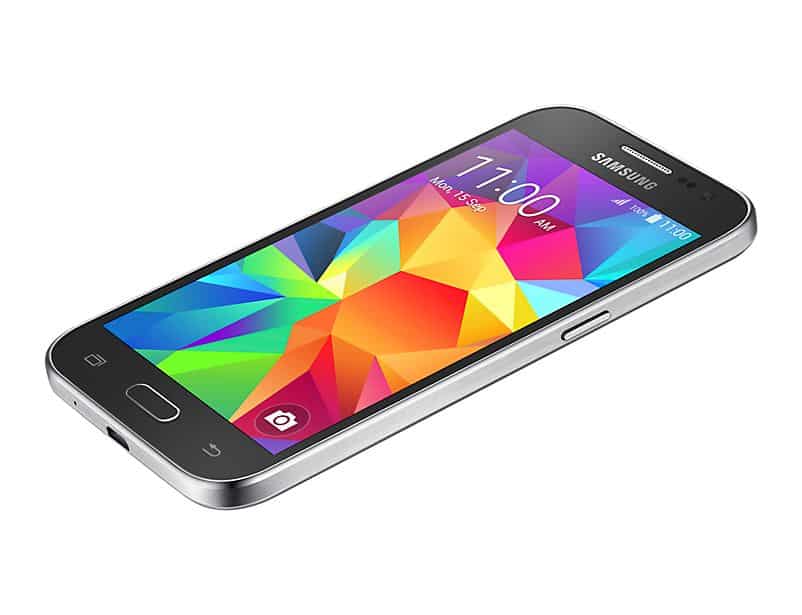
Design and build
- 4.5-inch screen, resolution 800×480
- Density of pixels: 207 pixels / inch
- Size: 5.2 inches; 2.7 inches; 0.35 inch
- Weight: 130 grams
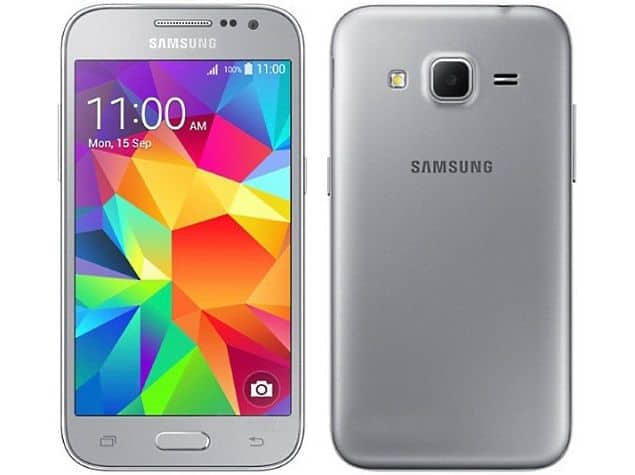
Overall, in terms of design, the machine possesses much of the same detail as most of Samsung’s predecessors (except for the recently launched Samsung Galaxy S6): Home button, rounded corners, battery slot and memory card MicroSD. The camera is equipped with 5MP rear camera and flash, while the front camera is only 2 megapixel support selfie shooting.
The 4.5-inch display screen makes the device easy to handle. However, the resolution of 800×480 pixels makes viewing the screen outdoors difficult.
Interface and applications
Samsung Galaxy Core Prime is only running Android 4.4.4 KitKat, not the latest version of Android 5.1 Lollipop. However, Samsung said, the device will be quickly upgraded to Android M.
Like other Samsung product lines, the TouchWiz interface and many additional applications and settings (such as the Ultra Power Saving Mode) are also installed. In addition, the home screen is set up quite simply, making use easier.
Display
4.5-Inch PLS TFT Display
The Samsung Galaxy Core Prime comes with a 4.5-inch PLS TFT display , showing 480 x 800 pixels so you get something like 207 PPI. Now, yeah the sharpness is on the lower side compared to modern phones, but back when the Core Prime was released, that resolution was pretty normal for budget handsets in general. The display is capable of displaying decent colors and brightness levels, but it is far from the sharp and vibrant displays found on higher-end smartphones.
Viewing Experience
The PLS (Plane to Line Switching) TFT display technology used in the Galaxy Core Prime offers some advantages over traditional TFT displays, such as better viewing angles and improved color reproduction. Even so, the display still misses the mark a bit when it comes to contrast , and especially the black levels, if you compare it with AMOLED or IPS panels. It also isn’t as bright as the more premium devices, so in direct sun light it can feel kinda tricky to actually see what’s on screen.
The lower resolution means that the text and pictures might look a bit pixelated, specially when you zoom in on photos or try reading small print. But for normal use, like web browsing, checking emails and hopping between social media apps, the display stays good enough, does the job, no huge drama.
Touch sensitivity
The Galaxy Core Prime’s display touch sensitivity is usually pretty good, it seems to react accurately when you tap or do swipes. It also handles multi-touch, so you can do pinch-to-zoom and a few other touch based actions, you know the usual stuff. But compared to the more expensive smartphone screens, this one can feel a bit less responsive… like it’s not as snappy, and there might be a touch of lag in certain moments.
Durability
The Galaxy Core Prime screen isn’t protected by Corning Gorilla Glass, or any other high strength glass tech, so it tends to be more vulnerable to scratches and cracks. It’s honestly a good idea to use a screen protector along with a protective case, to keep the display in decent shape. Also, since the device is made with plastic, the screen can pick up pressure marks if it gets hit pretty hard or gets forced in some way.
Camera
- The rear camera: 5 megapixel (default is 3.9)
- Front camera: 2 megapixels
- 720p video recording
Users can freely choose the mode: Auto, Panorama, Beauty Face, …. To take photos easily. In addition, you can manually set the machine through the Setting menu: image resolution, ISO, metering, white balance and exposure, …
The rear camera brings brilliant color pictures when shooting outdoors. However, in low light conditions, the image quality will be lower. Users can increase the brightness of the photo using the flash. Video on the machine capable of 720p HD video recording at a decent level, audio recording is normal. Outdoor video recording will produce clearer images and clearer sound.
Performance hardware
- Processor: 1.2GHz quad-core Qualcomm Snapdragon 410
- Memory: 8GB; RAM 1GB
- Extended storage: 128GB
- Battery: 2,000mAh (removable)
Equipped with the quad-core 1.2GHz Qualcomm processor, Samsung Galaxy Core Prime has the same power as other midrange smartphones. Navigation on the machine is quite stable.
Through testing, the transition of videos and songs is pretty fast, the device takes a few seconds to initialize the camera. Despite its poor screen resolution and fast touchscreen performance, the Core Prime delivers smooth gaming experience.
Samsung Galaxy Core Prime G360M/DS – Unlocked (White): Buy it now
Samsung Core Prime SM-G360Z Cricket 4G LTE GSM 8GB 5MP Flash – White: Buy it now
Samsung Galaxy Core Prime SM-G360T1 (Metro PCS) – White: Buy it now
Battery life and connection
Samsung says the Core Prime’s 2,000mAh battery can last up to 10 hours on 3G, 9 hours on video and up to 11 hours on Wi-Fi internet.
The device supports LTE network connectivity, Wi-Fi 802.11 b, g, n. The download speed of the machine usually ranges from 30 to 40Mbps and the upload speed is usually in the range of 20Mbps. Through the actual test, the product supports a lot of applications, downloading pages over the LTE network very fast.
Samsung’s Galaxy Core Prime is a fairly simple smartphone with a very attractive price.
In the same segment, the LG Lucid 3 ($ 200- $ 4.34 million) has much the same specs as the Core Prime but has a larger screen (4.7 inches), higher resolution (960×540-pixel) And larger capacity battery (2,440mAh). In addition, this competitor outperformed Samsung’s product thanks to 1080p HD video recording and integrated wireless charging. The only downside of the device is that the front camera only gets 0.3 megapixels.
On the other hand, if you own the Microsoft Lumia 735 ($ 192), you’ll experience a clearer screen (1,280x720p resolution) and a “top” camera (6.7MP at Back, 5MP on the front). This device will give users a lot of benefits when regularly using Google services.
Another option that comes with Core Prime is Motorola’s Moto E 4G LTE. This smartphone has a starting price of less than $ 150 but has similar specifications to Core Prime. However, the 2 megapixel camera in front of Core Prime easily “beat” completely selfie camera of Moto E 4G LTE (0.3 megapixel).
Multimedia and Audio
Multimedia Experience
Samsung’s Galaxy Core Prime gives you a pretty basic multimedia experience , and it handles the usual audio and video formats. You get Samsung’s built in music and video players too, so it’s mostly a plain simple way to run your files. If you want more flair, you can grab third-party apps from the Google Play Store and mix it up a bit.
The 4.5-inch display is alright for watching videos, but the resolution is pretty modest, so high-definition movies won’t look nearly as crisp as they would on fancier phones. Streaming is possible , like YouTube and Netflix, yet the whole thing feels more comfortable for short clips than long watching marathons, if that makes sense.
Audio Quality
On audio, there’s just one single rear firing speaker on the back. It’s decent but not impressive , the sound is basically average. In a quiet room it’s loud enough for music and video playback, but once you push the volume up too far the audio starts to sound rough or distorted. Also , because the speaker faces backward, it can feel a bit muffled if the phone is set down on a flat surface.
If you want a cleaner sound, you can use wired headphones or external speakers through the 3.5mm headphone jack. There aren’t premium extras here , like Dolby Atmos or built in equalizer modes, so people who like tweaking the sound will likely have to depend on third party audio apps.
Weaknesses
Outdated specs : the 1GB of RAM, and the Snapdragon 410 processor seem fine on paper but they really cap the device’s performance,so it can feel slow with newer apps ,and multitasking.
Limited storage : the 8GB of built in storage runs out fast, especially if you install several apps or keep lots of media.
Old software : Android 4.4 KitKat is pretty dated now, and since there are no official updates past that version it can bring security worries and compatibility problems.
Basic camera : the 5MP rear and 2MP front cameras handle simple shots and videos, but the results are plain compared with devices that offer richer modes and smarter features.
Overall Verdict
The Samsung Galaxy Core Prime, although it was a decent budget phone back when it came out, it has a lot of boundaries in today’s smartphone world. Honestly it fits best for people who just need a basic handset for everyday actions, and who don’t really care about the newest bells-and-whistles or updated software. If someone wants snappier performance, more advanced functions, and fresher system support then moving to a newer model would make more sense.
To wrap it up, the Galaxy Core Prime once did its job as an entry level smartphone but now it feels like a relic from an earlier chapter of mobile tech. It also shows how quickly the industry keeps moving, and how fast “modern” becomes “old”, sometimes before you even notice.
Related Posts



Tech Reviewer & Product Analyst
Định Bia has spent over 10 years testing consumer electronics with a focus on smart technology. He work as a product advisor at Biareview where he helped customers find the right devices for their needs. He personally tests every product featured on this site using a consistent evaluation framework covering quality, durability, and value. All reviews are based on experience, not influenced by the manufacturer.