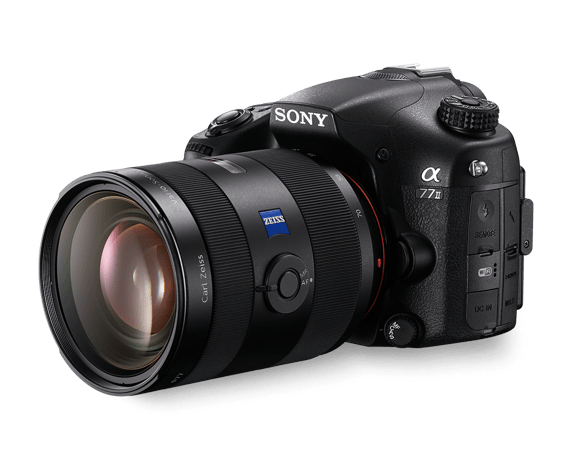
Beautiful design
The dimensions of the Sony A77 Mark II are 142.6mm x 104.2mm x 80.9mm while its weight is around 726g when combined with battery.
The Sony A77 Mark II, inherited from the standard model body, is 95% similar to the Sony A77. The body is made of polycarbonate but has a magnesium frame for a durable and firm feel. But still, the Sony A77 Mark II possesses some changes that can be the mark of its uniqueness:
Icon and Label for Controls are more user-friendly.
Built-in AF-assist illuminator with standard ISO518 built-in Flash (same model as A99, Nexus6, A6000, …).
The addition of silver instead of red letters.
Sony Alpha Mark A77 II takes away the D-pad and replaces it as Navigation Bar.
In general, those are changes that won’t bother any users upgrading to the Sony A77 Mark II.
Internal features
Sony A77 Mark II uses 24.3MP APS-C as found in previous generation A77 but sensing tech, on the other hand, is new within Sony A77 Mark II just as it was on high line A7/A7R recently introduced. Image processor is Bionz X-the latest model. The 23.5 x 15.6 mm sensor size results in very high pixel density.
The Sony A77 Mark II offers a total of 79 focus points, including 15 cross-type focusing points. That paired with the phase-in and center-focus for phase detection enhances the versatility of AF for focus and focus locking. The Bionz X processors offer users incredibly exciting features-with up to 12 frames produced every second, the machine can save up to 60 high-quality JPEGs before going into full buffer mode. It can also store up to 25 JPEG RAW images before buffering, a remarkable enhancement on the Sony A77 Mark II. The new upgrade is especially for those who love capturing high-speed action scenery like wildlife shooting, athlete sports, and much more.
The Quick Customizable Features of the Sony A77 Mark II line are Flexible Spot, Wide, Local, Zone, Expanded Flexible Spot and Lock-on AF. The feature Lock-on AF allows the camera to clutch the subject as it moves while it locks the subject. This feature was previously found in the old Sony A77 but time taken to customize the menu. In Expanded Flexible Spot, you can have one center crosstype point but with eight satellites, or points around an area to be able to support motion subject movement. In Zone AF mode, you will have nine are as to focus on 40% coverage area.
Connectivity
The Alpha 77’s successor, the Sony A77 Mark II, comes with Wi-Fi added. But there is no GPS connection so that the location of the image can be tagged. The A77 II can share images and also have its remote screen controlled by mobile apps through Wi-Fi and NFC.
Sony A77II Digital SLR Camera – Body Only: Buy it now
Sony Alpha A77 II Wi-Fi Digital SLR Camera Body with 55-200mm Lens + 64GB Card + Case + Flash + Battery & Charger + Kit: Buy it now
Sony Alpha A77 II Wi-Fi Digital SLR Camera & 16-50mm Lens with 55-200mm Lens + 64GB Card + Battery & Charger + Backpack + Flash + Kit: Buy it now
Sony Alpha A77 II Wi-Fi Digital SLR Camera Body with 18-135mm Lens + 64GB Card + Battery + Charger + Backpack Case + Filters + Flash + Kit: Buy it now
Performance
Sensor and Image Processor
The Sony A77 II is equipped to obtain the exceptional 24.3 MP APS-C Exmor CMOS imager and link it to the BIONZ X image processor; and they do exactly that in a very superior manner. Performance is also improved with the noise reduction and dynamic range enhancements to overall performance from the BIONZ X processor. Therefore, an effective photographing now with a resolution of about 24.3 Megapixels is sufficient for all possible uses, from large prints down to very detailed, small crops.
ISO Performance
The native ISO range is 100-25,600, and it can be expanded to ISO 50-51,200. This broad ISO range adds flexibility in using the camera under different light conditions. With decent performance at high settings, the camera is sufficiently quiet up to ISO 3,200. Beyond that noise morphs into being significant but carried off with appropriate post-processing noise reduction techniques.
Continuous Shooting Speed
The A77 II hits 12 fps at the top end, which puts it among the fastest in its class. That matters most for sports or wildlife, where the subject moves too fast and too unpredictably for a slower burst rate to keep up. The buffer backs it up — 60 JPEGs or 25 RAW files per burst, so you’re not stuck waiting for the camera to catch its breath mid-sequence.
Autofocus System
Phase Detection and Hybrid AF
One of the A77 II’s most remarkable features is its autofocus system. It consists of a 79-point phase-detection system combined with 15 cross-type sensors into a compact and very straightforward centerpiece of advanced technology. This hybrid AF system provides very fast focusing with excellent coverage of the frame, enabling the very fast and accurate focusing of subjects while on-the-move and converting action shots into dynamic compositions with precise focus.
Focusing Points and Coverage
Given the 79-point phase-detection system, which covers a very wide area of the frame, the camera’s capability to lock onto and track subjects improves significantly. The scope of 15 cross-types shades into the focus with improved accuracy when it is not located in the center of the frame. Such coverage allows for well-precise focusing and tracking, which in a lot of ways recommends the A77 II to action or sports photography.
Low-Light Performance
Low-light conditions do not bother the A77 II at all; it considers an F number of about -2 EV to display good focusing ability, considering that it thus allows for focusing in dimmer environments. This strength in focusing is good for low-light photography and nighttime images.
Image Quality
Resolution and Detail
The A77 II’s sensor, with its 24.3-megapixels, has a very high quality in both the aspects of resolution and detail. This would permit very large prints, or indeed very detailed cropping. Capture of detail and fineness in textures leads to the overall quality of the image. The camera’s sharpness and clarity performance are superior, and this is due to the high detail the Exmor CMOS sensor brings.
Color Reproduction
Accurate and vibrant colors are popular tonal qualities on the A77 II, attributable to the adept color science and sensor technology. Picture styles cover the basics — Standard, Vivid, Portrait, Landscape, and a handful of others enough to shape the look in-camera if you don’t want to shoot flat and edit everything later. RAW is there too, for when you’d rather have full control in post instead of committing to a look upfront.
Dynamic Range and Noise Control
The A77 II is commendable when it comes to dynamic response in good detail recovery of highlights and shadows. Noise control holds up well — at ISO 3200 there’s barely anything to complain about. Go higher and it creeps in more, but decent noise reduction in post handles most of it. Credit goes to the BIONZ X processor here; it’s doing more of the heavy lifting than people probably realize.
Video Features
Full HD Video
The A77 II records Full HD (1080p) video at a maximum frame rate of 60 fps for smooth and high-quality footage. A number of frame rates, such as 24p and 30p, are available for different cinematic looks. Full HD video recording capability accommodates nearly all video production needs with crisp, clear footage.
Video Autofocus
The A77 II shares its autofocus system with video recording; therefore rotating of continuous and accurate focus is crucial for filming. In large part, the timely smooth responding focuses are produced through phase detection, thus allowing the moving subject from the focus plane to stay in focus. Some focus shifts or focus hunting could occur on the autofocus, and manual focus for critical shots is a viable option.
Extended Video Features
The A77 II incorporates several video features such as manual exposure settings, audio level adjustment, and exporting in AVCHD and MP4 formats, which allow for varying degrees of flexibility in video production, permitting greater customization for the end-user.
Connectivity Features and Usability
Wireless Connections
Wi-Fi and NFC are both built in, so transferring files and controlling the camera remotely doesn’t need a cable. It works with Sony’s PlayMemories Mobile app too push images to your phone, or fire the shutter from there if you want to be in the shot yourself. NFC pairing is basically tap-and-done, no fumbling with settings menus.
GPS and Geotagging
The absence of an inbuilt GPS feature for geotagging on the A77 II may serve as a drawback to those wanting location information on their images. The camera does support alternative external GPS devices for use in geotagging, should the need arise.
Battery Life
The NP-FM500H battery handles power duties here, rated around 480 shots per charge by CIPA standards. That holds up fine against most DSLRs good enough to get through a full day of shooting without reaching for a backup. Nevertheless, some extra batteries might be needed on extended shoots or travel.
Comparative with Competitors
Canon EOS 7D Mark II
The A77 II pulls ahead on resolution and burst speed, but the 7D Mark II feels better built and handles more naturally in hand. Both are legitimate APS-C options, the choice mostly comes down to whether you’d rather have the numbers or the feel.
Nikon D7200
Resolution and burst speed are close between the two, but the D7200 skips phase-detection autofocus, which the A77 II has. What the Nikon gives back is better battery life and stronger low-light performance — a fair trade depending on what you shoot.
Sony A68
The A68 is another lower-level model that is a direct rival to the A77 II in regards to features. It has an even lower resolution sensor that lacks advanced features when compared to the A77 II. The A68 is more of an entry-level camera; the A77 II, however, is meant for those who want high performance and more advanced features.
Conclusion
The Sony A77 II is a pretty powerful and versatile DSLR that performs incredibly well while exhibiting high image quality along with a host of advanced functions. With its high-resolution sensor, fast continuous shooting mode, and strong autofocus system, the A77II is a serious contender for the mid-range DSLR market.
Its rugged build materials and weather sealing ensure durability and reliability, complemented by the enhanced shooting experience provided by the advanced autofocus area and high-resolution electronic viewfinder. Its video features, if somewhat pedestrian, are good enough for most video production purposes.
Although the absence of built-in GPS is conspicuous and a fixed LCD screen are other drawbacks, the overall performance and feature set makes this camera a highly deserving option for enthusiasts and semi-professionals alike. Its performance, image quality, and advanced feature set make it something worth checking out for those after a higher-end APS-C DSLR.
Related Posts






Tech Reviewer & Product Analyst
Định Bia has spent over 10 years testing consumer electronics with a focus on smart technology. He work as a product advisor at Biareview where he helped customers find the right devices for their needs. He personally tests every product featured on this site using a consistent evaluation framework covering quality, durability, and value. All reviews are based on experience, not influenced by the manufacturer.