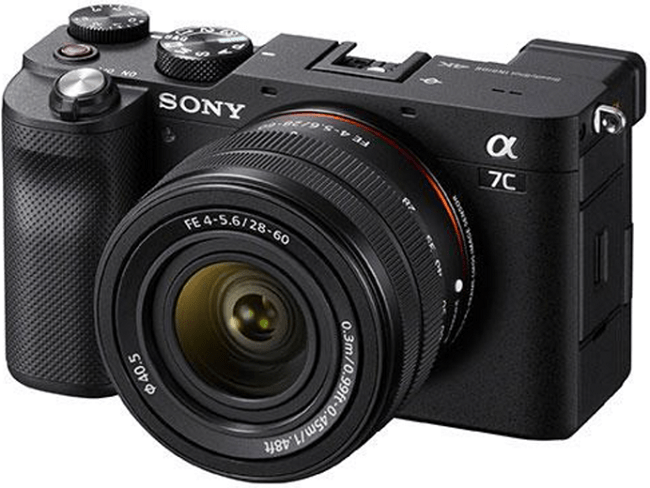
It is true that calling the A7C a smaller version of the A7 III is not incorrect since, aside from the design, the two have the same sensor and shutter speed parameters, in much smaller design. The A7C is intended for those moving to full-frame from the A6000 series and will feel much more familiar to them. Others, such as those who would like to change the feel of a camera but not the image quality from using one of the full-frame, or those who simply like it, buy it! The A7C has a full-frame sensor with very compact body dimensions which coincide with the requirements for high-quality photography and video recording.
The Sony A7C is wonderfully small yet blessed with technically big capacity; the design pays homage to the A6600 albeit a tad thicker to accommodate a larger battery for the A7 III. The camera has a 24.2MP Exmor R (BSI-CMOS) image sensor that is equal to that in the elder A7 III paired with a BIONZ X processor which enables a range of ISO from 100-51,200 with an expansion to 50 to 204,800, utilizing E-Mount lenses like those offered in other Sony Mirrorless cameras. That means that the Sony A7C will use all lenses for current Sony E-mount cameras. There are also promises from Sony for the A7C to come together with lots of compact lenses on that camera line; the 28-60 F/4-5.6 that comes in the kit with the A7C is one such lens and quite perfectly suited for the A7C. Just like its big brothers, this A7C has 5-Stop in-body image stabilization.
The A7C didn’t get a removable flash, just like the A6600; the movie button gets pushed to the top edge, and the EV adjustment wheel appears, which is something new for the top 6. The OLED electronic viewfinder has a high resolution of 2.4 million pixels. The A7C has a central multi-function dial and button, but it does not have a joystick, which is more comfortable for the users switching from the A6xxx to the A7C. A7 III or R III/R IV shooters will be let down by this absence by now.
Incorporating an LCD screen that can rotate forward for selfies or vlogging, as well as a larger grip that was molded to accommodate the new and larger FZ100 battery, the size and comfort of the grip are beyond reproach, although somewhat shorter, denying the little finger a fulcrum; perhaps separate bases or grips will set things straight in the future. Connection ports present in the A7C are located on the side and include microphone, headset, HDMI, USB-C, and SD memory card slot that supports UHS-II.
Infused with the new focus algorithm from the A7S III series, the A7C was given an autofocus speed that was really breathtaking; in low light conditions, the machine captures recognition of the subject and retention of focus accuracy. Sony A7C has Wi-Fi facilitates with faster image transfer through 5GHz 802.11ac and also carries on to support 4K @30 fps video recording, which is a common capability with the A7 III.
Sony a7C Mirrorless Full Frame Camera Alpha 7C Body with 28-60mm F4-5.6 Lens Kit Black ILCE7CL/B Bundle with Deco Gear Case + Extra Battery + Flash + Filters + Macro & Telephoto Lenses + Accessories: Buy it now
Sony a7C Mirrorless Full Frame Camera Body with 28-60mm F4-5.6 Lens Silver ILCE7CL/S Bundle + Vlogger Kit ACCVC1: GP-VPT2BT Shooting Grip w. Wireless Remote + 2X Battery + Deco Gear Bag & Accessories: Buy it now
Performance
1. Sensors and Image Quality:
The A7C runs a 35.9×24.0mm Exmor R CMOS sensor paired with the BIONZ X processor — Sony’s usual full-frame setup, and it does what it’s supposed to: good dynamic range, colors that don’t need much correcting.
Resolution: 24.2 megapixels lands in a good spot. You get enough detail to print or crop a landscape or portrait without ending up with 80MB files clogging your drive.
Dynamic Range: Shadows and highlights both keep detail, so a scene with, say, bright sky and dark trees doesn’t force you to pick one or the other. That gives you real room to move exposure around afterward.
Low Light: ISO goes from 100 up to 51,200, and you can push it to 204,800 if you’re desperate. Noise is well-controlled up through the normal range. Past that, like on most cameras, it’s there so you can get a shot, not necessarily a great one.
2. Autofocus:
The autofocus system in the Sony A7C utilizes the same technology found in some of Sony’s advanced models with 693 phase-detection points and 425 contrast-detection points. This hybrid AF system is made to achieve fast and effective focusing performance.
Speed: The AF mechanism of the camera is quick and responsive and locks onto the subjects within a fraction of a second. Such speed works well in freezing fast-moving subjects and action shots.
Accuracy: The cameras’ AF is highly accurate and can make a minimal number of focus errors. It has performed very well across different lighting scenarios, including in some really challenging, low-light conditions.
Eye Autofocus: The A7C incorporates Sony’s Eye Autofocus technology, which is a great aid in capturing portraits by ensuring the eyes of the subject are tack sharp for maximum detail and image quality.
3. Burst Shooting and Shutter:
Continuous Shooting: The A7C has continuous shooting at the rate of 10 fps employing mechanical shutter and 8 fps employing electronic shutter. This rate of burst shooting is great for fast-moving action and scenes.
Shutter Mechanism: The camera has a very tough mechanical shutter that opens to a whole range of shutter speeds. The electronic shutter can also be employed for silent shooting, which becomes important when silence needs to be maintained.
Features
1. Video Recording:
The Sony camera A7C is a versatile model for the video recording function, possessing a host of features aimed at various casual videographers and content creators.
Resolution and Frame Rates: The A7C video rec is as good as it gets with 4K up to 30p without pixel binning on a full pixel readout. Thus giving the best possible video with astonishing quality, while having almost no artifacts. Full HD recording at 120p is also supported for slow-motion effects.
Video Features: It’s equipped with a plethora of different video features: You can shoot in S-Log2 and S-Log3 gamma profiles for more flexibility in color grading. It also supports HLG (Hybrid Log-Gamma) for HDR video.
Audio: The A7C camera features a built-in mic with a headphone jack for monitoring the audio while recording. This is a huge plus for content creators needing accurate audio-level information.
2. Connectivity:
Wi-Fi and Bluetooth are built in, so pairing with your phone takes seconds — no cables, no manual. Once you’re connected, you can pull files off the card or trigger the shutter from your phone through Sony’s Imaging Edge app. Come in handy more than you’d think — tripod self-portraits, or just checking your framing instead of walking back and forth every time you nudge the camera.
Ports: USB-C handles both charging and data transfer, there’s a full HDMI out for an external monitor, and a mic input for cleaner audio. What’s missing is a headphone jack — annoying if you actually want to monitor sound while recording.
3. Battery Life:
The NP-FZ100 battery used in Sony A7C provides a very marked increase in battery life over previous models. Depending on usage, the A7C is capable of some 740 shots on a single charge, benefiting particularly long shooting sessions and travelling.
Comparative Analysis
A direct comparison with various other models will give a clearer idea of the position of Sony A7C in the market.
1. Sony A7 III:
Size and Weight: The A7 III is chunkier than the A7C — you’ll feel it in a bag. But that extra bulk means a deeper grip, which your hand will thank you for after a full day of shooting. The A7C’s grip is small enough that it starts to hurt after a while.
Viewfinder: The A7 III’s OLED viewfinder is noticeably crisper than the A7C’s — worth a look through both in person before you decide.
Autofocus: Both track subjects about as well as each other. The A7 III pulls ahead in low light and offers a bit more resolution, but it’s not a huge gap.
2. Canon EOS RP:
Sensor and Image Quality: Canon EOS RP is equipped with a full-frame sensor but LP is slightly lesser in resolution when compared to A7C, however, image quality is comparable, with both cameras excelling in the manner of dynamic range and low-light performance.
Build: The RP goes the traditional route — a real grip, physical dials, the kind of body that feels familiar if you’ve shot Canon DSLRs before.
Features: Both have vari-angle screens, but the RP is behind on video and wireless features. It’s built like a stills camera that video got added to later, rather than one designed around it.
3. Nikon Z5:
Build and Ergonomics: The Nikon Z5 is a tad larger than the A7C, but features a more weighty grip and extra controls plus an integrated EVF.
Performance: Z5 autofocus works, but technologically, it lags a bit to the A7C. It does have slightly higher resolution and better weather sealing than the A7C.
Strengths and Weaknesses
Strengths:
Compactness and Lightness: Highly portable is the compact A7C, ideal for travel and street photography.
Full-Frame Sensor: Full-frame sensor for outstanding image quality with high dynamic range and good low-light performance.
Versatile Video: 4K recording and video options for content creation.
Battery Life: Long life from the NP-100Z battery imparts usability for long fixtures.
Weaknesses:
Small EVF: The A7C’s viewfinder is tiny compared to something like the A7 III’s usable, but if you’re used to a bigger, brighter finder, this one feels like a step down. Some people won’t mind and shoot off the screen anyway.
Fewer dials, fewer buttons, less to remember — which is either a relief or a problem depending on who’s holding the camera. Coming from a phone or a basic point-and-shoot, it feels intuitive. Coming from something with a dial for every function, it feels like Sony took away your toys and buried them in a menu.
No headphone jack: This is the one that actually bites. You can watch an audio meter, but you can’t hear a problem wind rustling the mic, a cable that’s gone loose until you’re already home reviewing footage, and by then it’s too late to fix it on set.
Less Advanced Customization: The customization levels of the A7C are lower compared to the other Sony elite names like the A7R IV or A9. This could be a limiting factor for advanced users who rely more on button customization and customization of menus.
Questions regarding Build Quality: While the A7C is built sturdy enough, the materials used are not as premium as expensive models’. The use of plastic in some parts of the camera body might cause durability problems in the future especially in demanding environments.
User Experience
1. Handling and Usability:
The Sony A7C is made with the ease of use of most compatible with portability in mind. Easy to carry and quite easy to handle after a while, this becomes heavier by time and use. This camera is generally good ergonomically, but the grip is relatively small and might not be considered comfortable by large-handed individuals.
A very easy menu system and appears self-explanatory with a touchscreen to enhance this. A vari-angle LCD screen adds flexibility here, particularly for those who need vlogging done or shooting angles that require creative thinking. Users used to more advanced controls and customizations will find the A7C layout to be a bit simplified.
2. Various Shooting Performance Prospects:
Eye-AF is the real reason this camera works for portraits. Lock onto an eye and it stays there, even when the subject turns or fidgets — you’re not chasing focus between shots. Add the shallow depth of field you get from a full-frame sensor and the background just melts away in a way no phone’s “portrait mode” software convincingly reproduces, even now.
Landscapes: 24.2 megapixels is plenty for prints, and the dynamic range saves you in situations like a bright sky over dark trees. Full-frame also gives you a wider field of view than APS-C at the same focal length — useful, though not as game-changing here as it is for portraits or low light.
Action: 10fps and quick autofocus handle most everyday sports fine — kids’ soccer games, that kind of thing. Anything genuinely erratic, like birds in flight, will expose the limits fast. This isn’t a specialist sports body, and it doesn’t pretend to be.
Low light: This is where the sensor size actually earns its keep. Wide ISO range, clean noise handling, images that stay usable well past where a smaller sensor gives up.
3. Video And Content Creation:
Video capabilities of the Sony A7C make it a powerful contender for content creators. With full pixel readout in 4K video recording, the footage is of the highest quality with minimum artifacting. The vari-angle LCD screen sitting there helps a fair bit when it comes to vlogging and self-shooting, which allows flexible framing of the shots.
With the S-Log2 and S-Log3 gamma profiles, color grading is possible, which gives way for some creativity when considering the look of the footage in its end form. On the other hand, it does lack a headphone jack, which can be a turn-off for actual professional video work demanding critical-audio monitoring.
Alternatives and Comparison
1. Sony A7 III-The A7 III is a nearly identical rival to the A7C, using the same full-frame sensor and fitting tighter for the other features. It has an EVF incorporated, which is an important plus point for most users who prefer optical viewfinders. Also, it has better customizability and more controls, but the A7 III comes with larger and heavier embedding of the camera, which would affect portability.
2. Canon EOS RP:
It is another alternative in the full-frame race because the dimensions, resolution, and image quality that the EOS RP boasts are more: built DSLR-like and a vari-angle touchscreen with working similarity to the A7C. The Canon model will be most preferred by those whose color science and use interface match with Canon’s.
3. Nikon Z5:
It brings a slightly bigger footprint, a much more strengthened grip, and all those additional controls. Plus an EVF and reputedly very well-built, the Z5 is an option between those who prefer heavier camera-to-user transaction and more elaborate controls.
4. Fujifilm X-T4:
Not a full-frame camera but would consider it under the priority list of users, especially devoted to video and construction. The X-T4 packs impressive video specs-in-body stabilization-and a robust design, making it a good contender in the mirrorless space, especially given that APS-C sensor fans love the unique color profiles Fujifilm lends to their optics.
Conclusion
The A7C’s whole pitch is simple: full-frame image quality in a body you’d actually want to carry around all day. No trading sensor size for portability the way you usually have to with Sony’s A7-series bodies.
Low light performance is solid — better than you’d expect for something this small. The vari-angle screen is the real win for vloggers, since you can actually see yourself in frame instead of guessing. Grip’s a little small if you’ve got big hands, and the single card slot is annoying for anyone shooting paid work, but as a everyday full-frame that fits in a jacket pocket, it’s hard to beat.
On the downside, the absence of a built-in EVF and the limited customizability may be deal-breakers for some. The lack of a headphone port for audio monitoring could be another crucial limitation in a professional video environment.
The A7C is trying to solve a real problem: full-frame image quality in a body that doesn’t feel like a brick in your bag. For the most part it pulls it off. It competes fine against the rest of its class, and the feature set is solid enough for most day-to-day shooting.
Whether it’s right for you comes down to what you’re okay giving up. No big EVF, no headphone jack, controls that skew basic — none of that is a dealbreaker on its own, but stack them together and it’s clear this camera picked a lane. If that lane is yours, it’s an easy recommendation. If you need more control or better monitoring, you’ll outgrow it fast.
Related Posts

Tech Reviewer & Product Analyst
Định Bia has spent over 10 years testing consumer electronics with a focus on smart technology. He work as a product advisor at Biareview where he helped customers find the right devices for their needs. He personally tests every product featured on this site using a consistent evaluation framework covering quality, durability, and value. All reviews are based on experience, not influenced by the manufacturer.