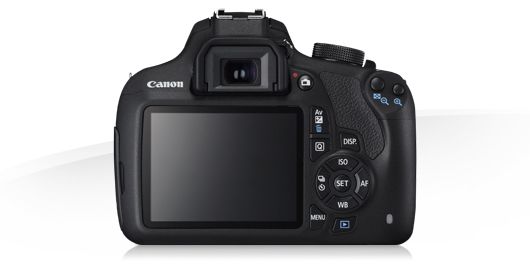
Design
The Canon EOS 1200D is a relatively lightweight DSLR camera and is not as powerful as its predecessors, such as the Canon 100D or Canon 700D.
This is a machine that costs only $800 excluding the kit lens, so the body is made of only plastic rather than magnesium alloy. The controls are larger than the EOS 1100D, but controlling the aperture and speed is not really easy with the beginner when using the same control wheel.
Designed for beginners, the camera incorporates a number of auto modes such as Scene Recognition Auto and some Creative modes to enhance the image to match the trend. Compete with smartphones or compact cameras.
The back of the camera is a 3inch screen with a resolution of 460k does not overwhelm the competition with the same segment as the Nikon D3300 or K-5000 (2 machines have a resolution of 921k). The screen has no touch as well as the mobility is fixed. The 95mm wide-angle optical viewfinder will make it easy for newcomers to feel the real frame.
The Canon EOS 1200D uses an 18 million-pixel sensor. The 4-Digic image processor is not so special, but it’s all confirmed by the quality of previous DSLR models. The use of Digic 4 has 4-year-old processor, though, will bring down the price but lack the competitiveness and breakthrough of its direct competitor, the Nikon D3300.
The speed of the D3300 is faster than 1200D to 2fps, the focus system of the 1200D is only 9 points in the equivalent of the popular Pentax K-500 was born two years ago, and the new Nikon D3300 has 11 focus points. However, the Canon 1200D is equipped with a new STM lens system, which helps to improve the focus speed better.
Now that all of Canon’s new DSLRs are equipped with full HD video capture capabilities, the Canon 1200D is no exception, and this is a pretty good model for beginners.
Picture quality
Although the upgrade version but in fact the image quality of the Canon 1200D does not really outperform the old generation Canon 1100D.
On the default image settings, the colors from the JPEG files of the 1200D are quite stable with good saturation in the blue and green channels. The Dynamic Ranger range works well and the high contrast image retains the detail.
High ISO noise control is not very impressive, at ISO 1600 and 3200 displaying high noise levels, color and sharpness starts to fall off considerably.
Canon EOS 1200D Digital SLR Camera with EF-S 18-55mm f/3.5-5.6 III Lens – International Version (No Warranty): Buy it now
Canon EOS Rebel T5 1200D 18MP EF-S Body Full HD 1080p Video Digital SLR Camera (NO LENS): Buy it now
CANON EOS 1200D Digital SLR Camera Kit with EF-S 18-55mm IS II Lens (International Model No Warranty): Buy it now
Performance
The Canon 1200D uses a multi-layered iFCL (Intelligent Focus, Color, Luminance) metering system with 63 light sensors. This sensor, based on color and brightness, also has the ability to handle the amount of light entering so that the result of exposure is accurate. This metering system has been confirmed from the 7D generation so for 1200D this low-level segmenter can guarantee accurate metering.
However, the 1200D auto focus system is the same as the older 1100D, which is quite disappointing with a budget but in terms of demand and cost it is acceptable. The ability AI Servo to capture fast motion is not very good, in addition to the Live View mode, the processing speed of this focus system is very slow under all light conditions, latency up to 3-5 seconds . This sluggishness of 1200D uses the built-in contrast control built into the Live View mode.
The camera’s auto white balance system produces stable results in various lighting conditions. In the home, under artificial light, the image quality tends to be warm but not prominent. Some times may be inaccurate, especially when using the default Incandescent setting.
The Canon EOS 1200D has a fast shutter speed of 3fps, which is well below current DSLR standards and barely fast enough to keep up with high-speed motion. Another problem is that when shooting fast, the processor takes time to display on the LCD screen from 1-2 seconds. Actually, low processing efficiency appears on all entry-level segmentation machines from Nikon D3300 to the Pentax K-500.
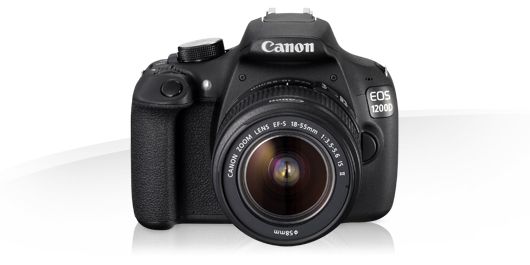
User experience
Ease of use
Canon aimed the EOS 1200D at first-time DSLR buyers. Shooting mode, ISO and exposure compensation are all on the mode dial or a dedicated button, and the menus are short and clearly labeled.
The Feature Guide is the most useful part for beginners. When you turn the mode dial or select a setting, a brief note explains it, for example that a lower f-number gives more background blur. Once you know the camera, the notes slow you down, but you can switch them off in the menu.
Image review and playback
Photos show on a 3-inch LCD. You can zoom in, bring up a histogram and check the shooting settings for each shot. The screen’s resolution is fairly low, so zoom in before deciding a shot is sharp. Playback is quick, and you can rotate and rate photos in camera, but anything beyond that is a job for a computer.
Portability and travel
For a DSLR, the 1200D is light, and with the kit lens it’s easy to carry all day. It won’t fit in a jacket pocket, though, and the shutter is loud, so it’s not the camera for discreet street shots.
The body is mostly plastic and isn’t weather sealed. That’s fine for ordinary travel, but keep it out of the rain and away from heavy dust.
Pros and cons
Pros:
Light for a DSLR
18-megapixel APS-C sensor gives detailed images with good color
Simple controls and an on-screen Feature Guide for beginners
Decent battery life
Full auto for starting out, full manual for later
Cons:
Only 9 autofocus points, which struggles with fast-moving subjects
No Wi-Fi or Bluetooth, so photos go to a phone or computer by card or cable
Fixed, non-touch screen
Video tops out at 1080p, with no microphone input
Plastic body with no weather sealing
Final thoughts
The EOS 1200D is a cheap, simple way into DSLR photography. The image quality is good, the Feature Guide really does help people learn, and it’s light enough to take everywhere. The trade-offs are the basic autofocus, no wireless and a body you shouldn’t take out in the rain.
If you’re a beginner who wants to learn exposure properly on a budget, it’s a sensible buy. If you shoot sports, kids running around or a lot of video, spend a bit more on a newer model.
Related Posts




Tech Reviewer & Product Analyst
Định Bia has spent over 10 years testing consumer electronics with a focus on smart technology. He work as a product advisor at Biareview where he helped customers find the right devices for their needs. He personally tests every product featured on this site using a consistent evaluation framework covering quality, durability, and value. All reviews are based on experience, not influenced by the manufacturer.