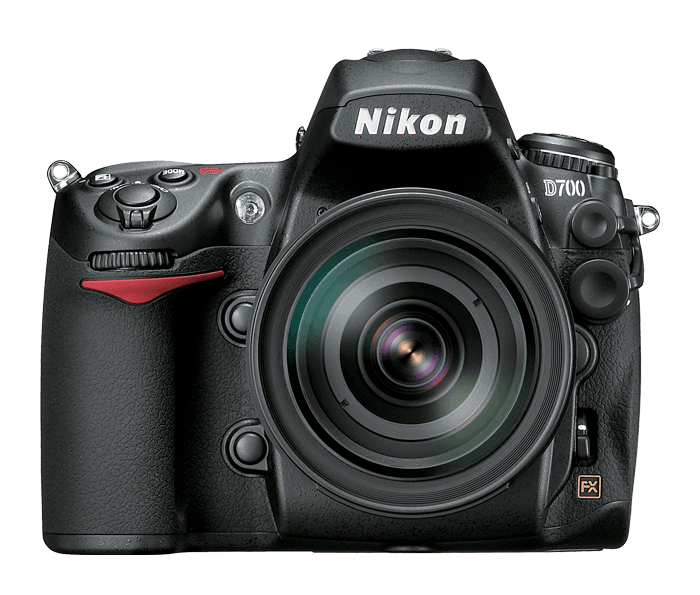
You can get the D700 body-only or bundled with the AF-S VR 24-120mm f/3.5-5.6G IF-ED lens. That lens alone runs about $500, but in the kit it works out closer to $300-400.
Weight-wise it undercuts the pro bodies 995 grams against the D3 and Canon’s 1D series, both under 1.2kg. Put it next to other full-framers like the Sony A900 (850g) or Canon 5D series (around 810g), though, and suddenly the D700’s the heavy one.
The magnesium alloy shell feels sturdier and more premium than the D300, even if it can’t match the D3 on weather sealing and dust resistance. But the body itself is styled closer to the D300 than the D3 which is honestly part of the appeal, since it still feels unmistakably like a Nikon.
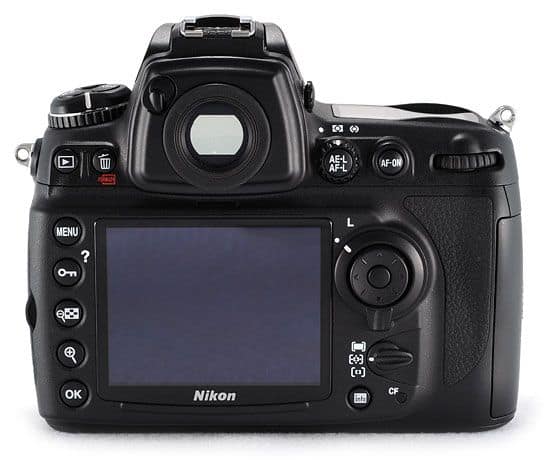
The controls of this machine are arranged on the front, back and top. On the left, the three buttons are quality, white balance and ISO sensitivity, mounted on a wheel that selects drive modes, Live View, Timer and mirror mirror lock. This design makes the choice of view mode (Live View) more cumbersome than the way many other manufacturers usually do is designed specifically for this feature a dedicated key.
Also on the upper side, but on the right hand side is where the shutter button is located, surrounded by a switch to turn the power on / off. Along with these are the keys used to adjust exposure compensation and select the exposure mode (P / A / S / M). Like tradition, Nikon equips the D700 with a small LCD screen at the top to display status information.
On the front, on the left, Nikon equips the D700 with a selector to select the focus mode and the keys used to turn on the flash, exposure compensation and ports to connect to the remote control and flash sync cable. On the right, the grip and lens have a function key that gives the user quick access to the predefined menus. Right above the key, it’s also centered around the lens and the grip is a key used to preview the depth.
One of the most popular features on the D700 as well as the mid-range and high-end models of the Nikon is that it has a 1.5 percent spot, center-weighted, evaluative, Single point, dynamic area, auto area, bring great convenience to users. In addition, the back of the machine also has the activation keys AF, AF / AE lock, playback, delete, info, menu and other basic keys.
Compared with the Canon EOS 5D Mark II, Nikon D700 seems to be outdated when only equipped with sensor resolution of 12 Megapixel (compared with 21 Megapixel of the opponent) and no video recording features. However, the advanced features that this machine possesses are enough for any specialized hands. Like other Nikon digital SLRs, the D700 is especially ideal for those who want to capture images with a wide range of contrasting colors.
Picture Controls handle contrast, brightness, sharpness, and saturation, and you can save your own presets. Nikon’s usual extras are here too. Active D-Lighting, vignette control — plus a DX crop mode carried over from the D3 for shooting with DX lenses.
Nikon D700 12.1MP FX-Format CMOS Digital SLR Camera with 3.0-Inch LCD (Body Only) – International Version (No Warranty): Buy it now
The speed of operation of the Nikon D700 very fast, only slightly less than the high-life model D3. Power off to first shot: under 0.2 seconds. In good light, each shot — focus included — takes about 0.3 seconds; in the dark, that climbs to 0.6. Even back-to-back shots with the flash firing only add up to 0.5 seconds for both. Continuous shooting speed of the D700 is 4.9 fps, can be increased to 8 frames per second if the user inserts MB-D10.
The quality of the photos taken by the D700 does not dampen the expectations of Nikon lovers. With a good lens, the photos taken by this machine are high-definition, standard exposure and very wide range of colors. The color of the details must be said impeccable, although in the light of tungsten light, the ability of the automatic white balance of the machine is affected a bit. Interference control is also a strong point of the D700, when the photos taken at ISO 6400 are quite high quality. Even at an ISO 12,800 level, the experienced photographer can still get beautiful photos.
It can be said that the only disadvantage for the Nikon D700 in the competition with its main competitors is in the 12-megapixel resolution of the sensor. That leaves the user restricted to printing large photos like banners, posters.
Advantage:
– The image quality is very high, even at an ISO level of up to 6,400
– Focus and capture speed, even in low light conditions
– The design and layout of the keys bring great peace of mind and convenience to the user
Disadvantages:
– Worse than rivals
– Low resolution
– Automatic white balance sometimes encounters problems in the light yellow state of volfram lamps
Related Posts


Tech Reviewer & Product Analyst
Định Bia has spent over 10 years testing consumer electronics with a focus on smart technology. He work as a product advisor at Biareview where he helped customers find the right devices for their needs. He personally tests every product featured on this site using a consistent evaluation framework covering quality, durability, and value. All reviews are based on experience, not influenced by the manufacturer.