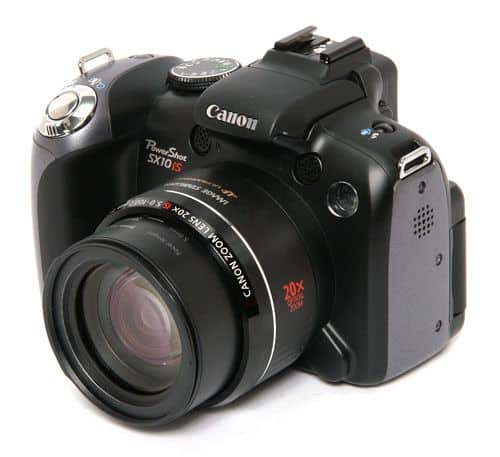
Inherit the design lines from the previous generation is the Canon PowerShot S5 IS, Canon PowerShot SX10 IS is quite easy to look, with many curves and body compact. The casing is plastic but feels very comfortable for the user while holding the phone, while the silver key and hotshoe on the black top of the machine are the details that contribute to the aesthetic beauty of the SX10 IS.
The 2.5-inch LCD screen on the back has the ability to flip over, rotate in the same direction as on a camcorder. It can be said, the design team of Canon spent a lot of time on this machine, while ensuring aesthetic and bring great convenience for users. The keys on the back are arranged reasonably, so that users can easily use the machine with one hand. The weight of this machine is only 560 grams, which is ideal for a super zoom.
In terms of features, the first is that the lens has an optical zoom of up to 20x. Not only is the telephoto good, the SX10 IS’s lens is very good at wide shooting, with a focal range of 28-560 mm, but does not compromise too much on its compact body. The image stabilization system is built right into the lens, giving users peace of mind at high zoom levels. Thanks to the built-in ultrasound technology, the lens moves very quietly, almost no sound.
One of the disadvantages that can make the user feel extremely disappointed about this model is the excessive reflection of the electronic viewfinder. It almost does not help the LCD screen when shooting in bright environments. Besides, the Canon PowerShot SX10 IS also has no battery status indicator, so it’s hard for users to know when the battery is about to run out.
Canon Powershot SX10IS 10MP Digital Camera with 20x Wide Angle Optical Image Stabilized Zoom: Buy it now
Although it has a 20x optical zoom lens, it only takes about 1.5 seconds to start up. However, due to the use of AA batteries, the Canon PowerShot SX10 IS captures only about 164 shots per charge, much less than a Lithium-ion battery.
Depending on shooting conditions, the Canon PowerShot SX10 IS can reproduce colors that are accurate and vivid, with high definition detail. Of course, the photos without zoom for the best quality and stability. However, it must be acknowledged that compared to the same competitors, the noise control capabilities of the Canon PowerShot SX10 IS are quite good.
Although built-in image stabilization on the lens, shots taken at up to 20x zoom are inevitably blurred and distorted. To overcome this point, the only way is to use tripod. In addition, outdoor shots on sunny days are often too exposed.
In short, there are still some downsides in the electronic viewfinder or LCD monitor, which is not equipped with HD video recording, but the Canon PowerShot SX10 IS is still a remarkable super zoom.
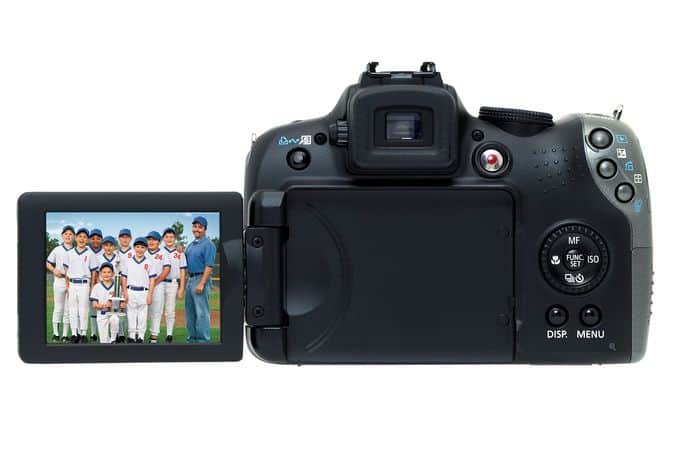
The 20x zoom is really the whole reason to consider this camera — 28-560mm equivalent, wide landscapes to distant wildlife in one lens. It’s built around a 1/2.3-inch, 10-megapixel CCD sensor, modest by today’s standards, but it holds up fine in good light — sharp, detailed, plenty for prints or everyday use.
Color’s a genuine strength, which tracks with Canon generally — vibrant, believable, works well whether you’re shooting portraits or landscapes. Detail’s good at lower ISOs; noise shows up as you climb, which is just what happens with a sensor this small.
Dynamic range is solid enough, holding onto detail in both highlights and shadows reasonably well. ISO runs 80-1600 — clean down low, noise starts showing at 400, and by 1600 it’s affecting the image noticeably. Stabilization helps take the edge off some of that low-light struggle.
Autofocus is contrast-detect — single, continuous, face detection, all there. Quick and accurate in good light, slower and less dependable once it gets dark, the usual story for this kind of system. Continuous shooting’s modest at 1.4 fps, fine for casual action, with a buffer that holds a decent number of shots before it needs to catch up.
Manual control is the real deal here: aperture priority, shutter priority, full manual, the standard P/A/S/M lineup, a Custom Mode for saving go-to setups, and My Colors if you want to tweak color output right in-camera. Scene modes cover the basics — Portrait, Landscape, Night Scene, and the Creative Filters (Color Accent, Color Swap, Fisheye) are genuinely fun without needing any editing afterward.
Handling is excellent, honestly — comfortable in hand, controls exactly where you’d want them, buttons that feel good, and enough customization to make it yours. The menu’s dense but stays navigable, clear display, nothing confusing.
Runs on four AAs, around 340 shots per charge with decent rechargeables, and switching to the EVF instead of the LCD stretches battery life further. Storage’s SD, SDHC, or MMC — all easy to find.
Video’s VGA at 30fps — fine for quick clips, nowhere near HD, no mic input, though the built-in stereo mics actually do a reasonable job on their own.
The 20x zoom is genuinely versatile, the build feels solid, manual controls actually work like manual controls, and the creative filters are a fun bonus, plus you’ll never be hunting for a replacement battery with AAs. On the other side, low light’s a weak point, video’s stuck in the VGA era, and at 560 grams it’s carrying a bit more heft than some of what it’s up against.
Related Posts


Tech Reviewer & Product Analyst
Định Bia has spent over 10 years testing consumer electronics with a focus on smart technology. He work as a product advisor at Biareview where he helped customers find the right devices for their needs. He personally tests every product featured on this site using a consistent evaluation framework covering quality, durability, and value. All reviews are based on experience, not influenced by the manufacturer.