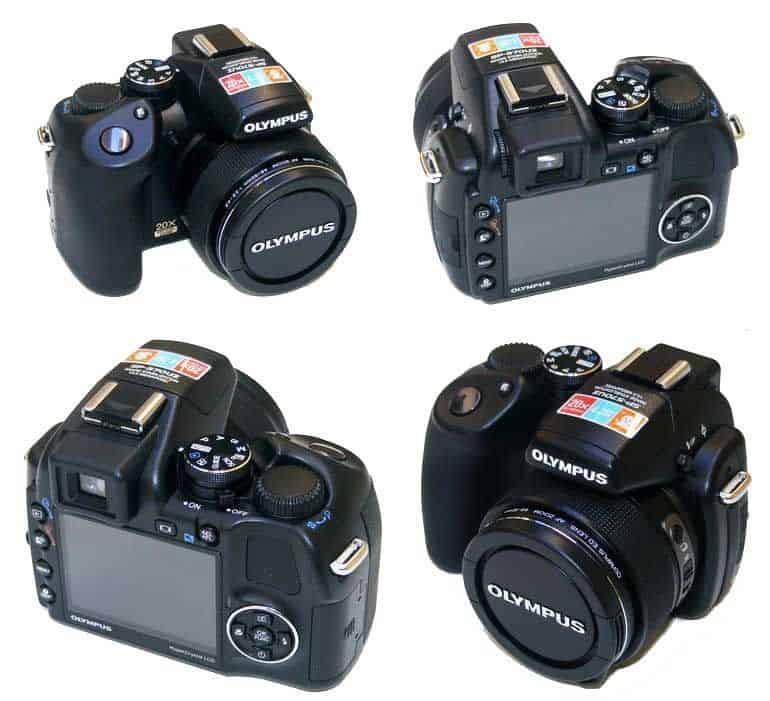
With dimensions of 118.5 x 87.5 x 84 mm, weighing 445 grams, the Olympus SP-570UZ has the same body size as the Olympus E-420, and slightly larger than the Olympus SP-560UZ.
The machine has a large handle to help keep the user comfortable and secure, and also contains four AA batteries to power the machine. On the top side, in addition to the hotshoe for attaching a flash, Olympus also equips the SP-570UZ with a large wheel to adjust the shutter speed, aperture, and other settings related to shooting. The back is 2.7-inch LCD screen, slightly larger than the 2.5-inch screen of the SP-560UZ.
The user interface and menu system of this machine are the same as other Olympus models, that is, they are streamlined, clear and explained very easily, even though the text on the screen is available. Small size. In addition, the Olympus SP-570UZ also features a feature that has become familiar in the DSLR, which is the selection of the directional keys but directly adjusted by the wheel at the top edge, help users Operation is easier. However, this machine is not equipped with the Olympus zoom, but rather a rotating lens like the professional model. It helps to bring the “pro” feeling to the user, but on the other hand also makes them have difficulty when not used.
The Olympus SP-570UZ possesses all the manual and semi-manual features that users expect from a high-end travel camera. In addition, this machine is also equipped with a lot of automatic mode to support those who do not have much experience.
First of all, the image stabilization system works by moving the sensor, which is extremely important for a high-speed camera like the SP-570UZ. There is also a manual mode called Guide mode for amateurs. Accordingly, the machine will give instructions step by step in different shooting conditions and modes.
The familiar My Mode mode in the Olympus series allows users to manually set up four different shooting modes and save them for later use. Also, like the SP-560UZ, this camera is also equipped with a hotshoe and wireless flash support, a useful feature and very easy to use. It can record VGA video at 30 frames per second with impressive picture quality. However, the video recording mode does not allow the user to use the zoom.
Olympus SP-570UZ 10MP Digital Camera with 20x Optical Dual Image Stabilized Zoom: Buy it now
The weak point of the Olympus SP-570UZ is its speed. This machine is even slower than the previous one, although the SP-560UZ is not much faster. It took 3.3 seconds to complete the new boot. Focus also takes 0.8 seconds (in ideal light conditions) to 1.8 seconds (for difficult focusing conditions). At such speeds, it is difficult to photograph animals or children playing with this machine.
The average shooting speed of the machine is 2.5 seconds for one image without flash, and 2.9 seconds for one image with flash on. With a continuous frame rate of one frame per second, it is difficult for users to capture action scenes or fast-moving objects. Although supporting the RAW image format, the time taken to capture an image of this type is 9 seconds. At that speed, only the studio photographers would be interested in testing this feature.
On image quality, one side of the f2.8-4.0, 26-520mm lens allows you to clearly capture the distant and wide positions, but in sharpness and details are not very high. The edges or edges of the image are often distorted and fringed, the texture of the color is broken, it does not look real. Even so, there are still pictures of “halo” pretty thick around the details of high contrast.
However, the photos taken with this camera are quite stable quality, especially when shooting at low light sensitivity and moderate zoom. Colors are reproduced accurately and naturally, the ability of the camera exposure is quite standard. Images taken from ISO 200 and below have no noise, the details are quite sharp.
Autofocus and Speed
Autofocus is contrast-detect — single AF, continuous AF, manual focus, all present. Quick and reliable in good light, but it slows down and starts hunting once things get dim, which was just how contrast-detect worked back then.
Continuous shooting caps at 1.2 fps, buffer good for 7 shots before it needs a breather. Not fast, but enough for casual action.
The 20x zoom is really the whole point of this camera, wide landscapes to super-telephoto wildlife shots to macro, all in one lens. Stabilization earns its keep at the long end especially, where shake would otherwise wreck a lot of shots. Manual control is real here too: aperture priority, shutter priority, full manual, plus the usual P/A/S/M set, a My Mode for saving your go-to settings, and panorama stitching built in.
Art Filters — Pop Art, Soft Focus, Grainy Film, a few others — add some fun in-camera without needing to touch editing software afterward, and scene modes cover you when you’d rather not fuss with settings.
Handling’s genuinely good — comfortable, controls where they should be, buttons that feel solid, and enough customization to make it yours. Menu’s dense but stays navigable, clear display, nothing confusing once you’re in it.
Battery runs on four AAs, good for about 400 shots with decent rechargeables, use the EVF over the LCD if you want to stretch that further. Storage’s xD-Picture cards plus microSD with an adapter — xD’s basically dead now, but the microSD workaround keeps this camera from being stranded.
Video’s modest: VGA at 30fps, fine for quick clips, nothing close to HD, no mic input, so don’t expect to do anything serious with it.
What’s good: that 20x zoom is genuinely versatile, the build feels solid, manual controls are the real deal, the filters are fun to play with, and AA batteries mean you’re never stuck without power. What’s not: low light is a weak spot, video’s stuck in VGA, the primary storage format’s basically extinct (microSD saves it), and autofocus drags once the light drops.
Even well past a decade old, this thing still has a place – travel (small, versatile, easy to power), wildlife (that zoom does real work), macro (gets down to 1cm), and just general everyday shooting if you want manual control without a steep learning curve.
All told, a solid bridge camera – versatile, easy to live with, and the creative modes genuinely make it fun to shoot with, even with video and low light showing its age.
Related Posts

Tech Reviewer & Product Analyst
Định Bia has spent over 10 years testing consumer electronics with a focus on smart technology. He work as a product advisor at Biareview where he helped customers find the right devices for their needs. He personally tests every product featured on this site using a consistent evaluation framework covering quality, durability, and value. All reviews are based on experience, not influenced by the manufacturer.