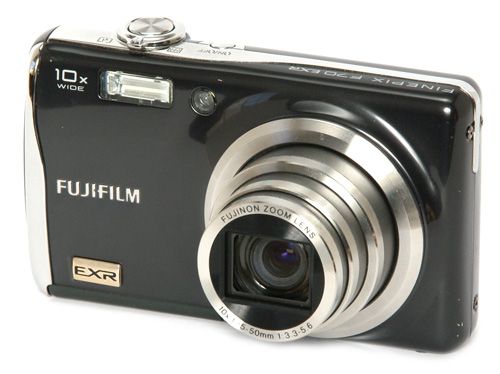
The design of the F70EXR is not worth anything except look like 200EXR. Interestingly, although this machine is super-zoom but thinner than its predecessor (only 22.7 mm compared to 23.4 mm at F200EXR). Fujifilm also claims the F70EXR is the world’s slimmest 10x zoom camera.
The downside of the F200EXR lies in the location of the flash. It’s too close to the grip so it’s easy to get lost when shooting. Unfortunately, the F70EXR version does not improve this issue. When the large lens occupies nearly half of the front of the machine, the idea of flash pop-up may be better.
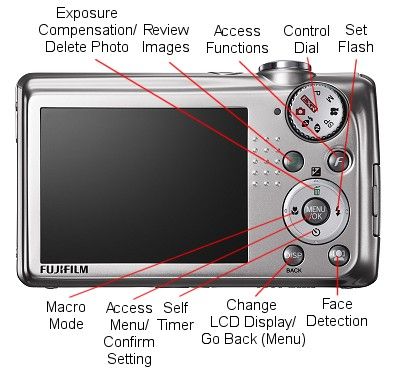
If you have used the Fujifilm camera, you will be familiar with the key layout behind the machine. The mode dial is located near the thumb and is easily controlled by this finger. The battery cover slides forward to open the battery compartment and the card, but not to the horizontal, reducing the possibility of breakage due to shortening of the excess.
In addition to the usual pre-set shooting scenes, you’ll see two new options: Pro Low-Light and Pro-Focus. These two modes work by continuously shooting multiple types and attaching them back to a sharp image at a resolution of less than 5 megapixels, like when using the EXR mode.
Generally in the viewfinder and shooting, the user can not clear the background blur to emphasize the subject while portraits, but with Pro-Focus mode, the F70EXR can capture two or three consecutive shots with focus points Different, then put together to create effects. Of course, this mode needs a large enough gap between the subject and the background to work. The downside is that the subject must not be moved, otherwise the picture will look like three or four photos stacked on top of each other.
As with the F200EXR, the F70EXR has sensors that operate in three modes: Resolution Priority, High ISO / Low Noise, and D-Range Priority.
The machine also has a manual mode. However, there are only two aperture options, and depending on the focus the aperture can run from F3.3 to 5.6 and from F5.6 to 11.
F70EXR takes about 2.5 seconds to start up and shutter lag is about 0.1 seconds. This speed is also normal with large zoom cameras. However, the time taken up to the first shot takes four to three seconds, which is too long.
When Pro Low-Light or Pro-Focus mode is selected, the camera will need approximately 2 seconds to process the image after shooting. Because these modes are primarily for capturing scenes, such latency does not make a big impact.
On focus, F70EXR focus is also quite fast and accurate. Multi-point focus mode tends to grab the nearest object. So, press half a button and then re-arrange the frame to something better.
FUJIFILM digital camera FinePix (FinePix) F70 EXR black F FX-F70EXR GM: Buy it now
Fujifilm Finepix F70EXR 10MP Super CCD Digital Camera with 10x Optical Dual Image Stabilized Zoom and 2.7 inch LCD . Exclusive Value Bundle includes Additional NP-50 original Fuji battery , Custom Fuji fitted case and tripod: Buy it now
Fujifilm is known for its good image quality in low light, of course the F70EXR also inherits this capability, although there are interesting differences between Pro Low-Light and High ISO / Low Noise EXR modes. According to test, the same scene, the noise seems to be well controlled in Pro Low-Light mode, but the image in High ISO / Low Noise EXR mode looks sharper.
The F70EXR easily passes the ISO test. At the lowest ISO of 100, the image looks clean. At ISO 200, there are some small spots in the dark area but it is not clear unless you scan it carefully on the computer screen. The image at ISO 400 is good and at 800 is also quite satisfactory. The noise is high but there are no blobs.
When comparing the ISO 400 of the F70EXR with the Lumix DMC-TZ7, the FinePix image looks better with less noise, however, the TZ7 looks sharper.
In terms of color, the machine is quite brilliant in creating brilliant but not too saturated color. The skin tone looks natural even when there is a flash. There is a bit of purple fringing in the edges but bright colors are well controlled and do not affect the image quality.
It’s hard not to like the quality of the FinePix F70EXR, although there are other points that make some people unhappy. Appearance not everyone has the same opinion but perhaps the Panasonic TZ7 looks more eye-catching, more color to choose and larger LCD.
But as mentioned above, F70EXR also has its charm. Pro Low-Light and Pro-Focus modes are easy to use and provide an unbelievably beautiful appearance for a point-and-shoot camera. One thing is for sure, if you need a good camera to shoot in low light, the F70EXR is the right choice.
Image Quality
Sensor and Resolution
12-megapixel Super CCD EXR sensor, and this one’s actually interesting — Fuji arranged the photodiodes differently to squeeze out better low-light performance, dynamic range, and color than a standard CCD could manage. 12MP is fine for prints and sharing; obviously newer cameras have blown past it since, but for its era it held up.
Color’s a genuine strength, accurate, natural, skin tones look right, which makes this decent for portraits too. The EXR sensor really does earn its keep on dynamic range, pulling more out of shadows and highlights than you’d expect from something this size.
Lens is a 10x zoom, 27-270mm equivalent. Wide enough for landscapes, reaches far enough for distant subjects, stays sharp with barely any distortion across the range. Stabilization matters a lot at the long end or in low light without it you’d be fighting shake constantly.
Autofocus is contrast-detection, so it’s fine day to day but starts to struggle with fast subjects or dim rooms. Single and continuous AF cover most of what you’d actually shoot.
Burst rate is 1.4 fps, casual moments, sure, real action, no. Buffer holds a short sequence before it needs a second to catch up. Shutter lag stays minimal most of the time, at least.
The NP-50 battery gets around 200-250 shots a charge — for a day out, bring a spare for anything longer.
EXR tech is really the headline feature here: it switches between High Resolution, Dual Noise Reduction, and Wide Dynamic Range modes depending on what you’re shooting, adapting to low light, high contrast, or fine detail as the scene demands. Scene modes hit the usual marks — portrait, landscape, macro, night, plus filters if you want to experiment.
Stabilization handles small handheld movements well. It won’t fix everything, but it noticeably improves your odds of a sharp shot, especially zoomed in.
Manual control’s there too, white balance, exposure comp, picture styles and the menu stays clean and easy to navigate whether you’re new to this or not.
What’s good: compact, genuinely versatile zoom, EXR sensor tech that actually makes a difference, and stabilization that works. What’s not: a dim, low-res screen, video that never gets past standard definition, a burst rate too slow for anything fast, and zero modern connectivity, no Wi-Fi, no Bluetooth, nothing.
Good option for casual shooters and travelers who want something small and capable without chasing the latest specs — and picked up at a lower price, it’s still a fair deal for what it does.
Related Posts



Tech Reviewer & Product Analyst
Định Bia has spent over 10 years testing consumer electronics with a focus on smart technology. He work as a product advisor at Biareview where he helped customers find the right devices for their needs. He personally tests every product featured on this site using a consistent evaluation framework covering quality, durability, and value. All reviews are based on experience, not influenced by the manufacturer.