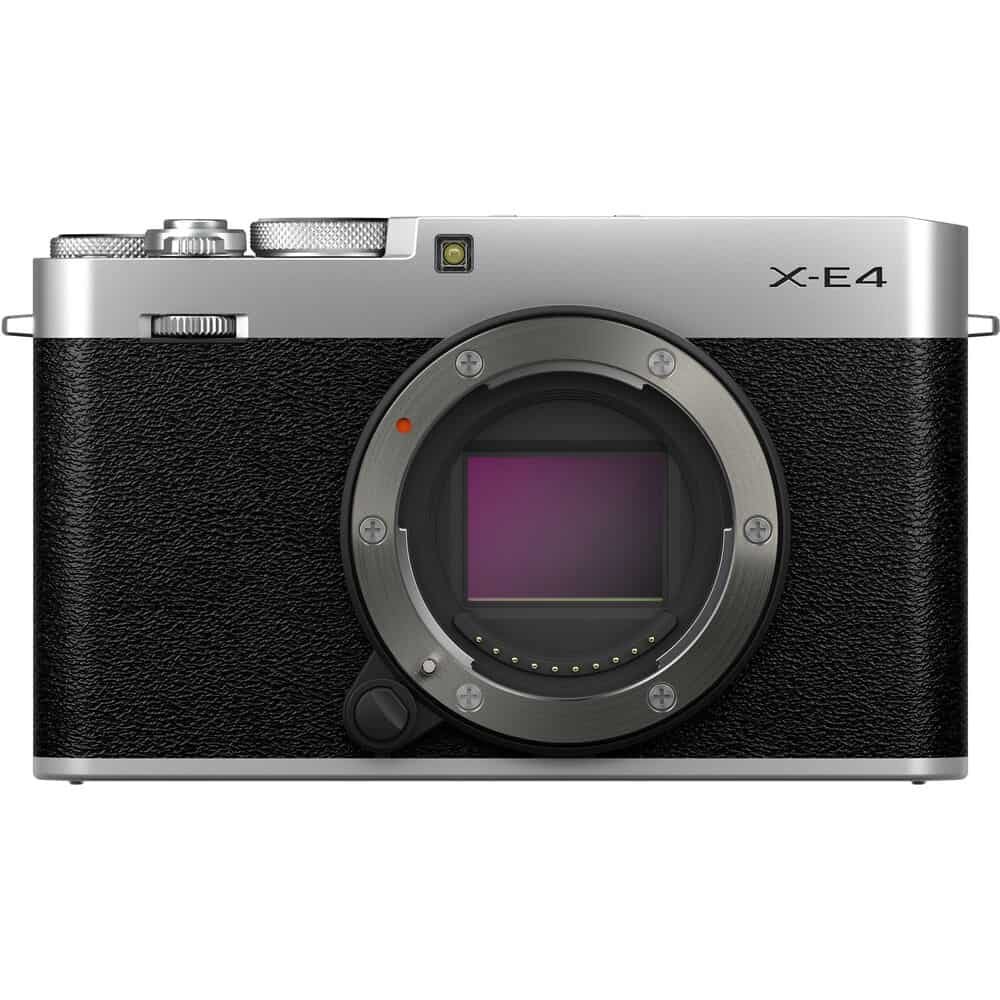
X-E4 Design and Feel
In external appearance alone with X-E3, but the fact makes it look even more square rather than slightly curved. They are both quite beautiful, but from the front will have two changes that make X-E4 more comfortable. The switch to select the AF mode M/C/S is no longer present; it now requires going through the Q function button to select the AF mode.
The common changes with the X-E4 concern the back side. The noticeable one is a new LCD screen able to flip up into 180 degrees, becoming a selfie screen and down almost into 90 degree angles. Increased screen resolution, same with the EVF, but hard to distinguish between them.
Though somewhat different, the button layout isn’t so strange that users would feel uncomfortable about changing. Three buttons on the screen instead of Video Mode/Drive and Delete/AEL are now located next to the screen. Between the image replay button and two buttons plus a joystick, everything else has changed. Generally, the buttons lay quite easily for the next finger and simple.
A 3.5mm port for mic or remote would be there on the X-E4 side, along with a USB-C charging port, and Fujifilm’s USB-C-to-3.5mm option as well to use it as a headphone port.
On, the X-E4 took away the Auto switch because it has a multifunctional Q button now. It’s a tad awkwardly placed, but it doesn’t feel too alien when using it. The shutter speed dial also has a P section now, which will be easier for those who have worked with previous X-E models.
Video features
Typical of recent Fujifilm cameras, the X-E4 records good-looking video of 4K/30p in 4:2:0 at 8 bits to an SD card or in 4:2:2 at 10 bits while outputting to an external device via HDMI and with F-Log profile. A particularly interesting feature is that the LED can have before-autofocus setup as a recording (tally) light for video-taking application. If the video is slow, it can capture at 1080/240p with autofocus.
Especially the machine’s 180-degree flip screen makes the X-E4 an even better-vlogged self-shooting device than its predecessor.
Fujifilm X-E4 Body – Black: Buy it now
Image Quality and Performance
1. Sensor and Image Processing:
The X-E4 runs on a 26.1MP APS-C X-Trans CMOS 4 sensor — nothing flashy on paper, but the X-Trans color filter array is the part that actually matters. By skipping the optical low-pass filter most cameras rely on, Fujifilm gets sharper detail without the moiré and aliasing you’d expect from ditching that filter. It’s the same trick Fuji’s been running since the X-Trans II days, and it still works.
The combination of X-Processor 4 with the X-E4Q enables a paradigm shift regarding performance in all aspects of the camera. Image quality is very high with excellent reproduction of colors and very little noise even on higher ISO settings. The processor is partly responsible for faster autofocus acquisition, increased burst shooting, and overall responsiveness.
2. ISO Performance:
The ISO of the X-E4Q is rated at 160-12,800 with expansion settings extending from 80 to 51,200. Well-regarded for its low-light capability, the camera preserves decent amounts of detail and color accuracy even at very high ISO levels. Noise is well controlled, making the X-E4Q workable under undesirable lighting and nighttime situations.
3. Autofocus System:
The X-E4Q has a sophisticated autofocus system featuring 425 phase and 425 contrast detection points. This hybrid AF system allows quick and accurate focusing with reliable performance in single-shot or continuous modes. The camera’s Face and Eye Detection work extremely well in portrait photography, ensuring the sharpness and focus of the eyes of the subject.
4. Burst Shooting:
Fujifilm X-E4Q offers a continuous shooting mode at 8 fps with the mechanical shutter and up to 20 fps with the electronic shutter. This high-speed burst is an excellent support in capturing images of fast-moving subjects in sports or wildlife photography. The buffer performance of the camera is commendable, providing a longer burst shooting without much significant slowdown.
Video Capabilities
1. 4K Video Recording:
Video on the X-E4 holds up well for a camera this size: 4K at up to 30p, 10-bit 4:2:2 color if you actually plan to grade footage rather than just export straight out of camera. Detail is sharp, colors look accurate without much fiddling, and artifacting is rare even in trickier lighting. F-Log and HLG are both in there too, which matters if you’re delivering HDR or want real headroom for color work — though at this point F-Log without internal RAW is table stakes for the category, not a standout feature.
2. In-Body Stabilization:
A major highlight of the X-E4Q is in-body image stabilization (IBIS). The 5-axis IBIS system compensates for the majority of camera shake during filming. In terms of IBIS system design and functionality, the added features like adjustable speed and travel amounts in real time give excellent results for handheld video. For the work of the videographer, this is precious in fast-moving and active fields.
3. Audio Options: 3.5 mm microphone input to external microphones for better audio recording, so this is an external plus. No headphone jack on the X-E4Q means audio monitoring is hampered, which is a possible hindrance for professional video work. So, one must consider other external solutions or check on audio during post-production to confirm sound quality.
4. Connectivity and Usability
Wireless: Wi-Fi and Bluetooth are in there, and the Camera Remote app gets images to your phone, good enough for Instagram, not much more than that.
Battery: CIPA rates the NP-W126S around 350 shots. That’s about right for casual use. Long day out, or a shoot that actually matters? Bring a spare, you don’t want this one dying on you mid-event.
Controls: Dials plus touchscreen, and it works well together. Set the dials up your way, let the touchscreen deal with menus, and you’re not stuck clicking through buttons for every little change.
Strengths and Weaknesses
Strengths:
Compact and Lightweight: The X-E4Q’s compact size and lightweight structure allow easy handling, great for traveling and day-to-day use.
High Calibration of Sensor and Processing: The APS-C 26.1MP sensor and the X-Processor 4 give high image quality with an edge of detail and dynamic range.
Good in-body stabilization: With its 5-axis IBIS, stabilization is good for still photos and videos, thereby supporting handheld shooting.
Fully Articulating LCD Screen: This vari-angle touch screen allows for creative shooting angles and self-recording.
Full Feature on Autofocus: The hybrid AF system fasts and accurately focuses while providing functional face and eye detection.
Weaknesses:
No viewfinder, no headphone jack, no weather sealing for a camera in this price range, that’s three corners cut, not just quirks. If you shoot through an EVF out of habit, you’re stuck with the LCD. If you’re recording anything that matters, you can’t hear whether the audio’s actually clean until you’re done. And there’s no sealing against rain or dust, so a light drizzle is a real risk, not just an inconvenience.
Battery life is the other one to watch 350 shots sounds fine until you’re six hours into a wedding or a full day of video, at which point you’re swapping batteries or you’re stuck.
Conclusion
The Fujifilm X-E4Q comes across as a very attractive contender in the mirrorless camera segment, especially for someone who fancies a blend of retro looks with a truly modern performance. It is lightweight, has a very efficient image sensor, and built-in stabilization, so working with it for a variety of photography and video requirements should be relatively easy. The fully articulating LCD gives it further helps in creative and practical applications, while an advanced autofocus system ensures a reliable and sharp focus in various shooting conditions.
Still, with the positives come a few negatives. A built-in electronic viewfinder and headphone jack have been absent, which for some users could prove significant shortcomings. The battery life on the X-E4Q is average at best and would also leave a few people wanting more, especially if intending to shoot for long hours or work on heavy-duty video jobs. No weather-sealing means that it could hardly be put to good use in brutish environments.
The X-E4Q will fit like a glove for photographers and videographers looking for light yet well-performing cameras steeped in Fujifilm’s famed image-quality tradition. It is a great study in balancing performance and portability, from travelling and street photography to everyday use. The design and controls will appeal to the crowd that has an appreciation for a classic feel tempered by modern conveniences.
Put it next to something like the X-T4 or Sony’s A6400 and the X-E4 isn’t trying to win on specs. It’s making a different argument: fewer buttons, smaller body, get out of the way and let you shoot. If that’s the kind of camera you want, nothing else in this price range really replicates it, the alternatives all lean more “tool” and less “object you enjoy holding.”
It fits Fuji’s X-series lineage well: compact, nicely built, more concerned with how it feels in your hand than what it says on a spec sheet. If you care about that as much as you care about the shots themselves, this is an easy one to recommend. And the images that come out of it back it up, sharp, well-rendered, and produced by a body small enough to actually bring with you.
Takeaways
Tight Pack: The little X-E4Q has a tiny stature and lightweight construction, making it well portable and handy everywhere.
Big in Picture Quality: With the 26.1MP APS-C sensor and the X-Processor 4, it is very much possible to create high-level detail, dynamic range, and colors.
Motion Stability Modification: The 5-axis IBIS system allows shaking when shooting pictures or taking video footage in still environments.
Any position LCD: Shooting angles and self-recording can be done using the fully manipulating touchscreen.
Intelligent Autofocus: With the hybrid AF, this is quick and precise focusing with face and eye-detection abilities.
Disadvantages:
Nonexistent Built-In EVF: And for those photographers who love shooting with that, it unfortunately loses points on that front.
Not Headphone Jack: Limited feedback in an audio sense when shooting video.
Battery Life: Battery life, although good, wouldn’t last an entire shoot length or heavy use in video work.
Not Completely Weather-Proof: Certainly would not be ideal for themselves during harsh weather conditions shooting.
Thus, the Fujifilm X-E4Q is one of the complete mirrorless cameras, which comes with some old-fashioned characteristics, but the performance it possesses is just too modern. Its focus will range from amateurs all the way up to pros for those keen on compact and stylish as well as powerful cameras. Image quality, stabilization, and autofocus strength have proven that it is worthy of being in anyone’s bag.
Related Posts



Tech Reviewer & Product Analyst
Định Bia has spent over 10 years testing consumer electronics with a focus on smart technology. He work as a product advisor at Biareview where he helped customers find the right devices for their needs. He personally tests every product featured on this site using a consistent evaluation framework covering quality, durability, and value. All reviews are based on experience, not influenced by the manufacturer.