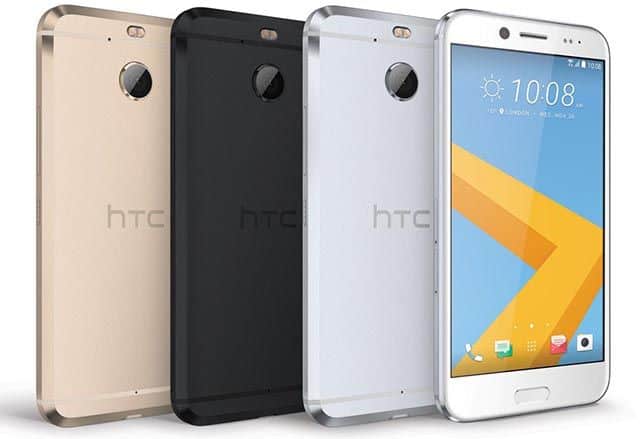
Design HTC 10 evo
HTC 10 evo is called “design inspiration from the light”, meaning that they emphasize the light in the design. So HTC has a metal design with polished diamond cut lines, many angles to reflect the light, creating a pleasant feeling for the user. This is not a design so unique, but it is much more personal when placed next to the OPPO, Samsung mid-range is going in the direction of safety in design.
The perfect quality of the HTC 10 EVO is very good, but not the same as the HTC 10 but more than the same price range. HTC is very experienced in making monolithic metal phones, which is why HTC 10 evo is so beautiful and seamless. We feel as if HTC used a piece of metal covered machine and then pruned to form HTC 10 evo.
About the design, the HTC EVO 10 has a beautiful back and strong, but the front of the screen border is relatively thick, making the machine looks slightly rather slender as current trends. The edges are beautiful and very sharp HTC. The hard keys offer a good sense of elasticity and the stylized power button is not to be confused with the volume down key.
The HTC 10 EVO give feeling very good grip, though when you look at the picture you can imagine it’s sharp. Actually, the slats of the HTC 10 EVO are very smooth and comfortable, firmly held. Currently, the 5.5-inch HTC 10 evo is no longer a big screen as before, it’s just the average size when users get used to the big screen phone.
At the bottom of the HTC EVO 10 is speakerphone, USB Type-C connector and microphone phone. The USB Type-C is a prominent feature of the HTC 10 EVO when it is the rare machine in the $300 segment equipped with this connector. Unfortunately, the HTC 10 evo only has a single speaker, not dual speakers like the HTC 10.
HTC said the HTC 10 evo has passed a series of tests such as bending, bumps and scratches. So this will be a very durable phone. The HTC 10 Evo is IP57 water resistant, compatible with many climatic conditions and even exceeds the corrosion test. Actually, the HTC 10 EVO is very sturdy and it is unlikely that the phone will crash after only a few phone calls.
HTC 10 evo (M10f) 3GB / 32GB 5.5-inches Factory Unlocked – International Stock No Warranty (Silver): Buy it now
HTC 10 evo (M10f) 3GB / 32GB 5.5-inches Factory Unlocked – International Stock No Warranty (Gold): Buy it now
HTC 10 evo (M10f) 3GB / 32GB 5.5-inches Factory Unlocked – International Stock No Warranty (Gray): Buy it now
Screen HTC 10 evo
HTC 10 evo is equipped with 5.5 inch Quad HD resolution. Among the genuine smartphone in asia today, Quad HD screen only appears in the segment over $450. The HTC 10 Evo screen gives a 534 ppi pixel density, a huge number and certainly not a matter of sharpness. The brightness of the HTC 10 EVO is also very good at maximum brightness of 525 nit, comfortable to read even in the sun.
HTC still loyal to Super LCD 3 screen technology on HTC 10 Evo. The advantage of this screen is the true colors and accuracy, but not as vivid and bright as the AMOLED screen. In addition, the HTC 10 Evo screen is also protected by Corning Gorilla Glass 5, the latest generation of toughened glass.
With these parameters, the HTC EVO 10 screen is definitely one of the best screen phones in the price range. Obviously, when the competition is only HD or Full HD screen, the Quad HD screen on the HTC 10 Evo superiority is evident.
Performance and Hardware
So, under the hood, the HTC 10 Evo runs on the Qualcomm Snapdragon 810 processor , which is an octa-core chipset. It was kinda considered a flagship thing at the time but by the moment the 10 Evo came out it was already a bit old fashioned. This chip then gets matched up with 3GB of RAM and 32GB of internal storage, and yes there is a microSD card slot too , supporting as much as 2TB for extra space.
Now the Snapdragon 810 itself , even if it can handle stuff, is pretty well known for thermal trouble, especially once you put it under heavy work. In normal daily routines, like web browsing, scrolling through social feeds, or just streaming and watching media, the phone feels fairly smooth enough. Still, you can tell it’s not “brand new” when you go into more demanding territory such as gaming , or multitasking, where several apps stay alive at the same time.
For graphically loud titles like Asphalt 9 or PUBG Mobile, the HTC 10 Evo will run them, but you might need to tone down the graphics settings so things stay steadier. Even then , you may notice stutters, occasional frame drops and slightly longer waiting periods for loading screens compared to newer phones that use more recent chipsets.
The whole heat management situation is, honestly, a mixed bag. The device includes a heat pipe that should help move heat away, yet the Snapdragon 810 reputation for getting hot comes through, particularly during long gaming stretches, or when you’re using the camera for a while. That means the handset can become uncomfortably warm on the outside, and that warmth can then start to annoy the overall experience.
When it comes to storage, the base model’s 32GB can start to feel kinda tight especially if you keep a lot of media, or you install big apps. Still, there’s a microSD card slot which gives a pretty straightforward workaround for anyone who wants more room. That kind of flexibility is a nice touch, because many smartphones have moved away from expandable storage and toward bigger built in options, kind of like an internal “everything at once” mindset.
The HTC 10 Evo also puts a fingerprint sensor right inside the home button. It tends to be quick, and it’s usually accurate too. Beyond just unlocking, it can be used for other little security tasks , like confirming payments or getting into protected apps.
Connectivity is another place where the HTC 10 Evo does fine. You get 4G LTE, Wi‑Fi 802.11ac, Bluetooth 4.1 and NFC. Honestly, the NFC inclusion is the part people notice, since it supports mobile payments through services such as Android Pay. On top of that it includes USB Type‑C, both for charging and data syncing, which matches the overall industry push toward the newer more flexible port.
In the end, the HTC 10 Evo performs in a way that’s basically “good enough” for most folks. But it doesn’t really shine in one single standout category. The aging Snapdragon 810, plus its thermal troubles, are probably the biggest weak spots, so it may not be as tempting for power users, or anyone who expects consistent top level performance.
Software Experience
The HTC 10 Evo shows up with Android 7.0 Nougat, out of the box, wrapped in HTC’s own Sense UI, so it’s not just “stock” nothing. HTC Sense has long been known as one of the more refined and user friendly Android skins, it kinda walks that line between tweaks and keeping things simple. The UI on the HTC 10 Evo keeps that idea, it’s clean, straightforward, and for the most part feels familiar if you have been around HTC phones for a while.
A big part of Sense UI is BlinkFeed, which shows up as a panel on the far left home screen. BlinkFeed gathers stuff like news clips, social updates, and other bits, based on what you set for your interests, so you can stay updated without hopping into a bunch of different apps. Not everyone will love it, and yeah, some users might think it’s extra or redundant. Still, it’s not like it’s stuck there forever it is adjustable, and it can be switched off when you don’t want it.
HTC also seems to have kept the bloatware situation relatively calm, which is honestly a breath of fresh air compared with some other brands. The apps that come preloaded are usually actually useful, and a lot of them can be removed too, if you really want less clutter. On top of that, HTC leans closer to near stock Android in certain places like the quick settings area and the notification curtain, and that helps the whole interface feel snappy and responsive instead of sluggish.
Still, the software side of it isn’t fully smooth. The HTC 10 Evo launched on Android Nougat, and sure, it got a few software updates, but HTC’s record for long-term support has been a bit of a mixed bag. Basically, by today’s standards this phone is on a dated Android version, which can bring security risks, and also makes it harder to get at newer apps and features, especially ones that insist on more recent operating system builds. So yeah, that continued software support situation is a pretty big downside for the HTC 10 Evo, in particular if you care a lot about security patches and the newest Android functions.
There’s also the whole customization angle inside the experience, because HTC doesn’t just leave Android alone. With HTC Sense you get added touches and some proprietary extras, like the HTC Camera app, HTC Themes, and HTC Boost+. The Camera app feels properly crafted, it has a user-friendly layout, with a range of shooting modes and manual options for people who like photography stuff. HTC Themes is where you can tweak the vibe, using different themes, icons, and wallpapers, which gives a personal feel that quite a few users will enjoy. And then there’s HTC Boost+ , it’s a utility-type application meant to help keep performance steady, it does things like clear cache, handle storage, and keep app behavior in check to save battery life.
However, while these customizations can enhance the user experience, they also add to the device’s total software footprint, and that can i think slow things down over time. This is especially noticeable on older setups like the Snapdragon 810. And HTC Sense , even if its really well designed, might not be everyone’s cup of tea, mainly for people who want something closer to a pure Android vibe.
When it comes to day to day use, the HTC 10 Evo handles the usual stuff pretty nicely. Browsing, messaging, and social media apps run without much drama, the interface stays mostly fluid, and multitasking feels competent. Still, like on many phones that have been around a few years, you may occasionally see some lag or a tiny stutter. It tends to show up when you bounce between heavier apps, or when you navigate through the system after longer sessions , because yeah the resources get used up.
Overall, the software experience on the HTC 10 Evo is solid but not really special. HTC’s Sense UI gives a clean, workable layout with practical features, yet the older Android base and the possible absence of future updates are the bigger negatives. If you care a lot about modern software, kept current and updated, this situation might become a dealbreaker.
Camera Capabilities
So the HTC 10 Evo has this 16-megapixel back camera, f/2.0 aperture, plus optical image stabilization OIS, and phase detection autofocus PDAF , not that it sounds as good in practice but anyway. On the front side, there is an 8-megapixel camera at f/2.4, with a wide-angle lens, which makes it pretty handy for selfies, and also for group photos when more people show up than you expected.
When the light is actually good, the rear camera works really well, taking pictures with solid detail, faithful colors , and relatively low noise. The OIS is a real help for keeping shots steadier, especially if you’re in lower light or you’re just holding the phone while shooting, no tripod involved. The camera application also includes a bunch of shooting modes, including Pro mode, where you can tinker around with things like ISO, shutter speed, and white balance, so yeah, for photography folks that want more control, it feels like a pleasant extra.
Still, there are some limitations you can’t really ignore. In dim lighting , the HTC 10 Evo can’t quite match the sharpness and clarity it manages indoors, or outdoors with brighter illumination. Images in darker scenes may show visible noise, plus a softer look, even with OIS doing its best. And for bright environments, the camera has a habit of overexposing, which can wipe out highlight detail, and that’s not ideal. None of this is shocking for a mid-range smartphone, but it does mean the HTC 10 Evo sits a bit behind a few competitors when we talk about camera performance.
The front-facing camera can manage decent selfies, with solid color reproduction and enough detail to share on social media . Still, that fixed focus lens can be a bit weird at times, it tends to turn out softer shots especially when the subject is either too near or, oddly enough too far from the camera. The wide-angle lens is a good extra, it helps users cram in more people, or get extra background into the same selfie frame.
As for video, the HTC 10 Evo lets you record up to 4K on the rear camera and up to 1080p on the front. The actual video look is usually pretty nice, colors stay accurate and motion comes off smoothly, but there’s no particularly advanced video stabilization, so when you hold it by hand the footage can look shaky, especially during walking or quick movement .
Overall, camera performance on the HTC 10 Evo feels capable, but not exactly groundbreaking. You’ll get dependable results in bright lighting, however low-light scenes are where it starts to stumble. For casual photographers it should be fine, yet if mobile photography is your top priority, you might feel underwhelmed next to newer devices that come with more advanced camera setups.
Battery Life
The HTC 10 Evo is run on a 3,200mAh non-removable cell, a pretty decent capacity for its size and specs. Still, when you look at battery life, it feels a bit all over the place, because the results change a lot depending on how people actually use it.
If you are a lighter to moderate user, like browsing the web, checking social media, or sending messages most of the time, the phone can usually stretch out to a full day, even if the day is fairly busy. But if you’re more on the heavy side, playing games, watching video nonstop, or using the camera extensively, the HTC 10 Evo might start dropping quicker, and you may need a recharge somewhere in the late afternoon or maybe by evening, not always but often.
A big part of the issue is that Snapdragon 810 is kind of power-hungry, then add the QHD display into the mix, and the battery can drain faster than in some newer phones with more efficient chips. Also, the thermal behavior tied to the Snapdragon 810 matters here too, because when the device gets warm during intensive tasks, you can end up seeing extra battery drain.
To help manage battery consumption, HTC brings in a few battery saving features, like Power Saver mode and Extreme Power Saver mode. The Power Saver style cuts down background processes , and it even reduces performance a bit, so the battery lasts longer. Extreme Power Saver goes further still , basically shrinking the device to what it considers essential things such as calls, texts, and basic apps. In real use these modes can be pretty effective for stretching battery life when you have to, but of course there is a trade off , because you lose some everyday functionality.
Charging the HTC 10 Evo goes through the USB Type-C port, and the phone supports Qualcomm Quick Charge 2.0. Now , this isn’t the fastest charging method you can find in 2026 and beyond, but it still helps the device refill at a pretty solid speed, overall it is kinda decent. A 30 minute charge should be enough power for several hours of use, or at least that’s the idea. Still , when you compare it with the more modern fast charging systems in newer smartphones, the HTC 10 Evo feels noticeably slower.
So in summary , the battery life on the HTC 10 Evo is good enough for most people, but it is not exactly a headline highlight. With light to moderate use it can usually get through the day, however if you are a heavy user, you might end up grabbing the charger more often than you’d like. The battery saving modes are a nice touch, but overall battery performance stays average, which really matches the reality of older hardware and a high resolution display that can be a bit demanding.
Audio Quality
HTC basically has a solid name when it comes to audio on its phones , and the HTC 10 Evo keeps that vibe going, but yeah there are some caveats. On this model you only get one speaker, it sits at the bottom and fires downward, which is kind of a shift from the dual front facing speakers you might remember from some older HTC devices. Even so, the single speaker is pretty loud and clear, just not the same kind of fully immersive thing you get when you have two speakers working at once.
For everyday listening the sound coming out of it is decent enough, with pretty strong clarity and not much distortion when you push the volume up. Still, the stereo separation is missing and because the driver is at the bottom, the audio can get noticeably dull when you hold the handset sideways, like when you’re watching videos or playing games. It’s not dramatic, but it happens.
One of the more debated parts of the HTC 10 Evo is the decision to drop, the traditional 3.5mm headphone jack. Instead of that, HTC went with USB Type-C audio and somehow you get a pair of USB-C headphones, right in the box. These included headphones are genuinely good , they deliver crisp sound with a fairly even, balanced tuning. And the USB-C link also supports digital audio, so in theory the end result can sound better than the older analog path you’d have used with a standard headphone jack.
Still, cutting out the headphone jack has its downside, I mean it’s kinda obvious. Like some users really want to carry on using their own wired headphones so they end up needing an adapter , but that one is not included, or they have to shift toward Bluetooth headsets instead. At the moment the device came out, this decision felt kind of controversial, since the whole industry was still kinda early in that shift away from the old fashioned headphone jack.
On the brighter side though, the HTC 10 Evo supports Hi-Res audio, so people can play high-quality sound files, assuming they also have compatible headphones. There is also HTC’s BoomSound Adaptive Audio, and it adjusts the sound profile according to the users surroundings, plus what headphones are actually connected. In practice, that can make listening feel more vivid, especially for folks who care about detailed, immersive audio.
So, to wrap it up, the HTC 10 Evo’s sound is good, just not really exceptional. The lone speaker does the job for everyday listening, and the USB-C headphones are a pretty dependable option. Still, losing the 3.5 mm jack, along with not having dual speakers, might feel like a step back for audiophiles, or anyone who likes a more classic audio configuration.
Connectivity and a few extra tricks
The HTC 10 Evo is packed with a bunch of connectivity options that were pretty normal back then for phones. You get 4G LTE, Wi‑Fi 802.11ac, Bluetooth 4.1, plus NFC. Having NFC around is genuinely useful, especially for mobile payments and for connecting up with compatible gadgets, like that kind of neat tap-and-go behavior. It also brings GPS and GLONASS together, so location services work more reliably in different places.
A big part of the connectivity story on the HTC 10 Evo is the USB Type-C port. It’s the one used for charging, moving files, and even audio output. Back when this device came out, USB Type-C was still kind of new-ish, but nowadays it’s pretty much the norm across most modern smartphones. The USB‑C plug is reversible, so you don’t have to fumble around like with the old Micro‑USB style. Beyond that convenience it can also handle quicker data transfer speeds compared to older generations.
The HTC 10 Evo also includes a fingerprint sensor. It’s built into the home button on the front of the phone. The sensor is snappy, and it feels dependable, giving you a safer method to unlock the device and to verify things like payments or secure apps. Having it up front helps a lot of people, because you can reach it easily without actually lifting the device. Still, like a lot of what the HTC 10 Evo does, this fingerprint setup shows the design habits of its era. Since then, newer models have moved toward in‑display fingerprint readers, or even face recognition tech.
In terms of storage, the HTC 10 Evo comes with 32GB of built in space, and yeah that might feel kinda limiting nowadays, especially if you keep a lot of videos, photos, or even apps and games right on the device. The good part is that it supports microSD cards for expandable capacity, so you can add, up to an additional 2TB. That kind of flexibility, is a pretty big advantage for people who need more room for their content.
Then there is the IP57 certification, meaning it is dust resistant, and it can handle being submerged in water to about 1 meter, for as much as 30 minutes. That’s a helpful detail for extra durability, though it’s also worth mentioning that IP57 isn’t as tough as the IP68 rating you’ll see on newer smartphones, which usually means better protection against both water and dust.
And one more thing that stands out is HTC’s BoomSound Adaptive Audio. This setup automatically tweaks the audio output depending on the user’s surroundings, and also the type of headphones you’re using. It doesn’t really replace the dual front facing speakers from some older HTC models, but it does improve the listening experience overall, especially when you’re using headphones.
For people who enjoy mobile gaming, the HTC 10 Evo kind of works, it offers a decent run, but it’s not really tuned for the newest and most graphically heavy games. The Snapdragon 810 chip, sure it’s capable, but during intense sessions it can still feel a bit strained ,and after a while the phone may start to heat up. Also yeah, battery life might become a real stop sign for gamers who play for hours straight, especially when there’s no charger nearby.
On the connectivity side ,the HTC 10 Evo comes with dual band Wi‑Fi, so performance is a little better in crowded places where many networks are fighting for space. There’s also Bluetooth 4.1 ,which is fine for pairing earbuds, headphones or even smart watches. Plus it has NFC, that can be used for mobile payments through services like Google Pay, and it can help with quick pairing for compatible devices too.
Overall, the connectivity options and extra extras on the HTC 10 Evo are pretty solid, just not earth shaking. Expandable storage and water resistance add clear value, but more modern features you see on newer models, like 5G support, or Wi‑Fi 6, are missing.
Conclude
HTC 10 evo feels right for those who want a device with a strong, masculine vibe. The design and the screen on the HTC 10 evo both came off as high-end. Some designers might not pick it just because it’s this powerful, but if you want a smooth finishing touchscreen and a super sharp display ,the HTC 10 Evo is pretty much a bargain at $300.







Tech Reviewer & Product Analyst
Định Bia has spent over 10 years testing consumer electronics with a focus on smart technology. He work as a product advisor at Biareview where he helped customers find the right devices for their needs. He personally tests every product featured on this site using a consistent evaluation framework covering quality, durability, and value. All reviews are based on experience, not influenced by the manufacturer.