Design and Build Quality
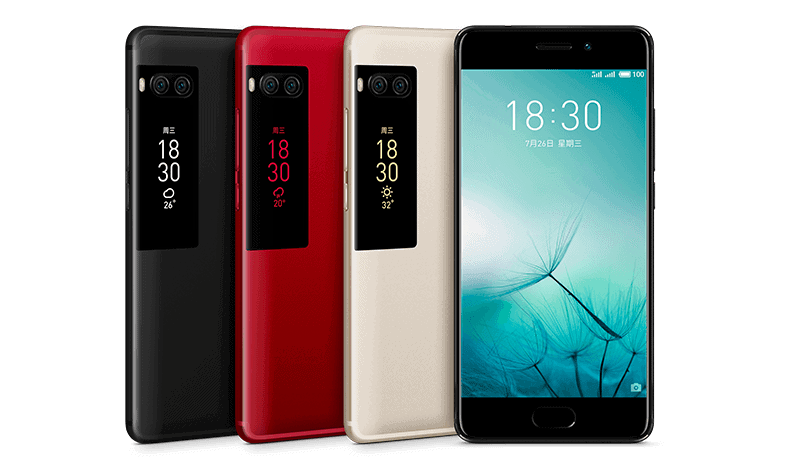
The Meizu Pro 7’s design is kinda its main thing, like, its most defining feature. The phone uses a metal unibody and it really gives you that premium vibe, pretty similar to other high end smartphones from that same period. In general the build quality feels solid, the chassis is well made, and when you hold it in your hand it feels steady, not flimsy. It also has this sleek, minimalist appearance, smooth curves, and a slim body that is easy enough to keep in your grip, and actually pleasant to use.
Now the part that really separates it is the extra AMOLED display that sits on the back. It’s placed just under the dual camera module, so you get this extra “Fenêtre display” idea right there.
That 1.9-inch panel can handle a bunch of everyday stuff like notifications , weather updates, music controls and it can even double as a viewfinder when you take selfies using the rear camera. What’s nice is that it isn’t slapped on in some weird way, it’s kind of integrated really smoothly into the whole design… so it adds character without making the phone feel too thick or ,you know, clumsy
On the front side , the Meizu Pro 7 uses a 5.2-inch Super AMOLED screen. The bezels are kept fairly thin, so the device looks more modern and neat. Beneath the display is the home button, which also acts as a fingerprint scanner. The scanner is fast, and it’s accurate as well, so you get a dependable method to unlock the phone and jump into protected apps with not too much fuss
So overall, the Meizu Pro 7 has this sort of design that feels, like inventive but still tasteful, you know. The second screen is a real bold move and it genuinely helps the phone stand out , while the build quality is staying pretty much in line with what you’d expect from flagship phones around that time.
Beautiful design, vibrant AMOLED display, extra screen with a lot of useful functions, and dual camera support for taking photos are honestly the most noticeable features of the Meizu Pro 7 after its recent launch.
Display
So the Meizu Pro 7 comes with a 5.2 inch Super AMOLED screen, 1920 x 1080 pixels in resolution, and it clocks in around 423 PPI, which honestly makes the whole device feel really sharp. This panel is kind of one of the most noticeable bits of the phone, it gives vivid tones, deep blacks and pretty solid contrast numbers. You kind of see it right away, even in normal use. AMOLED is kind of famous for rich saturated colors, and the Pro 7’s panel kind of keeps that promise, no real letdown.
Now about the 1080p part, it is not as detailed as the Quad HD displays you might see on some top tier flagships, but it’s still more than enough for this screen size. Text looks sharp and when you watch videos, or look at pictures, the clarity is very good. It also holds up outdoors pretty well, because the brightness is high, and there’s an anti-reflective coating that helps keep things visible even under direct sunlight.
And then there’s the extra screen, on the back side. It’s a 1.9-inch AMOLED display, running at 240 x 536 pixels. The main idea is quick glances at alerts and other info, without waking the main display. But it can be used in other ways too, like taking selfies with the rear camera, which is kind of a fun twist. This secondary display is bright, sharp, and the colors look well balanced, so it ends up being both useful and pretty pleasant to look at, not just some decorative add on.
Meizu Pro 7 owns high-class luxury with a very high quality monolithic metal. In particular, the red version also more personality to this product. The back of the Meizu Pro 7 carries many of the same design features as Apple iPhone 7/ Apple iPhone 7 Plus with two U-shaped strips painted in the same color as the back side to create consistency. The feel of the Meizu Pro 7 handheld is extremely handy although the machine is quite square design but the compact size as well as the smooth paint should experience a very comfortable use. As a premium product, the quality of Meizu Pro 7’s finishes are extremely good, all fittings are meticulously machined.
However, the most notable highlight of this product is not in the design, that is sub-screen in the back. Though rumors previously said it will use an e-ink screen, it’s actually a touch screen with 2-inch AMOLED panels. The main task of this sub-screen is to display some information such as date, weather, call message notification, liveview screen to selfie with the rear camera ….. To wake up this screen, users just double-click the machine will automatically light whether the main screen is bright or not.
In addition, the machine is equipped with dual camera system on the back. Both cameras use the Sony IMX 386 12MP resolution, f / 2.0, but will have a monochrome sensor and a color sensor, while the front camera has a resolution of 16 megapixel f / 2.0. The 5.2-inch Full-HD display and Super AMOLED panels for vivid color display are also the strengths of this product.
Performance
The Meizu Pro 7 is powered by the MediaTek Helio P25 chip set , it’s paired up with 4GB of RAM and 64GB internal storage too. There’s also a step up model, the Pro 7 Plus , and it uses the more forceful MediaTek Helio X30 chipset , plus you can get up to 128GB of storage. In this review, i’m mostly looking at the standard Pro 7 model, because well, that’s the one most people will be on.
The Helio P25 is sort of a mid-range chip, not really in the same league as the flagship processors from Qualcomm or Samsung, yet it’s more than enough for the day to day stuff. Day to day it feels steady, multitasking stays smooth, and app switching is quick, responsive even. Stuff like web browsing, social feeds, and video streaming run without much fuss, and honestly it doesn’t often show that dragging feeling, or those tiny slowdowns that ruin the vibe.
Gaming wise , the Meizu Pro 7 can handle most titles you’ll find on Google Play. Still, it might have a harder time with games that look more demanding visually. Asphalt 8 and Modern Combat 5 generally run quite well, you may notice only occasional stutters in the frames, but nothing too nasty. For heavier games like PUBG Mobile, you’ll likely need to tone down the visuals a bit, otherwise “playable” becomes more like “maybe, if you adjust things”.
So yeah, the Helio P25 isn’t top tier, but it lands in a solid middle ground between usable power and energy thrift. Even when you game for a while, the phone tends to stay cool to the touch, which is helped by the chipset’s efficient thermal management, and that small detail really matters over time.
Software
The Meizu Pro 7 uses Flyme OS, Meizu’s own Android skin, which is built on Android 7.0 Nougat. Flyme OS is kind of famous for that very customized vibe, it strays from the “standard” Android look quite a lot, both in design and day to day functionality. Still, the overall experience feels clean, and honestly pretty pleasant to look at, it leans toward simplicity, and easy handling.
A big standout thing in Flyme OS is the way it handles navigation. Instead of the usual Android navigation buttons, Flyme OS kind of pivots around one home button, and you can work it with a bunch of different gestures, for various tasks. For example, a quick tap on the home key brings you straight to the home screen, while swiping upward from the bottom opens up the multitasking area. In day to day use, the gesture vibe feels kinda natural, smooth and responsive, but honestly it might take a little while for new people to fully catch on, to the whole thing.
Also, Flyme OS comes with a bunch of personalization options. You can adjust the overall appearance, change themes, swap wallpapers, and even replace icon sets without too much hassle. On top of that there are options for the lock screen, the status bar, and other smaller interface details, so the device can feel more “yours”, if you want that.
But, Flyme OS does have some weak spots. Because it’s so heavily themed, sometimes the experience can feel a bit uneven or inconsistent, and some people might think it’s more complicated than stock Android. Plus, the phone ships with several pre-installed applications, and a portion of them can’t be removed, which some users could see as extra clutter, you know bloatware.
Another area where Flyme OS falls short, is really the software update rhythm. Meizu has been kinda known for taking its time rolling out Android updates, and the Pro 7 doesn’t break that pattern. When the phone first landed, it shipped with Android 7.0 Nougat, but after that, it still took a while before Meizu started sending out newer Android versions. For people who care about the latest features and also the security fixes, this kind of delay can be a bit worrying , and honestly it feels like a long wait.
Battery Life
The Meizu Pro 7 comes with a 3,000mAh battery, which is pretty typical for a handset in this size and class. In real use the battery life is decent, though it’s not exactly amazing either. Most users can expect a full day on one charge with moderate activity, like web browsing, social media, messaging, and maybe some occasional gaming or video streaming here and there.
But if you push it harder , say long gaming marathons or heavy media consumption, the charge will slide down faster, and you may need to plug it in before the day is fully over. Still, for the average routine, the Meizu Pro 7’s battery should be enough without having to do constant “quick top ups”.
One bright spot is mCharge, Meizu’s fast charging system. With the included fast charger, the device can go from 0% to around 50% in about 30 minutes, which is a big plus for anyone who’s always moving. A complete charge takes just a bit over an hour, and that’s competitive with other fast charging options around the time the Pro 7 came out. This quick charging feature helps balance out the more average endurance, so you can bounce back to full power when you really need it.
One limitation to note is, the absence of wireless charging. While it might not be a deal-breaker especially in the mid range, wireless charging has become kind of a standard option on a lot of smartphones. Not having it here could feel like a small hiccup for people who are used to the ease of wireless charging pads.
Audio Quality
The audio experience on the Meizu Pro 7 is kinda mixed,overall. The device has a single bottom-firing speaker which is pretty common on many phones, but it can lead to a less immersive soundstage, especially compared to handsets with stereo speakers. So yeah, it sounds fine enough, though the surround like feel is more limited. The speaker does manage clear sound with decent volume, though it doesn’t bring the kind of depth and richness you’d get from more audio oriented models. The highs and mids are presented in a fine way, but the bass is noticeably underwhelming, so music and media can feel a bit flat.
If you like to use headphones, you’ll be glad to know the Meizu Pro 7 still includes a 3.5mm headphone jack, which is becoming less common these days. The headphone output is quite respectable , with good clarity and a fairly balanced sound. Still, audiophiles may feel it doesn’t have enough punch or fine detail when compared to dedicated audio gear, or even phones with more advanced DACs (Digital-to-Analog Converters). The phone also provides several audio enhancements through software settings, so you can adjust the tone and response, more or less to your taste.
However, the Meizu Pro 7 kind of misses some of the more advanced audio extras, like Hi‑Fi DAC support or Dolby Atmos , that you can find on certain competitors. So for people who care a lot about sound fidelity, especially when listening to songs or watching movies, this feels like a small nudge in the wrong direction, audio-wise.
Connectivity and Sensors
On the connectivity side, the Meizu Pro 7 comes with what you’d normally expect from a modern smartphone. It supports dual‑SIM, so you can run two different phone numbers or data plans at the same time, which is handy for many users. It also offers 4G LTE on both SIM slots, that part is genuinely useful if you travel often or need fast data on more than one carrier.
You still get Wi‑Fi 802.11 a/b/g/n, Bluetooth 4.2, and GPS using A‑GPS along with GLONASS and BDS. These are mostly standard, but it’s worth pointing out that there’s no NFC , so you can’t use contactless payment apps like Google Pay. For users in areas where tap‑to‑pay has become common, this omission might be a real hassle.
As for sensors, the phone includes an accelerometer, gyroscope, proximity sensor, and ambient light sensor. They work fine in everyday use, and they help the whole experience feel smoother. The fingerprint reader is built into the home button , and it tends to be quick and dependable, giving a fast and secure unlock without much fuss.
That said, the absence of NFC plus the older Bluetooth generation may be viewed as small drawbacks. It might not bother everyone, but if NFC payments or newer wireless habits are part of your daily routine, you may feel the gap even in an otherwise well put together device.
Conclusion
So, the Meizu Pro 7 it’s a smartphone that kind of stands out because of its bold design choices, and also because it comes with some innovative stuff. Having that secondary display is a pretty unique and creative addition , and that alone makes it different from a lot of other devices on the market. It gives practical benefits like fast access to notifications , but also a sort of new method for selfies using the rear camera which feels , oddly, more fun than it should.
Also it really performs well in the areas that matter most, like build quality, display performance, and camera capabilities. Basically it kind of works as a well-rounded choice for people who care about those sorts of things, you know. The Super AMOLED main screen gives lively colors and deep blacks, and the dual camera system takes pretty impressive photos too, especially when the lighting is kind of good.
That said , it does have shortcomings too. The Helio P25 processor, even though it’s decent, just doesn’t hit the same level as flagship chipsets. And then there’s the issue of not receiving software updates in a timely way, which could bother some users. Plus, missing things like NFC , stereo speakers , and more advanced audio features may feel restrictive if someone really prioritizes media and payments features in a phone.
Overall, the Meizu Pro 7 is one of those devices that kind a fits users who care about design innovation, and they’re also looking for something not the usual smartphone routine. It has that kind of standout setup, like the secondary display and the dual-camera system, which bring pretty practical gains and yes, that tends to make everyday use feel smoother. Still, if you’re the type of person who wants sheer performance first, plus longer software support and a more complete feature set, then, there can be better choices within the same price band.
Like any phone, deciding to buy the Meizu Pro 7 really depends on your personal needs and preferences. If you enjoy the oddball look and you’re willing to live with the compromises then the Meizu Pro 7 gives you a distinctive, kind of fun experience that you won’t easily stumble upon elsewhere.
Meizu Pro 7 Unlocked 4G LTE Smartphone Deca Core 4GB RAM 128GB ROM 5.2″ 1080P Super AMOLED Two-sided Screen Dual Rear 12.0MP Camera Fast Charge Cell Phone (Black): Buy it now
Meizu Pro 7 Unlocked 4G LTE Smartphone Deca Core 4GB RAM 128GB ROM 5.2″ 1080P Super AMOLED Two-sided Screen Dual Rear 12.0MP Camera Fast Charge Cell Phone (Gold): Buy it now
Original Meizu Pro 7 Smartphone 4GB 128GB 5.2″ 1080P Super AMOLED Screen Deca Core 10nm Helio X30 Dual Camera Two-sided Screen (Black): Buy it now
Original Meizu Pro 7 Smartphone 4GB 128GB 5.2″ 1080P Super AMOLED Screen Deca Core 10nm Helio X30 Dual Camera Two-sided Screen (Gold): Buy it now
Meizu Pro 7 Dual AMOLED Display (4GB, 128GB) Helio P25, 5.2″ Dual 12.0MP FDD LTE Smartphone (Black): Buy it now
Meizu Pro 7 Dual AMOLED Display (4GB, 128GB) Helio P25, 5.2″ Dual 12.0MP FDD LTE Smartphone (Gold): Buy it now
Related Posts





Tech Reviewer & Product Analyst
Định Bia has spent over 10 years testing consumer electronics with a focus on smart technology. He work as a product advisor at Biareview where he helped customers find the right devices for their needs. He personally tests every product featured on this site using a consistent evaluation framework covering quality, durability, and value. All reviews are based on experience, not influenced by the manufacturer.