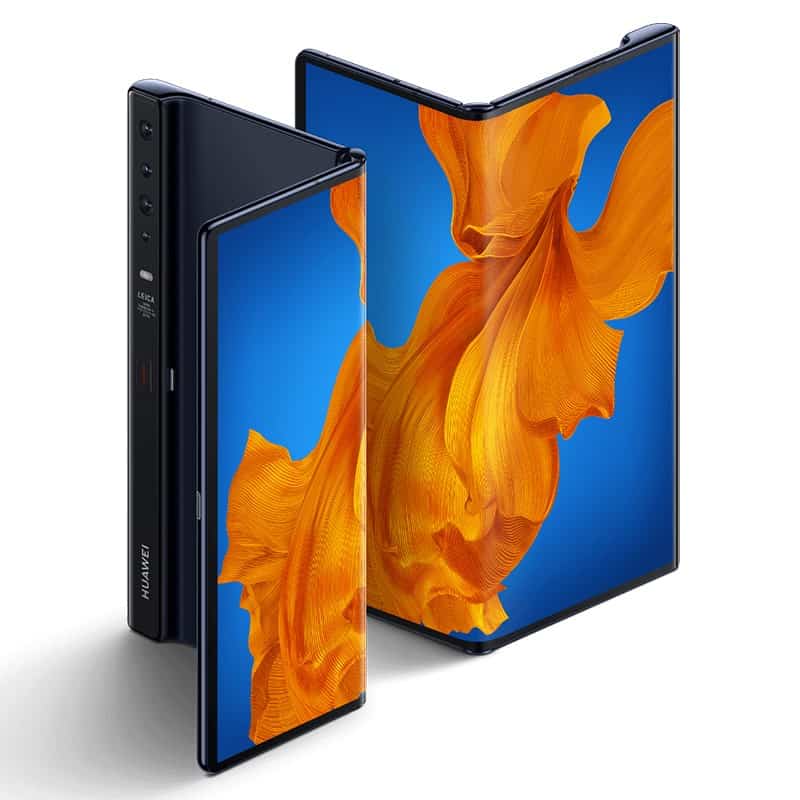
Design and Build Quality
Unfolding the Future
One of the most noticeable things about the Huawei Mate Xs is that foldable setup, it’s kinda hard to ignore. Unlike a bunch of other foldable phones that bend inward with the screen, the Mate Xs goes with outward-folding. That small design choice, makes it feel like the handset can quietly do double duty as a smartphone and a tablet. When it’s opened up you get a big 8-inch display, and when it’s closed you end up with a more normal 6.6-inch screen. In practice, it’s less “just folding phone” more “two sizes in one”.
As for the build quality, it feels solid, premium, and it actually matches the price. Huawei leans on aerospace style materials here, like a zirconium based liquid metal frame, plus a flexible polymer display that’s been strengthened so it can handle the everyday bumps and bends. Also the hinge, which Huawei calls the “Falcon Wing,” is a big deal. It helps the device fold and unfold in a smooth way, and there aren’t any obvious gaps. The display crease situation is also minimal, at least nothing that really jumps out during normal use.
Ergonomics and Usability
When it’s folded the Mate Xs is a bit thicker than a regular phone, but it’s still comfortable enough in the hand. You can use it with one hand without feeling like you’re fighting the size the whole time. The power button and fingerprint sensor are on the side, and that placement feels natural. Even when it’s unfolded, the controls stay reachable, so you’re not constantly stretching or doing awkward finger angles.
The overall design is kinda sleek, modern, with slim bezels and this minimalist vibe. But well, that unique form factor does bring trade offs, not really a surprise. Like, for example, the outward folding display is always out there, so it might end up being more prone to scratches or other little damages than inward folding designs. Huawei kinda handled this by putting a protective case in the box, still though, users will want to be careful every time they move, carry, or just place the device down.
Portability
One of the usual problems with foldable devices is trying to balance the larger screen surface with actual portability.
The Mate Xs does pretty well with this mostly because it stays fairly slim when it’s folded. It can get into a pocket or a bag without too much drama so it feels easier to lug around. Still, at 300 grams it can feel a bit heavier compared to most smartphones, so if somebody really cares about ultra lightweight things, this might not feel quite right.
Less than a year after Huawei introduced its very first foldable phone (Huawei Mate X) the company has now shipped the next foldable model. It’s called the Huawei Mate XS, and it’s basically described as an upgrade to the earlier Huawei Mate X. The Huawei Mate XS gets a sturdier processor , a faster network connection, a better camera setup, and then a handful of small design tweaks.
Now the big question, since it was launched by Huawei globally: does the Mate XS have enough power to actually go head to head with the foldable phones that are already on the market? Let’s go through a detailed review below so we can figure out our own answers about Huawei’s latest folding screen flagship.
Display
A Display, Like No Other
The Huawei Mate Xs has an 8-inch OLED screen, with a resolution of 2480 x 2200 pixels once it’s fully opened up. That big, high-definition panel gives you this really immersive look, good for binge viewing , gaming, and even the multitasking kind of work. Colors feel lively too, deep blacks, strong contrast, all because OLED technology kind of does that. It also supports HDR10 which basically extends the usable dynamic range in the content you watch.
When it’s folded, the Mate Xs turns into something much more familiar, like a regular smartphone, with a 6.6-inch display in the front and 6.38-inch on the back. These two screens use the same kind of premium OLED panel, so you get a fairly steady experience no matter which way you’re using the device.
Screen Quality, and Performance
Overall, the screen quality looks great, sharp textures, believable colors, and wide viewing angles too. The huge near bezel-less surface is made for watching videos, playing games, and scrolling through the web. And since it’s foldable, it also helps productivity, because you can run multiple applications at once, side by side, in a split-screen setup.
Still, the display’s design isn’t perfect, there are some little caveats. First off, the display is built from a plastic polymer layer, not glass, so it can pick up scratches and dents more easily. Huawei did improve durability compared with the previous model, yet people really should be careful with day to day handling. Also there’s a noticeable crease down the center, which you might not catch immediately while watching, but you can feel it when you swipe across the screen.
Outdoor Visibility and Brightness
The Mate Xs ends up doing surprisingly well in a lot of light setups, like when you re right under direct sunlight. The display is bright enough so you can still read things outdoors, with solid visibility and not much annoying glare. The auto brightness part also behaves properly, it fine tunes the screen brightness according to what s around you, so your eyes don’t get stuck in that too dim, or too harsh vibe.
Quality upgrades
At first glance, we kinda struggle to tell the Mate XS and Mate X apart, because their design are almost sameish. But once you actually use them and compare, you notice the Mate XS is a bit more slim compared with the previous model.
A pretty notable improvement on the Huawei Mate XS is that Huawei has added a polymer layer meant to guard the phone’s OLED panel. There s also a pre installed screen protector, and Huawei says users should not take it off.
Like the Mate X, the Mate XS is also a 6.6 inch device, (19.5: 9 aspect ratio, 2,480 x 1,148 resolution) ,and it kind of doubles as an 8 inch tablet too. When you open it, it is around 5.4mm thick, but when it is folded it turns into 11mm.
You probably already know Huawei’s foldables use a different opening approach than rival Samsung Galaxy Fold. On Galaxy Fold, the screen sits inside, so you open it the way you’d open a book, with Huawei, the screen sits on the outside. This Mate XS layout is often seen as more practical for everyday users. And instead of squeezing in an extra front camera on the outer side like the Galaxy Fold does, the Mate Xs is only using a selfie camera, because the whole folding arrangement already shapes how things work.
In this version of the Mate XS, the hinge mechanism has been improved so that it feels more solid and well, just better. The hinge itself has been carefully researched, and made by Huawei engineers so the hinge ends up sturdier, and the folding operation also seems to become smoother. Huawei is quite confident that these hinge upgrades will make the Mate XS much more durable than its predecessor.
The powerful 5G phone
Not only the beauty on the outside, the hardware of the Mate XS is also very impressive, really. Huawei Mate XS uses the Kirin 990 chip to keep it capable of 5G connectivity. Battery and charging are also upgraded versus the Mate X. Mate XS is integrated with 2 batteries on both sides of the screen, with a total capacity of 4,500 mAh. It can charge from 0-85% in just 30 minutes thanks to Huawei’s 55W SuperCharge fast charger, which honestly sounds nice. Also, the Huawei Mate XS is equipped with a new cooling system that’s integrated on both sides of the phone, helping prevent overheating especially when you’re doing heavy tasks for a while.
The ability to take pictures on Huawei’s smartphones is, let’s say it like it is, unquestionable. And the recent Huawei Mate XS doesn’t really miss this point either. However, there’s a rather unfortunate thing: the Mate XS does not come with the “SuperSensing” camera found on the P30 Pro and its Mate 30 Pro. In return, Mate XS inherits the RYYB sensor, and it uses 40MP (f / 1.8) with pixel binning technology and AI, so fast photos are still possible even in low light conditions. During testing, the captured photos turn out to be of very good quality, not really inferior to what you get from the P30 and Mate 30.
Besides the main camera, it also has this 8MP (f / 2.4) telephoto camera, a 16MP (f / 2.2) super wide-angle camera, plus a 3D depth sensor kind of thing. The Mate XS supports 3x optical zoom, and 30x digital zoom as well, and honestly that segment is pretty handy when you need a bit more reach, for example from farther away.
Performance
Processing Power
So under the hood, the Huawei Mate Xs runs on the Kirin 990 5G chipset, basically Huawei’s flagship chip around the time the phone came out. It uses a 7nm+ manufacturing process and it even has a built in 5G modem, which is why the Mate Xs was among the earliest foldable devices that could actually do 5G right away.
This chip is teamed up with 8GB of RAM, and that helps with steady multitasking, plus it keeps things responsive across a pretty wide set of apps. You know, when you’re scrolling , streaming, or jumping into those more demanding games that need extra graphics, the Mate Xs just keeps going, no real drama. On top of that, the Mali-G76 MP16 GPU improves the gaming side, giving you more consistent frame pacing and visuals that look genuinely sharp.
Everyday Performance
Day to day, the Mate Xs feels like a proper workhorse. Applications open quickly, navigation moves with smooth transitions, and there isn’t any obvious stutter when you bounce between tasks. The device especially shines when you’re multitasking, like using split screen mode on that big display, it’s a nice layout for people who want to juggle things without constantly switching back and forth.
And then there’s the 5G piece. When you’re in coverage, downloads and uploads tend to be notably faster, so the whole experience feels more current. In a way, that makes the Mate Xs more “future aware”, meaning it can better benefit from newer network improvements as 5G keeps expanding.
Storage and Expandability
On the Huawei Mate Xs you get 512GB of built in storage, honestly that is enough for most people. With that much room onboard you can keep plenty of apps, photos, videos, and various documents without constantly thinking about it, like “oh no i’m out” or anything. Now, if you really do end up needing more, the phone also supports Huawei’s own Nano Memory (NM) cards, so you can stretch it by another 256GB.
Some folks might see the NM cards as a step sideways since microSD is the usual thing, and yeah that could be mildly annoying. Still, it feels like a small trade off when you look at the Mate Xs overall features and abilities.
Software and User Experience
EMUI with Android
The Huawei Mate Xs runs EMUI,which is Huawei’s own interface sitting on top of Android. When it first launched it arrived with EMUI 10.0, based on Android 10, and later it got updates too, including moving to EMUI 11. EMUI tends to feel a bit different, it leans into personalization, performance tuning, and a whole set of Huawei specific apps plus services.
That said , because of the restrictions still being enforced by the U.S. government, the Mate Xs doesn’t include Google Mobile Services (GMS). So, things like the Play Store, Gmail, YouTube, and Google Maps won’t be there by default , and instead you’ll need other options using Huawei’s AppGallery or you can sideload apps. Honestly, this missing layer is an important point for anyone considering it, especially if your daily workflow is deeply tied to Google’s usual apps and services.
AppGallery and Alternatives
Huawei keeps pushing to strengthen AppGallery, which is basically the main app shop for the Mate Xs. AppGallery has grown a lot since launch, so you can find more apps than you could before, but it still doesn’t quite have several of the big titles people expect, the ones you’d normally see on the Google Play Store. So, Huawei kind of covers this with Petal Search, a search tool that lets users locate and grab apps from third party sources.
At the same time, Huawei also folded in its own services, things like Huawei Cloud, Huawei Browser, and Huawei Music , all meant to kind of fill the space where Google services are missing. These options do pretty well when you stay inside the Huawei world, however for some users who are used to Google’s setup, it might not feel like a perfect swap.
User Interface and Features
EMUI is kinda famous for its lots of customization options and extra features, and the Mate Xs really does not fall short. The user interface feels smooth, fast , and responsive, while still offering a variety of themes, wallpapers , and icons you can use to personalize things. EMUI also brings a system-wide dark mode, which looks really nice on the OLED panel, and honestly can help extend battery life too.
One of the more noticeable things on the Mate Xs is the multi-window support. It makes the most out of that big, foldable screen , so you can have two apps running side by side. This makes multitasking feel more natural and less like you are constantly switching back and forth. On top of that, the Mate Xs supports Huawei’s Multi-Screen Collaboration, so the phone can play well with other Huawei devices , like laptops or tablets, with a more seamless sort of interaction.
Software Updates and Longevity
Huawei has stayed fairly steady with software updates, delivering regular security patches along with occasional feature improvements. Still, the long term software support for Huawei devices is something a lot of people worry about , mainly because of the ongoing political situation, and the uncertainty around whether future Android updates will be available. That’s definitely worth noting if you’re trying to judge how long the Mate Xs will stay relevant.
Huawei Mate Xs 5G EU/UK Model Dual Sim [ NO Google Services ] TAH- N29m 8GB+512GB Global ROM – Interstellar Blue: Buy it now




Tech Reviewer & Product Analyst
Định Bia has spent over 10 years testing consumer electronics with a focus on smart technology. He work as a product advisor at Biareview where he helped customers find the right devices for their needs. He personally tests every product featured on this site using a consistent evaluation framework covering quality, durability, and value. All reviews are based on experience, not influenced by the manufacturer.