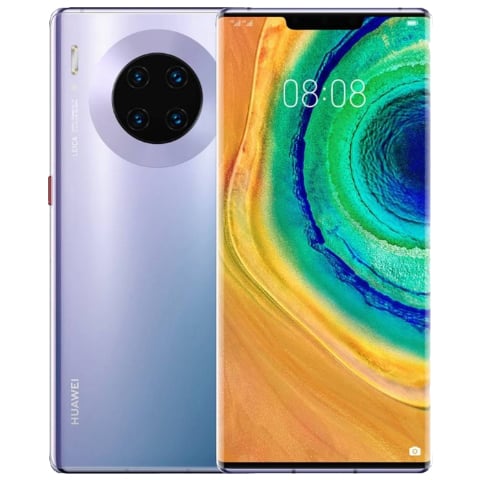
- General
Recently, the US embargo has blocked Huawei’s parts supplies, making it unable to use Google services. Many people think that Huawei’s future will be very difficult after the US ban, but after a year of facing this ban, Huawei is still doing well.
Honestly, apart from the trouble of not being able to use Google apps, the ban doesn’t really seem to do much to the Huawei Mate 30 Pro. The device is still pretty much in line with the home phones like the iPhone 11 Pro , and the Galaxy Note 10 Plus.
- Design
Mate 30 Pro gives users a sense of luxury. The screen is designed with curved edges like the flagship Samsung, but the curvature at the edges of the Mate 30 Pro is somewhat more curved. To do this, Huawei has made the metal chassis much thinner compared to other phones. Many people believe that leaving the two sides of the screen too curved will make the ability to hold the device is not firmly, but in fact, the feeling of holding the Mate 30 Pro is very solid.
Huawei ditched the physical volume rocker and, kind of replaced it with a software thing. People say it only helps the look of the device, but in reality it doesn’t feel as comfortable as the old school physical button. To make it work, you have to double-tap the edge of the screen, right above the power button, and that part is not always smooth. Especially if you’re using the phone with one hand, or you’re mid call and trying to do it without thinking about it. The good news is, Huawei still keeps the physical power button so at least one thing remains straightforward.
On the back, Huawei has taken the square camera module from the Mate 20 series, and swapped it for a round one. Around the polished camera area there’s this very eye-catching ring effect, it almost looks too sharp. The rest of the phone back is finished with a glossy, mirror-like surface. It does make the Mate 30 Pro look premium and clean, but it also means smudges arrive sooner than you’d like, dust and fingerprints included.
The bottom edge of the Mate 30 Pro holds a USB-C port, a speaker , and a SIM card tray with memory card, like you’d expect. On the side of the device, there’s also a feature that a lot of the other competitors don’t really offer: a versatile infrared zoom, it lets users operate TVs, AC units and basically other electronic devices too.
As for color options, the Mate 30 Pro comes in Black, Silver, Purple and Emerald Xang. The pictures used in this Mate 30 Pro review are from the silver version.
- Screen
The Mate 30 Pro comes with a very nice AMOLED panel, made by Samsung, and it is covered with Gorilla 6 tempered glass, sort of like you’d expect. If you check the listed specs, the resolution and pixel density are a bit lower than on the Mate 20 Pro , yet in real everyday use, I honestly didn’t notice any difference in sharpness between these two. So overall the screen on the Mate 30 Pro is close to the P30 Pro as well, and that kind of tells you the panel quality is really strong.
The front camera area, that little notch, does look a little dated now. Nowadays a lot of manufacturers remove the notch, and instead use some kind of “black dot” camera inside the screen, or they go for a pop-up approach. On the Mate 30 Pro, the notch holds the selfie camera, a depth sensor, and the whole 3D facial unlocking system.
Still, a number of people seem to dislike devices that feel too smooth or overly rounded. For that reason Huawei changed things on the Mate 30 Pro. Instead of those rounded edges the Mate 30 pro leans into a sharper, more angular look, with a slightly more masculine design vibe.
Also, the Mate 30 Pro display doesn’t offer 90Hz or 120Hz, so if high refresh rate is a must for you, then the Huawei P40 Pro would be the safer pick.
As for unlocking, the fingerprint reader works pretty reliably. It sits fairly low on the screen which makes one-handed use slightly harder, you kinda have to adjust your grip. Usually, the face unlock happens first, before you even reach the fingerprint sensor, and the Huawei Mate 30 Pro’s facial unlock is quick too, fast and pretty accurate in practice.
- Performance
During testing, the Mate 30 pro felt quite quick and smooth, like really fast, but also kinda steady. It’s probably all because of the Kirin 990 chip. Huawei has put a ton of money into its chips over the years, no wonder this thing keeps moving.
When it comes to performance scores, the Mate 30 Pro still did really good , but it lagged slightly behind the handsets using Snapdragon 855 Plus. More precisely it landed 3,834 points on Geekbench 4 Single, and 11,355 points on Geekbench 4 Multi.
If we try to put it in a more clearer way, the OnePlus 7T was around 3,681 on Geekbench 4 Single, and 11,443 on Multi. Meanwhile the Note 10 Plus, with a Snapdragon 855 chip, got roughly 369,029 points on AnTuTu, and on Geekbench 4 Single / Multi it landed at 3,434 / 10,854 .
Phones with Snapdragon 865 are doing even better. Starting from April 2020 , devices like the Galaxy S20 Ultra, LG V60 and OnePlus 8 Pro have been showing strong performance, pretty steady, and consistently.
Also, the Mate 30 Pro comes with 128GB or 256GB storage, plus 8GB RAM , so you can live with it day to day, without feeling stressed about internal memory getting filled up or RAM getting overflown. And yeah, just like the P40 Pro, P30 Pro and Mate 20 Pro, the Mate 30 Pro is fitted with an expandable nano memory slot.
- Battery
Last year Huawei bundled the Mate 20 Pro with this fast 40W charging ability, and honestly even now this tech still feels pretty solid in the market, so Huawei decided to carry the 40W fast charging over to the Mate 30 Pro. The main difference though, is that the battery capacity jumps up from 4,200 mAh to 4,500mAh, kinda simple but it matters.
From what actual test results show, the Mate 30 Pro can get fully charged from 0 to 100% in about 70 minutes. Meanwhile, the 0 to 39% part only needs around 15 minutes, so the early boost is really quick.
You can also power up the Mate 30 Pro using its fast wireless charger, rated at 27W, and yes it also supports reverse wireless charging. Huawei claims wireless charging is around 3x faster than before, which sounds like marketing but still.
In the real-world use test, the Mate 30 Pro managed to pull ahead of those two well known rivals, the Note 10 Plus and OnePlus 7T, especially in mixed use, wifi stability and video playback. It s endurance was pretty close to the ROG Phone 2 as well, even if that one comes with a 6,000 mAh battery.
So in practice you can comfortably keep the Mate 30 Pro running for a whole day without plugging it in, and if your usage is more light, you might stretch it to two days, or even beyond that depending on how you treat it.
- Camera
When the manufacturers start focusing more on software, Huawei decided to bring in hardware too, in order to boost the camera’s overall quality. And yeah, this Huawei upgrade gives you kind of a more adaptable, flexible shooting kind of experience.
The cameras on the Mate 30 Pro are basically arranged in a way that feels quite similar to the P30 Pro, but there are a few key changes that end up making the whole photography experience better. The most noticeable change, is the wide-angle camera that now jumps up to 40MP. In general, higher resolution gives you brighter wide-angle images
Then there’s another difference with the Mate 30 Pro: the optical zoom is dialed back to 3x, while the P40 Pro stays at 5x.
Now, the main 40MP camera uses an RYYB pixel setup, it swaps green pixels for yellow pixels to grab more light. With that sensor, you get an f / 1.6 lens together with OIS, plus a few photo editing tools, so the Mate 30 Pro is able to handle low light very well.
Also, the depth sensor on the Mate 30 Pro works really smoothly, it seems to sort out the subject from the background, like it knows what you want without much fuss at all.
Even though both phones use the same sensor, the Mate 30 Pro still leans toward a better white balance than the P30 Pro when the light drops, in other words in low light it looks more right. You can even notice it , the P30 pro tends to show a heavier yellow tone when you shoot at night or in dim rooms.
For the selfie camera , the Mate 30 Pro comes with a ToF depth sensor up front , so the whole face comes out more crisp… sort of. This helps when the subject gets highlighted and the background turns out blurred, so selfies look better in general. The main thing is that the overview camera selfies are fine as well. There is only a small issue though the selfie camera leans a bit too hard on that smooth skin editing stuff, maybe you will like this detail even more than the men.
The Mate 30 Pro can record 4K video at 60 fps. Still, on the device we tested , the default was 1080p at 30 fps. There are effects for font removal , wide angle video recording, plus time lapse too. The phone can also do fluid slow motion recording at a frame rate of 7,680 fps at 720p.
- Software
During the first 3 days of using it, I tried the apps Huawei recommends that come on the device. Like, these are apps made by Huawei to replace Google applications. But don’t expect too high of them really, because of course these apps aren’t as smooth as Google’s own apps. If you’re the kind of person who’s used to Google apps on Android devices, then yeah it becomes a bit of a barrier when you’re deciding to buy the Mate 30 Pro.
You can still get forgotten apps back, from the Google Play Store, but you’ll need to grab them via a third party application called LZPlay. And it takes a little time too, to get through the steps, like allowing access, before you can actually download apps.
- Audio
The speaker sound on the Mate 30 Pro is kinda loud. If you put the Mate 30 Pro right next to the Mate 20 Pro and run the exact same music, the Mate 30 Pro’s sound pretty much “engulfs” the Mate 20 Pro, completely.
A little annoyance with the loudspeaker is that it’s so strong that when you play music through the external speaker, the Mate 30 Pro vibrates, slightly.
The speakerphone section is hidden under the screen, so you still get a clean and crisp output. Like most newer handsets nowadays, the Mate 30 Pro does not include a headphone jack either.
Huawei Mate 30 Pro 8GB 512GB RAM 5G LTE 6.53″ Unlocked – Chinese Version No Google Play Support, No Warranty (Orange): Buy it now
Huawei Mate 30 Pro 5G LTE No Google Play 6.53″ 256GB 8GB Unlocked – Chinese Version, No Warranty (Cosmic Purple): Buy it now






Tech Reviewer & Product Analyst
Định Bia has spent over 10 years testing consumer electronics with a focus on smart technology. He work as a product advisor at Biareview where he helped customers find the right devices for their needs. He personally tests every product featured on this site using a consistent evaluation framework covering quality, durability, and value. All reviews are based on experience, not influenced by the manufacturer.