Very thin, and tougher than that sounds
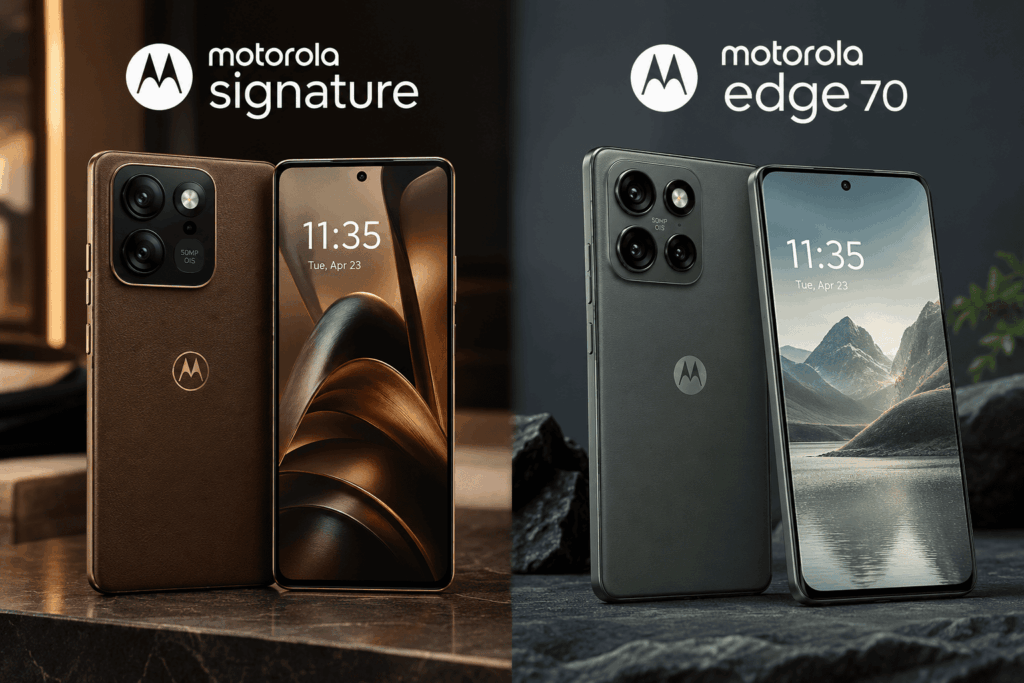
The first thing you notice picking either of these up is how little there is of them. The Signature, Motorola’s flagship, is 6.99mm thick and weighs 186 grams, which puts it ahead of the iPhone 17, the Galaxy S26 and the Find X9 on both counts. The Edge 70 goes further: 5.99mm and 159 grams, which lands it in the same conversation as the iPhone Air and the Galaxy S25 Edge.
Thin phones have a reputation for being delicate. These two are certified otherwise, carrying MIL-STD-810H along with IP68 and IP69 ratings, and IP69 covers high pressure hot water jets. The Signature’s front glass is Gorilla Glass Victus 2, the Edge 70’s is Gorilla Glass 7i.
Motorola brought Pantone in on the colors, and on the Signature the more interesting decision is the material underneath: a milled aluminum frame, rounded off at the edges, with woven fabric across the back. The fabric shrugs off sweat and fingerprints, and it has enough texture that the phone stays where you put it rather than creeping toward the edge of a table.
Holding the Edge 70 is a slightly different problem. At under 6mm there’s less phone to get your fingers around, and you notice it. The sides are flatter with only a slight curve, and the backs come in faux leather, linen or nylon, all soft enough to take the edge off.
Both phones have a large camera bump out the back. That is the price of keeping serious optics in a body this thin.
Two very good screens
The Signature has a 6.8 inch Extreme AMOLED panel with LTPO, running at 1.5K.
The number that matters is peak brightness: 6,200 nits, enough to read the screen in direct midday sun. Thin bezels and the slight curve into them make the display look like it runs off the edges. LTPO drops the refresh rate when nothing is moving to save battery and pushes to 165Hz when something is. Most phones in this bracket stop at 120Hz, and you can feel the difference scrolling, more so in a fast game.
The Edge 70 gets a 6.67 inch P-OLED at the same 1.5K, capped at 120Hz. It is tuned more neutrally, with strong color and deep blacks but nothing that tires your eyes over a long session.
Both have in display fingerprint readers. The Signature’s is ultrasonic, so it still works with wet fingers. The Edge 70’s sits low enough on the screen that you end up bending your thumb down to reach it, which gets old.
Stereo speakers with Dolby Atmos on both, and they are clear, with more low end than you would expect from a phone this thin.
Cameras, and a horizon lock borrowed from action cams
Cameras are where flagships are won and lost, and Motorola has spent money here. The Signature has three rear cameras, all 50 MP, though the sensors behind them are not equal.
The main camera uses a Sony LYTIA sensor, 1/1.28 inch, at f/1.6 with optical stabilization, and it pulls in a lot of light. Daylight shots come out bright with plenty of contrast. The periscope telephoto does 3x optically and claims 100x with AI doing the rest. At 6x and 10x the processing earns its keep, rebuilding small details like distant lettering without smearing the color into mush. Portrait mode runs from 24mm to 85mm, and the edge detection holds up on hard subjects, loose strands of hair included.
The Edge 70 has two rear cameras, both 50 MP, a main and an ultrawide. The sensors are a step down from the Signature’s, but they cover most of what you would want. Where it does well is focus, which stays quick in awkward light, and macro, which benefits from the high resolution lens.
For video, both phones have horizon lock, which until now has mostly been an action cam feature. Spin the phone through a full 360 degrees and the frame stays level. If you shoot while moving, that is the feature here worth having. The Signature records up to 8K; the Edge 70 stops at 4K.
Performance, and the software around it
Motorola has traded a little peak performance for cooler running. The Signature runs a Snapdragon 8 Gen 5 with 12GB of RAM and 256GB of UFS 4.1 storage. On a spec sheet that’s a tier below the Snapdragon 8 Elite Gen 5 and the Dimensity 9500, which sounds like it should cost you something. It didn’t. Heavy games ran at maximum settings and stayed there, which is down to the gel and copper mesh cooling as much as the chip. AnTuTu came back near 3 million, if that’s the kind of number you want. Cooling is a gel and copper mesh arrangement.
The Edge 70 sits lower, with a Snapdragon 7 Gen 4, 8GB of RAM and 256GB of storage. Just over 1.4 million on AnTuTu, which is fine for everyday use and most games. The thin body does limit what it can shed, though, and the back around the camera warms up fairly quickly under a sustained load.
Both ship with Android 16 under Hello UI, which stays close to stock: clean, uncluttered, quick. Motorola promises seven years of updates. The flip side of that restraint is that there is not much to customize, certainly less than Samsung, Oppo or Xiaomi give you.
AI is a big push for Motorola this year, big enough that both phones have a dedicated hardware key on the left edge for Moto AI, Google Gemini or Microsoft Copilot.
Magic Eraser, Photo Unblur and the scene recognition all work. The rest is less finished. More complex language interaction is not supported yet, and the hardware key often still needs you to tap the screen afterwards rather than just answering your voice.
Silicon carbon batteries, and what they buy
The rule has always been that thinner phones get smaller batteries. Silicon carbon cells are what break it, packing more energy into the same space. So the Signature gets 5,200 mAh, and the Edge 70, at under 6mm, still finds room for 5,000.
Both last. On PCMark’s battery test, which cycles through browsing, photo editing and video work, the Signature ran 15 hours 41 minutes and the Edge 70 12 hours 41 minutes. Neither will need a top up before the end of a hard day.
The Signature takes 90W TurboPower over a cable and 50W wireless; the Edge 70 does 68W and 15W. Both filled in around 40 minutes, with about half of that done in the first 15.
Verdict: two phones for two different people
The Signature is for someone with flagship money who has grown tired of phones that all look the same. Fabric back, 165Hz screen, cameras that hold up, seven years of updates: that is a real answer to the iPhone 17 and the Galaxy S26. The AI side needs more time, particularly on local language support.
The Edge 70 is the harder engineering problem. Getting under 6mm while keeping a 5,000 mAh battery and cameras nobody had to gut is not a common trick. It suits anyone who wants a phone that does not look like everyone else’s, as long as they can live with the warmth that comes off it when they ask it to do something graphically heavy.
Both are seriously made, and both look and feel like Motorola rather than like anyone else. If this is where the company’s long game starts, it is a decent place to start from.
Motorola Moto Edge 70 5G Ai (Compatible with Tmobile Mint Tello & Global) (512GB+12GB) NFC 50MP 4K Triple Cam Dual Sim 6.67″ Curved XT2601-3 Latino American Version (Bronze Green): Check Availability on Amazon
Motorola Edge 70 Dual-SIM 512GB ROM + 12GB RAM (GSM | CDMA) Factory Unlocked 5G Smartphone (Pantone Bronze Green) – International Version: Check Availability on Amazon
Motorola Signature Dual-SIM 512GB ROM + 16GB RAM (GSM Only | No CDMA) Factory Unlocked 5G Smartphone (Pantone Martini Olive) – International Version: Check Availability on Amazon
Motorola Signature Dual-SIM 512GB ROM + 16GB RAM (GSM Only | No CDMA) Factory Unlocked 5G Smartphone (Pantone Carbon) – International Version: Check Availability on Amazon
Related Posts